

A male white shark was tagged off Nova Scotia in the autumn of 2018.
Then he left.
He travelled south through a western North Atlantic range measured in thousands of kilometres.
Winter passed.
Spring followed.
And in 2019, he returned to Nova Scotia.
Then he did it again in 2020.
When researchers compared his locations, something remarkable emerged.
He had returned to within less than two kilometres of the place where he had originally been tagged.
A shark capable of crossing enormous stretches of ocean had come back to almost the same patch of Canadian water.
Why?
That question takes us to the next chapter of our journey.
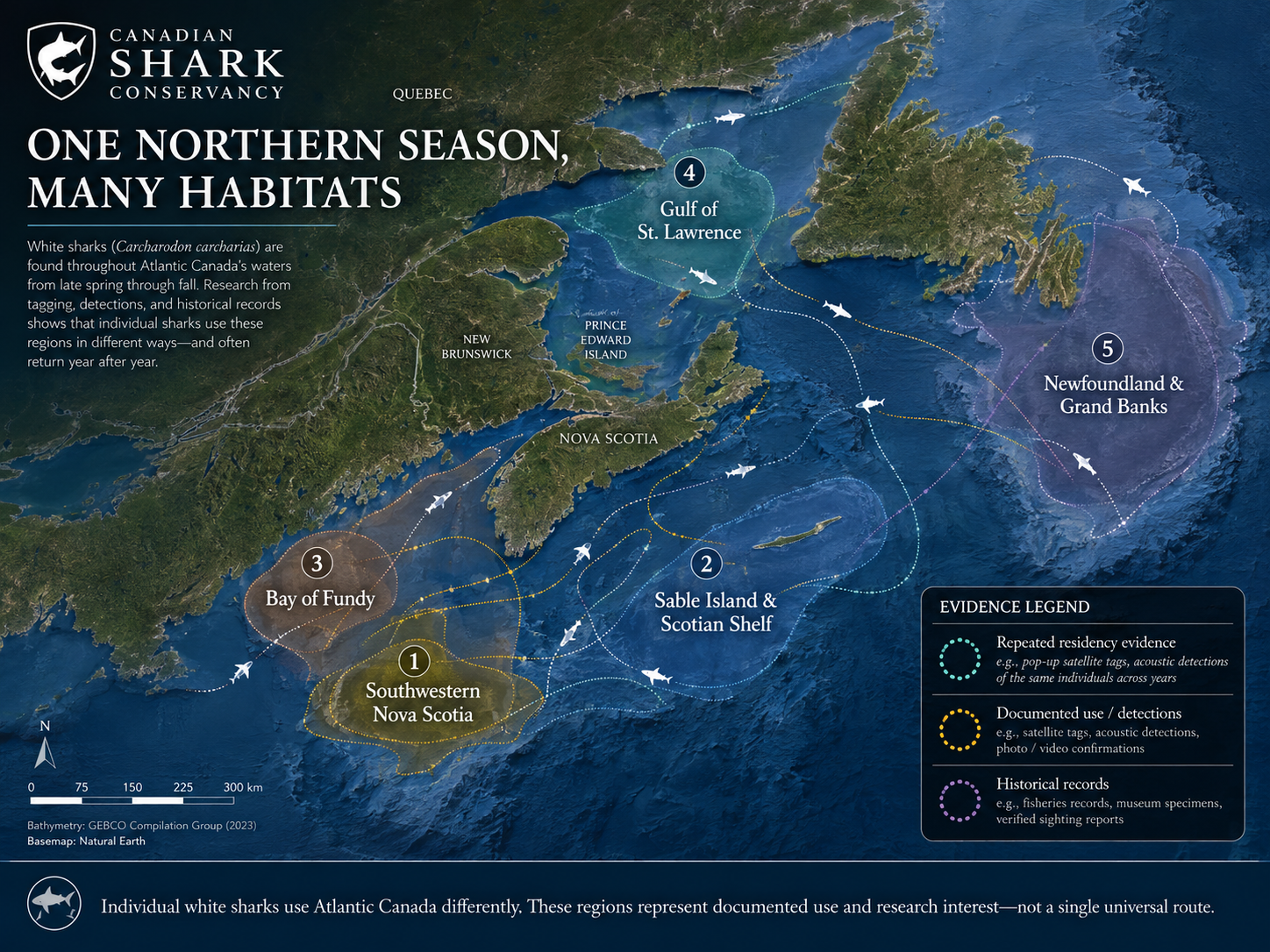
We know white sharks migrate into Atlantic Canada.
We know some return to particular Canadian regions in successive years.
Now we need to ask:
What are they finding when they get here?
Food is almost certainly part of the answer.
But Canada's northern white-shark habitat is more complicated than a simple map of seal colonies.
It stretches across continental shelves, islands, banks, bays, channels and extraordinarily productive marine ecosystems.
Some places have strong tracking evidence.
Some have historical observations.
Some contain obvious potential prey.
Some may simply be corridors connecting more important habitats.
And despite decades of sightings and increasingly sophisticated telemetry, Canada still cannot say with scientific confidence:
“This is the critical habitat of the Atlantic white shark.”
The sharks know which places matter.
Science is still trying to catch up.
First, What Do We Mean by a “Feeding Ground”?
The phrase sounds definitive.
It shouldn't.
In shark research, there is an important difference between identifying an area where sharks are found and demonstrating why they are using it.
A shark might occupy an area because it is:
feeding,
travelling,
resting,
following temperature,
following prey,
seeking reproductive opportunities,
or responding to some combination of those factors.
Canada's final recovery strategy is unusually clear on this point.
The habitat needs of white sharks within Atlantic Canadian waters are still considered unknown.
Researchers know the animals regularly occur in Canadian coastal and offshore waters, particularly during summer and fall. Warmer seasonal waters and the presence of seal rookeries are plausible reasons for that distribution, and white sharks probably both hunt and scavenge marine mammals here.
But those relationships have not yet been mapped precisely enough to identify critical habitat under Canada's Species at Risk Act.
So throughout this article, feeding ground should be understood as a working ecological idea:
Canadian areas where the convergence of repeated shark use, prey availability and seasonal conditions suggests important foraging opportunities.
It is not a legal designation.
It is a question science is actively investigating.
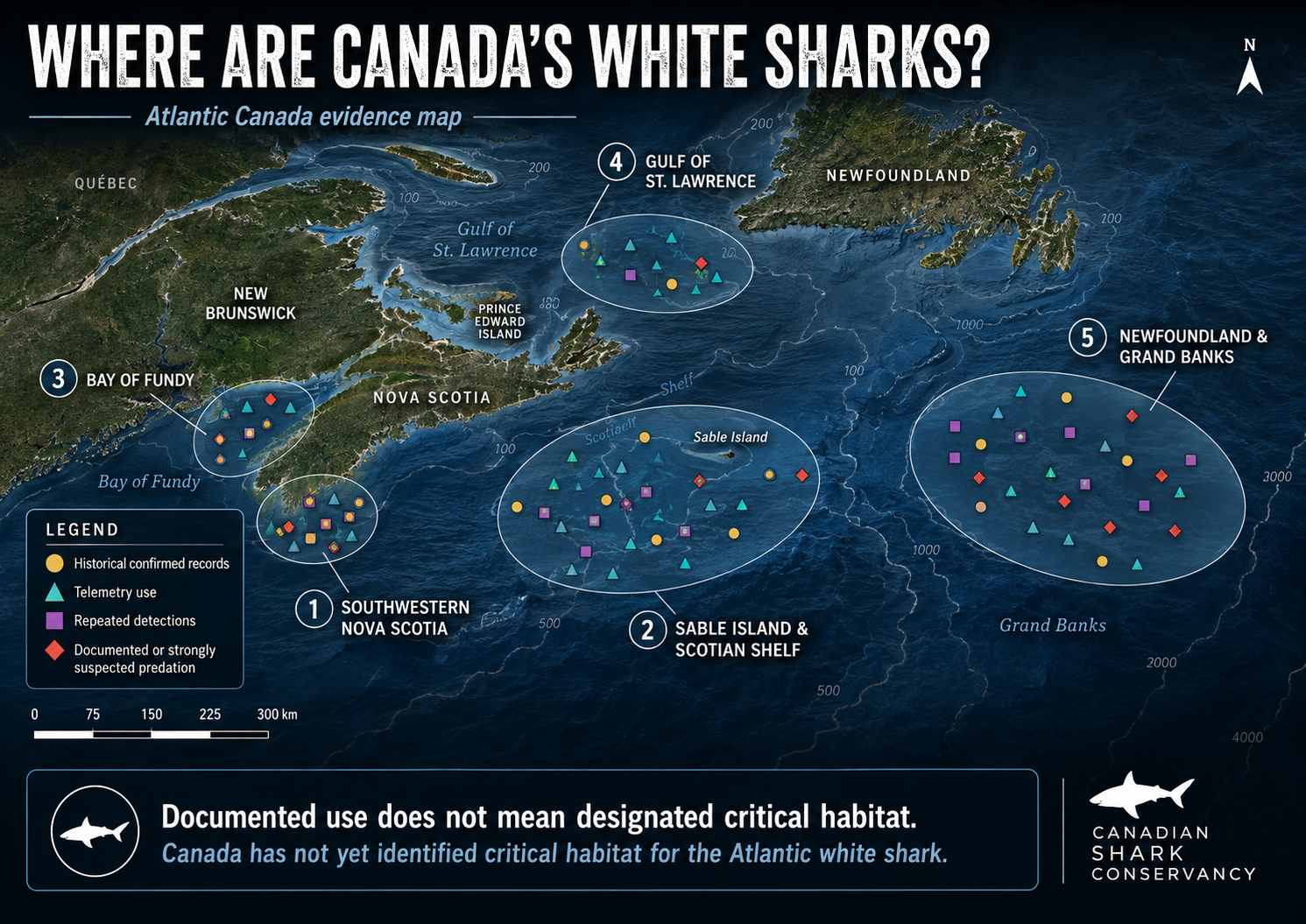
Southwestern Nova Scotia — Where the Tracks Begin to Tighten
If one region has become central to modern Canadian white-shark research, it is southwestern Nova Scotia.
In 2018, an OCEARCH research expedition located and sampled seven white sharks in an area south of Lunenburg.
Researchers described the concentration as a clear white-shark hotspot.
But even then, the reason for that concentration was uncertain.
Was it a feeding site?
A mating site?
A refuge?
Something else?
The researchers could establish that sharks were repeatedly present.
They could not yet establish everything those sharks were doing there.
That distinction remains important.
More recent work continues to strengthen the case that portions of southwestern Nova Scotia matter.
Atlantic Shark Expeditions has developed its white-shark research program in the region, including work off the southern end of the province.
Then, in October 2025, the Shark Research Foundation remotely satellite-tagged a 14-foot female white shark called Salvager near remote islands off southwestern Nova Scotia.
Her early movements were striking.
She remained relatively close to those outer islands after tagging and also travelled into the Bay of Fundy.
The Foundation carefully described what the track showed:
those islands appeared important to that individual.
Not necessarily to every white shark.
Not yet critical habitat.
But somewhere worth investigating.
This is how habitat science develops.
One shark uses an area.
Then another.
Some return.
Some stay longer than expected.
Eventually individual tracks begin forming a pattern.
Sable Island — Seal Country
Far offshore from mainland Nova Scotia lies one of the most remarkable pieces of sand in the North Atlantic.
Sable Island.
To people, it is famous for wild horses, shifting dunes and isolation.
To a large marine predator, another feature may be considerably more interesting.
Seals.
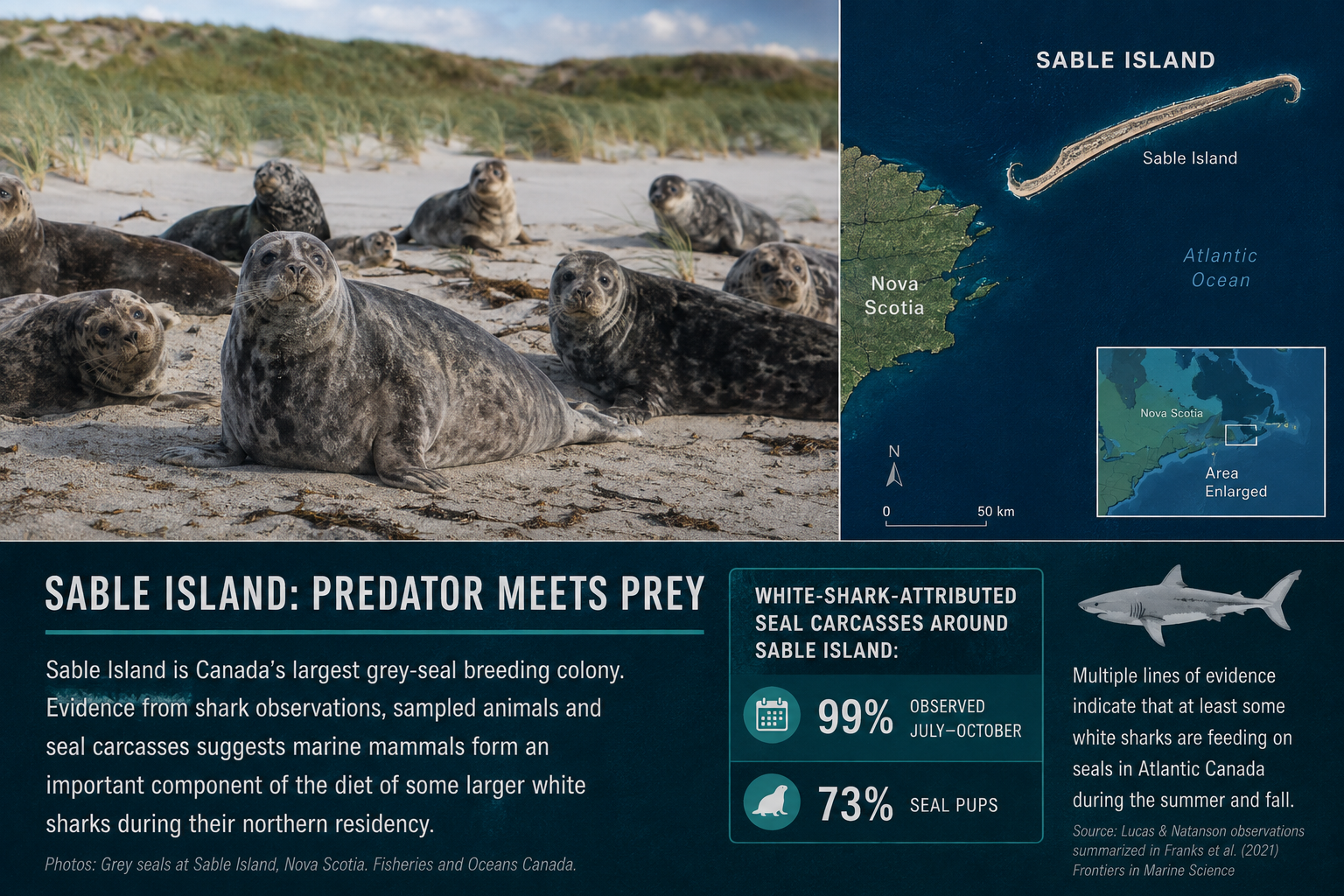
Sable Island is Canada's largest grey-seal breeding site. DFO's long-term population work has documented the extraordinary recovery of Atlantic Canadian grey seals after historical depletion, with the Sable Island and coastal Nova Scotia component growing from only a few thousand animals in the 1960s to hundreds of thousands.
That creates an enormous potential source of energy for a large white shark.
And unlike many assumptions about shark feeding, there is evidence connecting white sharks with seals in this region.
Researchers examining seal carcasses around Sable Island documented wounds attributed to white-shark predation.
The seasonal pattern was particularly interesting:
99% of those carcasses were observed between July and October.
And 73% were seal pups, although animals of multiple ages showed evidence of shark predation.
That timing overlaps remarkably well with the period when white sharks occupy northern residency areas.
There is additional evidence.
White sharks captured during Nova Scotia research expeditions showed:
- seal fur in fecal samples;
- fresh seal scratches around the head and mouth;
- large girths and distended abdomens consistent with substantial recent feeding.
Taken together, those observations provide some of the strongest evidence that at least some white sharks are making energetic use of Canada's seasonal seal resource.
But Not Every White Shark in Canada Is Hunting Seals
This is where the popular image of the great white can mislead us.
We picture a giant adult shark.
A seal.
A violent surface attack.
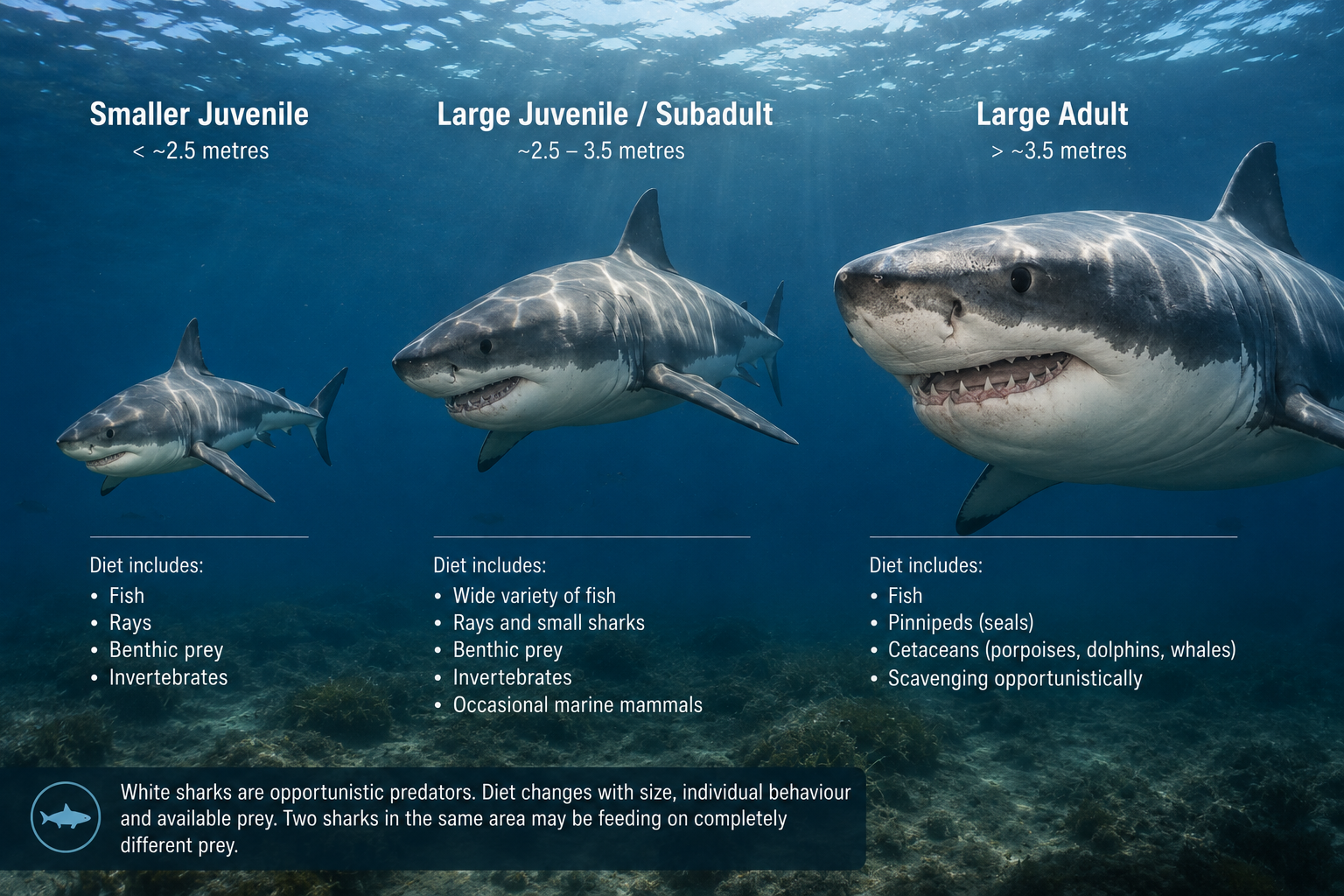
But Canada's white-shark population includes different ages and sizes.
Canada's recovery strategy notes that juvenile and subadult white sharks appear disproportionately represented in Canadian waters.
And white-shark diet changes substantially as the animal grows.
Smaller white sharks tend to feed more heavily on:
fish,
small sharks and rays,
bottom-associated prey,
and invertebrates.
As sharks grow beyond roughly three metres, large marine mammals become increasingly important potential prey.
But even large white sharks remain highly opportunistic predators.
So the Canadian feeding-ground story is not:
seal colony = white shark.
It may be multiple overlapping food landscapes.
A juvenile shark might find productive fish habitat attractive.
A much larger adult might exploit seals or cetaceans.
Another individual might scavenge a whale carcass.
Two sharks can occupy the same Canadian region for entirely different reasons.
A Predator With a Surprisingly Broad Menu
Historical Canadian records provide a glimpse of that diversity.
In 1953, between Passamaquoddy Bay and Grand Manan Island, observers reported a very large shark believed to be a white shark attacking and consuming part of an adult harbour porpoise.
Another harbour porpoise was reportedly taken by a large shark in the same broader region in 1969.
In 1971, a 5.2-metre white shark captured off New Brunswick contained three harbour porpoises in its stomach.
And a three-metre white shark caught near Wallace, Nova Scotia, in 1962 contained a small porpoise.
Those historical observations tell us something valuable.
Canadian white sharks were interacting with marine mammals long before modern satellite tagging made their northern presence visible to the public.
These animals are not new arrivals.
Our ability to watch them is new.
The Bay of Fundy — A Place of Tides, Prey and History
West of Nova Scotia lies one of the most energetic marine environments on Earth.
The Bay of Fundy.
Its enormous tides move vast quantities of water through narrow passages and coastal basins.
The result is a highly productive marine ecosystem supporting fishes, seals, porpoises, whales and seabirds.
White sharks have a long documented history here.
Canadian records include:
Passamaquoddy Bay,
Grand Manan,
Maces Bay,
Letete Passage,
and other locations around the Bay of Fundy region.
This is also where some of Canada's strongest historical observations of predation on harbour porpoises occurred.
And now modern tracking is adding another layer.
After her 2025 tagging off southwestern Nova Scotia, Salvager moved into the Bay of Fundy before returning toward the outer-island region where she had initially been tagged.
Does that mean the Bay of Fundy is a white-shark feeding hotspot?
Not yet.
But it means an individual shark used it.
Historical evidence tells us other white sharks have used it.
Prey is available.
And the ecological ingredients make the region impossible to ignore.
The next generation of research will have to determine how regularly individual sharks enter the Bay, how long they remain, and what they do while there.
The Gulf of St. Lawrence — Farther Inside the Continent
A white shark travelling north does not necessarily stop at Nova Scotia.
Records extend well into the Gulf of St. Lawrence.
Canadian observations have occurred in:
Northumberland Strait,
Chaleur Bay,
around Prince Edward Island,
the Laurentian Channel,
and as far inland as the St. Lawrence Estuary.
Telemetry studies have similarly documented white sharks in the broader Nova Scotia–Gulf of St. Lawrence residency region.
Franks and colleagues found that sharks tracked during late summer and early autumn commonly occupied northern areas including Nova Scotia, Prince Edward Island, New Brunswick and Newfoundland.
Again, prey may help explain part of that pattern.
Grey seals occur throughout the Gulf of St. Lawrence, Scotian Shelf and waters off Newfoundland and Labrador.
Canada's COSEWIC assessment specifically identifies white-shark presence around coastal Nova Scotia, Sable Island and the Gulf of St. Lawrence as potentially associated with foraging on grey seals.
But “potentially” matters.
We know sharks enter these waters.
We know seals occur there.
We know white sharks eat seals.
We do not yet have sufficient fine-scale evidence to declare every overlapping area a feeding hotspot.
Cabot Strait — Destination or Doorway?
One especially interesting location is Cabot Strait, the deep passage between Cape Breton Island and Newfoundland connecting the Atlantic Ocean with the Gulf of St. Lawrence.
An acoustic monitoring line across Cabot Strait has become part of efforts to quantify changes in white-shark presence in Canadian waters.
A 2025 study examined detections of 260 acoustically tagged white sharks at standardized Ocean Tracking Network receiver lines near Halifax and across Cabot Strait between 2014 and 2023.
The probability of tagged sharks reaching both monitoring regions increased over time, and the estimated seasonal detection period in Atlantic Canada became longer.
But Cabot Strait illustrates another important habitat question:
Is the shark stopping there—or passing through?
A receiver tells us the animal crossed an acoustic listening line.
It does not automatically tell us whether it fed there.
Cabot Strait may function partly as a gateway into and out of the Gulf.
That distinction—corridor versus residency habitat—is exactly the kind of thing researchers need finer tracking data to resolve.
Newfoundland and the Grand Banks — The Northern Edge
For some sharks, the journey continues farther north and east.
Tracking has documented white sharks around Newfoundland and the Grand Banks, while historical records extend across the Newfoundland Shelf and associated banks.
The Grand Banks are among the most productive shelf ecosystems in the North Atlantic.
Cold and warm water masses interact.
Nutrients support plankton.
Plankton supports fishes.
Fishes support larger predators.
And white sharks can exploit food webs at several trophic levels.
One Nova Scotia-tagged shark carrying a pop-up archival tag travelled into the Grand Banks region and experienced extraordinary thermal conditions—including water near or below freezing during portions of its northern occupation.
That tells us how far the physiological abilities discussed in our Cold Blood, Warm Muscles interlude can take these animals.
But again, presence does not equal proof of feeding.
The Grand Banks may provide foraging opportunities.
They may also be part of a wider northern residency landscape.
The question remains open.
The Continental Shelf May Be the Real Landscape
There is another pattern linking much of this geography.
The continental shelf.
Globally, white sharks can use deep offshore waters and dive hundreds of metres.
But much of their western North Atlantic residency occurs over continental-shelf habitat.
Historical sightings and incidental records in the region have also been heavily concentrated in comparatively shallow water.
COSEWIC reports that more than 92% of 564 opportunistic coastal white-shark observations and incidental captures in the broader region occurred at depths shallower than 100 metres, with a median depth around 30 metres.
That does not mean white sharks are shallow-water animals.
They are not.
But shelves are biologically productive places.
Fish aggregate.
Marine mammals forage.
Banks concentrate food webs.
Oceanographic fronts develop.
The shelf may therefore act not merely as a route north but as an enormous seasonal hunting landscape.
From the shark's perspective, the meaningful map may not be:
Nova Scotia.
New Brunswick.
Quebec.
Newfoundland.
It may be:
bank.
channel.
front.
seal colony.
fish aggregation.
shelf edge.
The political geography disappears.
Ecological geography takes over.
Why Does Returning Matter?
Now we can return to the shark that came back within two kilometres of its previous Nova Scotia location.
Why revisit somewhere so precisely?
One possibility is familiarity.
Animals that repeatedly use a productive region may become more efficient at navigating it and locating resources.
Researchers studying western North Atlantic white sharks have suggested that regional fidelity could provide ecological advantages by increasing familiarity with physical and biological characteristics of a known range—including prey capture opportunities.
Imagine the difference between searching an unfamiliar coastline and returning to a place where you have successfully fed before.
Where seals move.
Where currents concentrate prey.
Where channels create predictable movement.
Where the bottom drops away.
Where an animal has learned the landscape.
For a predator with enormous energetic needs, familiarity may be valuable.
Perhaps the shark is not simply returning to Canada.
Perhaps it is returning to a remembered hunting landscape.
But We Still Don't Know Which Places Matter Most
This is the point at which scientific humility becomes essential.
There is a temptation to look at tracking maps, identify clusters of dots and declare:
“White shark habitat.”
Canada cannot yet do that with the precision required for conservation law.
The final federal recovery strategy explicitly states that available information is insufficient to identify critical habitat for Atlantic white sharks.
Instead, one of the recovery program's priorities is to improve understanding of:
distribution,
prey preferences,
habitat use,
movement,
migration,
and seasonal abundance.
DFO also identifies the need to gather Indigenous knowledge, maintain sightings information and expand research and monitoring.
That means the map is still being drawn.
And some of the most important areas may not yet be obvious.
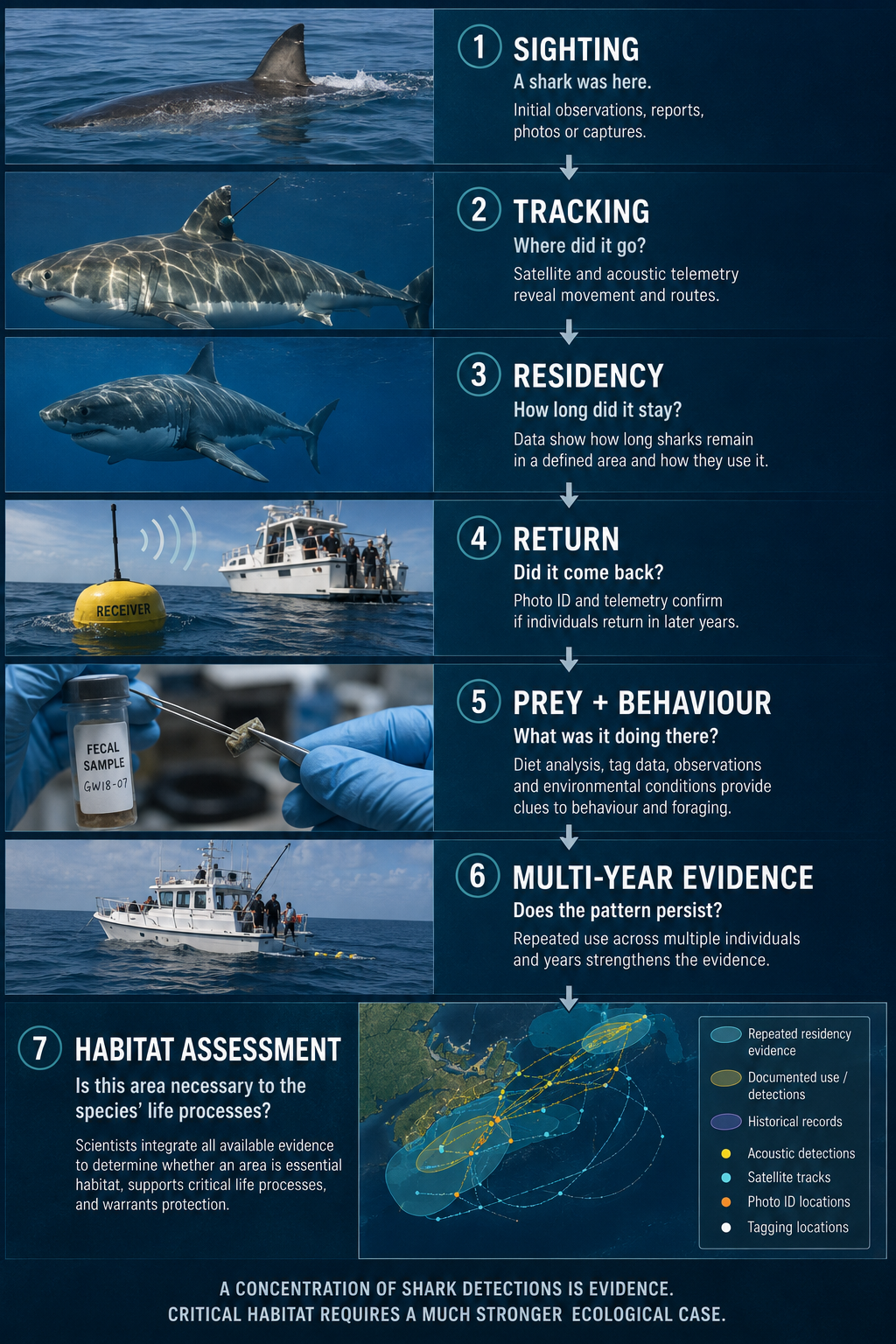
What Would Prove a Canadian Feeding Ground?
Imagine scientists repeatedly documenting the same pattern.
White sharks arrive during a particular season.
They slow down and begin area-restricted movement.
Individuals remain for extended periods.
Some return in later years.
Prey concentrations overlap with their locations.
Biological sampling reveals recent consumption of those prey.
Cameras or direct observations document predation.
Environmental conditions repeatedly predict shark presence.
At that point, the ecological argument becomes increasingly strong.
To get there, researchers can combine:
Satellite telemetry — where sharks travel.
Acoustic telemetry — when tagged sharks cross monitored areas.
Archival tags — depth and temperature.
Photo identification — which individuals return.
Fecal and stomach-content analysis — what they ate.
Stable isotopes and biochemical methods — longer-term dietary information.
Prey surveys — what food was available.
Seal movement studies — how predator and prey overlap.
Environmental data — temperature, fronts, currents and productivity.
Indigenous and local knowledge — observations accumulated from people living and working on these waters.
No single method solves the puzzle.
Together they begin revealing the habitat from the animal's perspective.
The Shark Knows Before We Do
Somewhere off Nova Scotia this summer, a white shark may enter a stretch of water it has visited before.
Perhaps it remembers the place.
Perhaps temperature tells it the season is right.
Perhaps currents bring chemical information from prey.
Perhaps it follows a coastline, bank or magnetic signature.
Perhaps seals are moving through a familiar corridor.
We cannot ask the animal.
So we follow.
We tag.
We listen.
We sample.
We watch.
And slowly, individual movements become patterns.
Patterns become hypotheses.
Hypotheses become evidence.
Eventually, evidence may reveal which Canadian habitats are truly important.
That work matters because a migratory animal does not need every part of its range equally.
Some places may simply connect one destination to another.
Others may provide the energy that makes the entire annual journey worthwhile.
And if a white shark travels thousands of kilometres to reach one of those places—
then leaves—
and returns the following year—
perhaps the most important question is no longer:
Why are white sharks coming to Canada?
It is:
What do they remember about the places they return to?
NEXT — PART 5
The Sharks That Return
What site fidelity may teach us about white-shark memory, navigation and experience
Some white sharks return to the same broad Canadian regions year after year.
At least one tracked animal returned to within kilometres of where researchers had encountered it before.
In Part 5 of White Sharks in Canada, we move beyond migration and ask something more difficult:
Can a shark know a place?
What does “memory” mean in a migratory predator?
How do scientists distinguish instinct from experience?
And what happens when an animal's mental map spans thousands of kilometres of ocean?
Research & Further Reading
Fisheries and Oceans Canada — Recovery Strategy for White Shark in Atlantic Canadian Waters (2025; final publication). Canada's current recovery strategy states that white-shark habitat requirements in Atlantic Canadian waters remain unknown and identifies distribution, prey preferences, habitat use, tagging and critical-habitat research as priorities.READ SOURCE ↗Franks et al. (2021) — Spatio-Temporal Variability in White Shark Movement Ecology During Residency and Migration Phases in the Western North Atlantic. The multi-year telemetry study provides major evidence for northern residency, Atlantic Canadian site fidelity, seal feeding and use of Canadian shelf waters.READ SOURCE ↗COSEWIC (2021) — White Shark, Atlantic population. Canada's status assessment documents historical and contemporary Canadian distribution, diet, prey relationships and the potential association between white sharks, grey seals and northern habitats.READ SOURCE ↗Shark Research Foundation — Salvager. The 2025 remote-tagging project off southwestern Nova Scotia provides an emerging example of fine-scale individual habitat use around the province's outer islands and Bay of Fundy.READ SOURCE ↗Fisheries and Oceans Canada — Grey Seal. DFO identifies Sable Island as Canada's largest grey-seal breeding site and documents the remarkable recovery of the Atlantic Canadian grey-seal population.READ SOURCE ↗Protect Sharks. Protect Our Oceans. Protect Our Future.