

They don’t live in Canada. They return to Canada.
In the autumn of 2018, researchers tagged a male white shark in Nova Scotia.
He was about 3.9 metres long.
Eventually, as white sharks do when the northern season ends, he left Canadian waters.
Winter passed.
Then spring.
And in 2019, the shark came north again.
Not merely back to Canada.
He returned to within less than two kilometres of where researchers had tagged him the year before.
Then another winter passed.
And in 2020, he came back again.
To essentially the same place.
Three seasons.
Thousands of kilometres of movement.
One extraordinarily familiar piece of Nova Scotia.
The shark was identified in the scientific study simply as NS2018-03.
But his movements raise a question much larger than one animal.
Can a white shark know a place?
And if it can—
what does remembering an ocean look like?
One Shark Returning Is Interesting
One animal returning to an area might be coincidence.
Several begin to form a pattern.
The western North Atlantic telemetry research we have followed throughout this series found striking evidence of repeated use of Atlantic Canadian waters.
Six white sharks fitted with satellite tags in Atlantic Canada during 2018 produced enough subsequent tracking information to follow their next season.
All six returned to Atlantic Canadian waters in 2019.
Three were still being tracked when they returned again in 2020.
Researchers tagged another 11 sharks in Atlantic Canada in 2019.
Six supplied useful tracking data during the following summer.
Five of those six returned to Atlantic Canada.
And NS2018-03 was not the only example of repeated regional use.
A separate Canadian acoustic-telemetry study found individual sharks returning habitually to particular Canadian regions.
Two sharks—MA1702 and MA1512—were detected in Canadian waters during four consecutive years, with each tending to use a particular section of the coast.
Another shark, MA1606, returned to the Bay of Fundy in three consecutive years.
This is no longer simply:
White sharks come to Canada.
It becomes:
Some particular white sharks repeatedly come back to particular parts of Canada.
That is a very different biological statement.

SOME SHARKS COME BACK
Show three individual examples:
NS2018-03
Nova Scotia
2018 → 2019 → 2020
Returned to within <2 km of original tagging location.
MA1702
Atlantic Canada
Detected during four consecutive years.
MA1606
Bay of Fundy
Returned during three consecutive years.
Footer:
Individual examples illustrate site fidelity. They do not mean every western North Atlantic white shark returns to Canada annually.
Sources: Franks et al. 2021; Bowlby et al. 2022.
Scientists Have a Name for This
The term is site fidelity.
At its simplest, site fidelity describes an animal repeatedly returning to, or repeatedly using, a particular geographical area.
It occurs throughout the animal kingdom.
Sea turtles return to familiar feeding areas.
Seabirds revisit nesting colonies.
Marine mammals return to seasonal foraging grounds.
And sharks do it too.
A major review of shark movement studies found evidence of residency, site fidelity or related philopatric behaviour across 31 shark species, despite many of those animals being perfectly capable of travelling enormous distances.
But several related terms can easily become confused.
Residency
An animal remains within, or repeatedly uses, a particular area for an extended period.
Site fidelity
An animal leaves an area and later returns to it.
Philopatry
A broader tendency to return repeatedly to a particular “home” region or biologically important area.
Natal philopatry
An animal returns specifically to its birthplace or birth region, often for reproduction.
That last distinction is especially important.
We have evidence that some white sharks repeatedly return to Atlantic Canadian areas.
We do not have evidence that Nova Scotia is their birthplace.
So calling these sharks “Nova Scotia-born” or saying they are returning “home to where they were born” would go beyond the science.
What we can say is already remarkable enough:
They leave, travel enormous distances, and some later find their way back to the same Canadian regions.
But Not Every Shark Comes Back
This may be just as important as the return behaviour itself.
White sharks are individuals.
Some repeatedly use Canadian waters.
Others do not.
Some spend their northern residency around Massachusetts.
Others continue farther north.
Some migrate largely along the continental shelf.
Large mature females sometimes undertake extensive offshore movements unlike the more shelf-oriented movements of many other individuals.
Canadian acoustic data also suggest that the animals reaching Canada are not simply a random sample of every tagged white shark in the western North Atlantic.
Certain individuals appear disproportionately likely to return.
Juveniles and subadults were also more likely than adults to be detected in Canadian waters in the Canadian telemetry analysis.
Canada's current recovery strategy reflects that same picture: only part of the larger Northwest Atlantic population enters Canadian waters seasonally, and individuals show repeated use of similar Canadian areas across years.
So there may be no single behaviour called:
“what white sharks do.”
There are population-level patterns.
And inside those patterns are individual strategies.
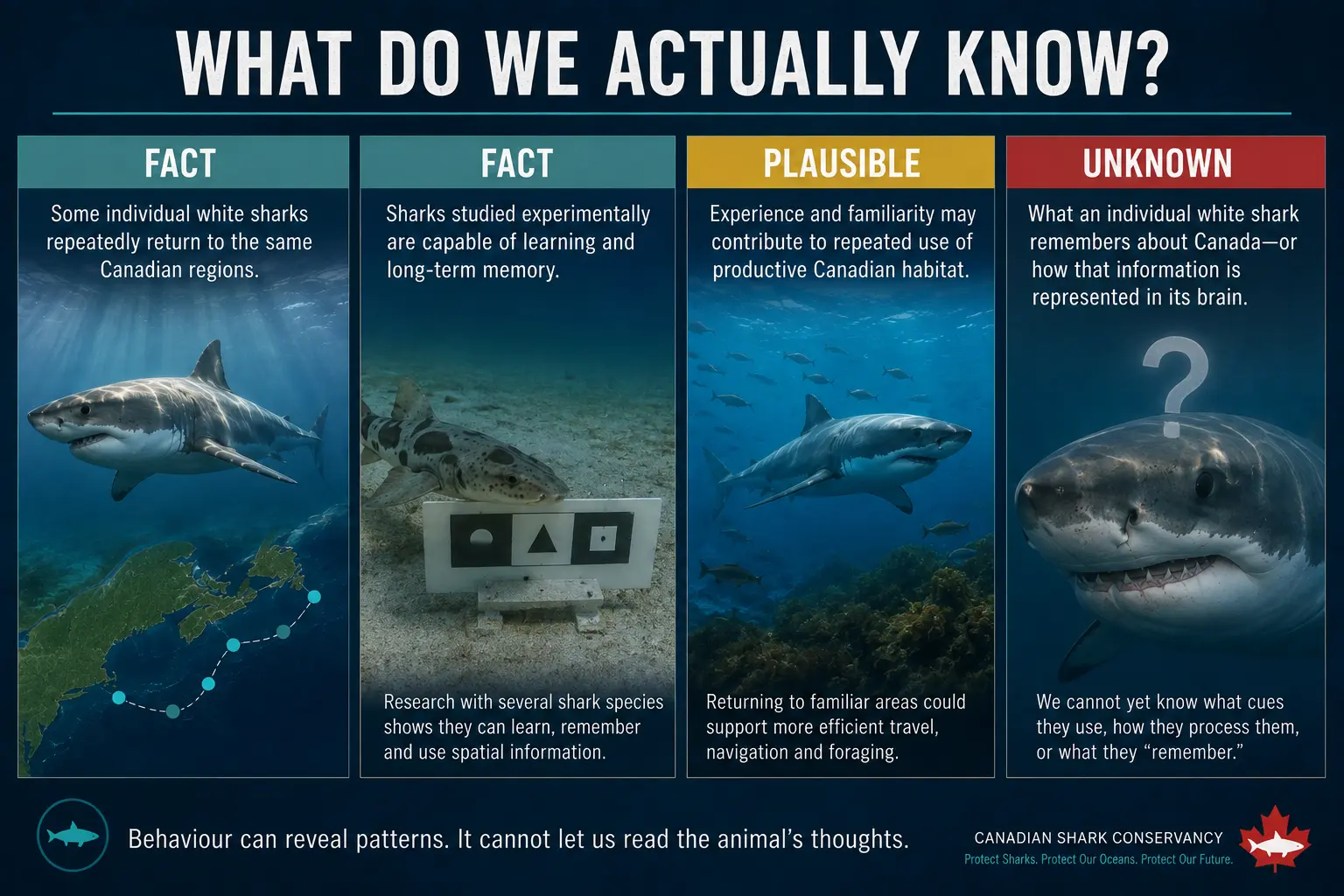
Does Returning Prove a Shark Has Memory?
Here we need to be careful.
It is very tempting to see a shark return within two kilometres of a previous location and say:
“The shark remembered Nova Scotia.”
Maybe it did.
But telemetry cannot show us a memory.
A satellite tag records movement.
An acoustic receiver records presence.
Neither records thought.
Repeated site fidelity demonstrates that an animal can successfully return to a previously used region.
It does not, by itself, reveal the cognitive process that produced the return.
That distinction matters.
A shark might navigate using:
inherited migratory tendencies,
temperature,
currents,
coastlines,
chemical cues,
bathymetry,
Earth's magnetic field,
learned experience,
or several of those simultaneously.
The movement is observable.
The animal's internal experience is much harder to measure.
So the scientifically responsible conclusion is:
Site fidelity is evidence of repeated return behaviour. It is not direct proof of a human-like memory of place.
But that does not mean sharks lack memory.
Quite the opposite.
Sharks Can Remember
Laboratory studies of other shark species have demonstrated learning and memory directly.
Juvenile grey bamboo sharks trained to distinguish visual patterns were later tested without reinforcement.
They retained the learned information for as long as 50 weeks, when the experiment ended.
Experiments with catsharks have demonstrated rapid learning during foraging tasks involving electrical cues, along with habituation when signals repeatedly failed to produce food.
And broader reviews of shark and ray cognition now document:
spatial learning,
long-term memory,
discrimination learning,
habituation,
social learning,
object categorization,
and multiple navigation strategies.
The modern scientific picture is very different from the old stereotype of sharks as essentially reflex-driven feeding machines.
Sharks learn.
Sharks remember.
Sharks use spatial information.
What we cannot yet say is exactly how those documented cognitive abilities contribute to a white shark's return to Nova Scotia.
That is the fascinating unanswered part.
Familiarity Has Value
Why would an animal return to somewhere it already knows?
Because familiarity can save energy.
Imagine arriving in an unfamiliar marine landscape.
Where is the food?
Where do prey animals concentrate?
Which channels produce favourable currents?
Where does deep water approach an island?
Where do seals move between resting and feeding habitat?
Where are the profitable hunting opportunities?
Now imagine you have successfully fed there before.
Returning to known habitat could reduce the cost of searching.
The authors of the major western North Atlantic telemetry study proposed exactly this possibility.
Site fidelity can increase familiarity with an area's physical and biological characteristics and potentially improve the efficiency of behaviours such as movement, migration and prey capture.
That does not prove a shark is consciously thinking:
“Last year I found seals behind that island.”
Animal cognition does not need to resemble a human internal monologue.
The biological advantage may simply be that animals capable of recognizing or navigating toward previously productive habitat spend less energy searching randomly.
Experience can have value without requiring anything resembling human thought.
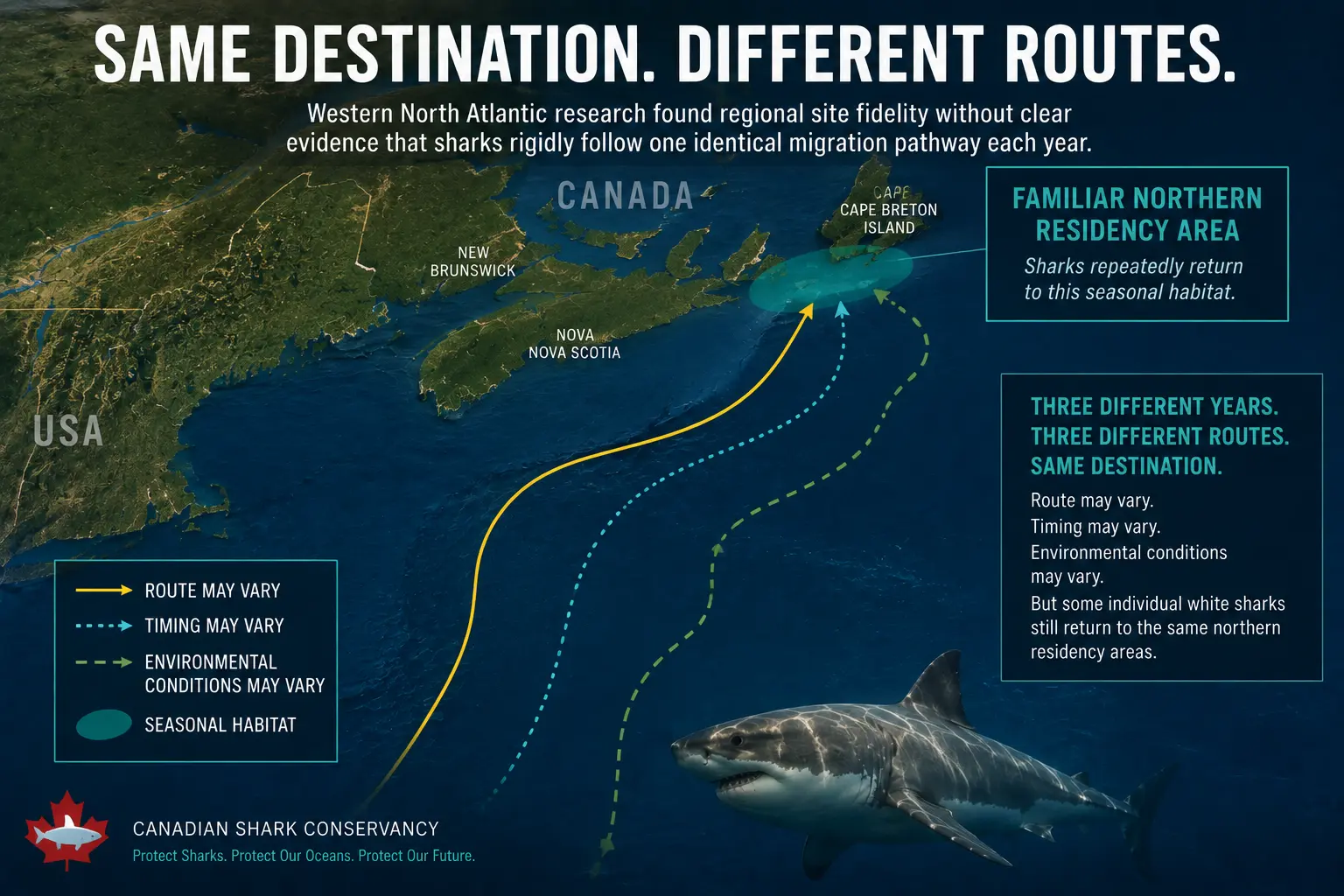
Destination Without a Fixed Road
There is another finding in the tracking data that makes the story even more intriguing.
Western North Atlantic sharks showed evidence of fidelity to their residency areas.
But researchers did not find a clear pattern showing individuals rigidly following the same migration route every year.
Think about that.
The destination can remain similar.
The route can vary.
That resembles something very different from simply following one permanent underwater highway.
A shark may travel along different portions of the shelf.
Weather and currents change.
Ocean temperatures shift.
Prey moves.
Yet some individuals still arrive in familiar northern areas.
This does not prove that white sharks possess a human-like “cognitive map.”
But it gives us a useful question:
If the route can change while the destination remains recognizable, what information defines the destination to the shark?
What Is the Shark Following?
Our first Shark Science interlude explored the sensory world available to a migrating shark.
Now those senses become relevant again.
A long-distance navigator has several potential information sources.
Earth's magnetic field
In 2021, controlled experiments with bonnethead sharks demonstrated that sharks can use geographical information contained in Earth's magnetic field as a map-like cue.
That experiment involved bonnetheads, not white sharks.
So we should not simply assume identical navigation.
But it demonstrates that geomagnetic mapping is biologically possible within sharks.
Temperature
Water masses and seasonal temperature gradients provide large-scale environmental structure.
White-shark migration timing is strongly seasonal, and temperature undoubtedly contributes to the habitat landscape these animals experience.
Currents and oceanography
Currents move water, prey and chemical information.
Shelf edges, fronts and channels can all create recognizable physical environments.
Smell
Chemical cues may become particularly useful at smaller scales.
Vision and coastline
Closer to shore, visual features and bathymetry may provide additional information.
Experience
And finally there is the possibility that past encounters matter.
Perhaps a returning shark is not relying on one compass.
Perhaps it is integrating multiple layers of information until the ocean becomes increasingly familiar.
We do not know.
And saying “we do not know” is not a weakness in this story.
It is the beginning of the research question.
Are White Sharks Unusual?
Not in their ability to return.
But the distances make their behaviour spectacular.
In the Northeast Pacific, long-term photographic records have documented individual white sharks returning repeatedly to the same coastal aggregation sites over extraordinary periods.
One study used distinctive dorsal fins to identify five individual sharks across periods ranging from 16 to 22 years, demonstrating both longevity and long-term site fidelity.
Pacific white sharks also show strong fidelity to predictable coastal areas despite making major offshore migrations.
That tells us something important about white sharks globally.
An animal's ability to travel far does not mean every place becomes interchangeable.
Mobility and attachment to place can coexist.
A shark can cross an ocean and still repeatedly prefer one tiny corner of it.
The Individual Matters
For much of fisheries science, animals are understandably discussed as populations.
Abundance.
Mortality.
Growth.
Recruitment.
Distribution.
Those measurements are essential.
Telemetry adds something different.
Biography.
NS2018-03.
MA1702.
MA1512.
MA1606.
Suddenly the population becomes individual animals with different movement histories.
One returns to the Bay of Fundy.
Another repeatedly occupies waters between Yarmouth and Halifax.
Another returns near where researchers first encountered it.
Long-term tracking shows that individuals are not simply interchangeable dots moving according to one population rule.
They can display persistent differences in where they go and what regions they use.
That matters scientifically.
And it matters for conservation.
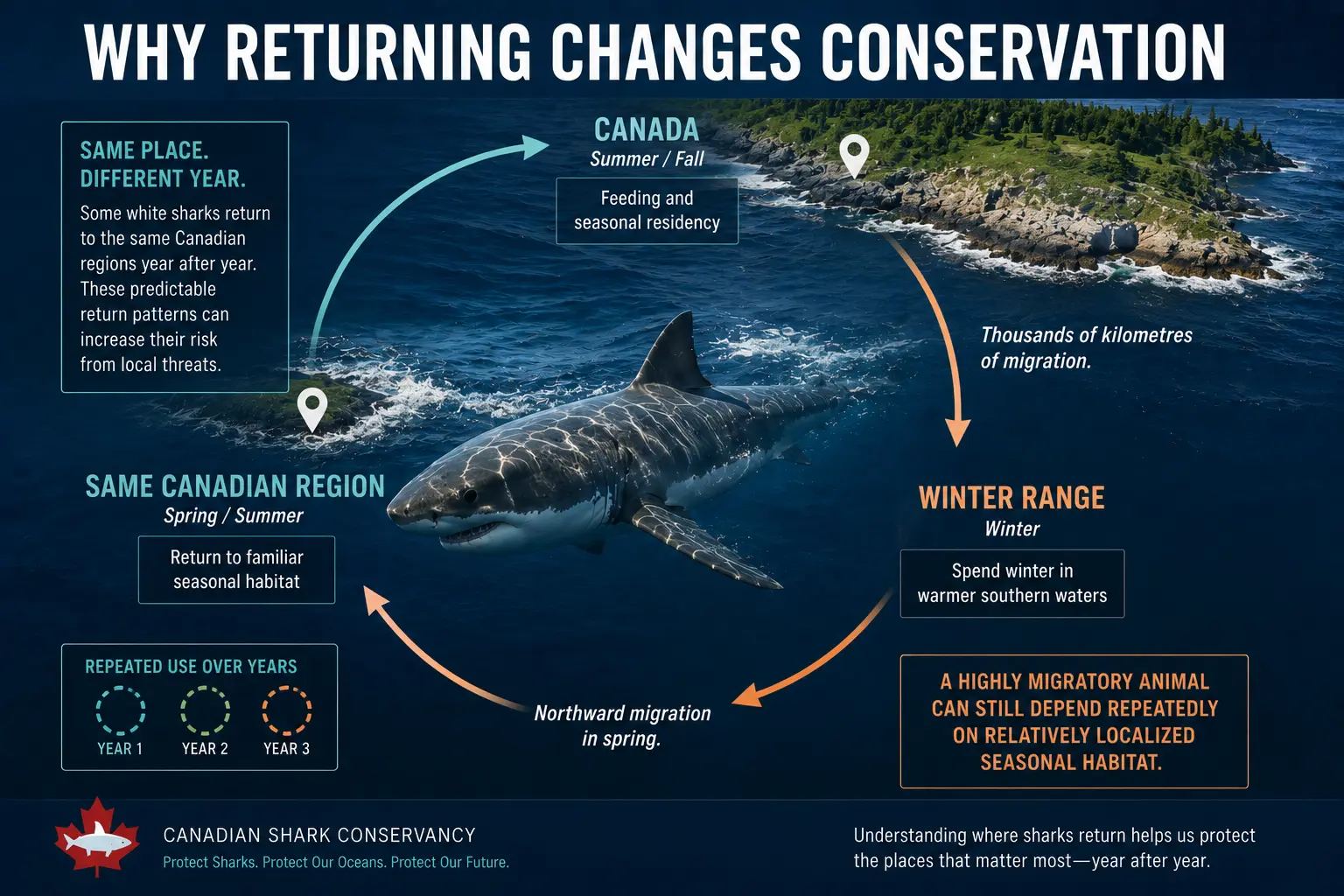
Site Fidelity Can Create Vulnerability
Imagine a population capable of spreading across an enormous ocean.
At first glance, that mobility sounds protective.
If conditions become poor somewhere, perhaps the animals can simply go somewhere else.
Site fidelity complicates that assumption.
If particular individuals repeatedly return to particular habitats, then threats concentrated in those habitats may repeatedly affect the same animals.
Fishing interactions.
Entanglement.
Vessel activity.
Habitat change.
Changing prey distributions.
Human disturbance.
An animal capable of swimming thousands of kilometres may still become predictably vulnerable during the months it returns to one relatively small region.
This is one reason understanding shark residency and fidelity matters for management. Reviews of shark movement ecology have repeatedly emphasized that site fidelity can create population structure at much finer scales than raw dispersal ability would suggest.
For Canada, this is especially important because the federal recovery strategy states that critical habitat still cannot be identified with current information.
Determining where sharks repeatedly return—and why—is part of closing that knowledge gap.
Is Canada Home?
That word deserves care.
Home is a human concept loaded with emotion.
We do not know whether a white shark experiences attachment to a place in anything remotely resembling our experience.
And Canada is certainly not its only habitat.
The shark spends much of its year elsewhere.
It crosses borders.
Uses southern waters.
Travels migration corridors.
Some individuals venture offshore.
Its life cannot be contained within one country.
But ecology gives us another way to think about home.
A place can matter because an animal repeatedly chooses it.
A place can matter because food is predictable there.
Because conditions are favourable.
Because experience reduces uncertainty.
Because returning has worked before.
In that sense, some portions of Atlantic Canada may be something more than temporary coordinates on a migration map.
They may be familiar places within an enormous annual range.
Does a Shark Remember Nova Scotia?
We began with that question.
And the answer is:
We don't yet know exactly what that means to a shark.
We cannot ask NS2018-03 what he recognized when he returned.
We cannot know whether a coastline seemed familiar.
Whether the Earth's magnetic signature helped define the destination.
Whether prey cues completed the final approach.
Whether experience from previous years changed his behaviour.
But we know this:
He travelled away.
He returned.
Then he did it again.
Other sharks have done the same.
Sharks are capable of learning.
They are capable of retaining information.
They are capable of using spatial information.
And some white sharks repeatedly select particular Canadian regions after months away and movements spanning thousands of kilometres.
Perhaps we should resist the temptation to turn that immediately into a human story about memory.
But we should also resist the older temptation to assume there is no cognition involved at all.
The ocean is not empty to a shark.
And perhaps the map it carries is not entirely written in instinct.
Maybe part of it is written by experience.
They Don't Just Return to Canada
That may be the most important lesson of Part 5.
They don't simply return to Canada.
Some appear to return to places within Canada.
Specific regions.
Specific seasonal habitats.
Sometimes locations astonishingly close to those they used before.
And that changes the way we should think about the migration.
The journey is not merely north.
Then south.
Then north again.
For some sharks, it may be a recurring circuit connecting familiar places across an enormous ocean.
Which means that when a white shark disappears from Nova Scotia in autumn—
perhaps it is not leaving that place behind.
Perhaps, in whatever way a shark stores information about its world,
it is carrying something about that place with it.
Until the next northern season begins.
NEXT — PART 6
Reading a Shark's Signal
What tracking technology can tell us—and what it cannot
Satellite ping.
Acoustic detection.
Depth record.
Estimated position.
Public tracking maps can make a shark's movements appear remarkably precise.
But every technology has blind spots.
In Part 6 of White Sharks in Canada, we will look beneath the shark-tracker map and examine how researchers turn incomplete signals into scientific evidence.
How accurate is a satellite ping?
What happens when the shark does not surface?
How far away can an acoustic receiver hear a tag?
How do researchers estimate where a pop-up archival tag travelled?
And how easily can the public misinterpret the empty spaces between the dots?
Knowing how sharks are tracked is only part of understanding the science.
We also need to know where the uncertainty lives.
Research & Further Reading
Franks et al. (2021) — Spatio-Temporal Variability in White Shark Movement Ecology During Residency and Migration Phases in the Western North Atlantic. The principal telemetry study supporting the Atlantic Canadian site-fidelity patterns discussed here, including sharks returning across multiple years and NS2018-03 returning to within two kilometres of its original Nova Scotia tagging location.READ SOURCE ↗Bowlby et al. (2022) — Conservation implications of white shark behaviour at the northern extent of their range in the Northwest Atlantic. Canadian acoustic monitoring documented repeated regional returns, including animals detected in Canadian waters over three and four consecutive years.READ SOURCE ↗Fisheries and Oceans Canada — Recovery Strategy for White Shark, Atlantic population. Canada's current strategy recognizes repeated use of similar Canadian areas across years and identifies continued research into seasonal distribution, movement and habitat use as priorities.READ SOURCE ↗Schluessel et al. — Shark cognition and memory research. Reviews of experimental work show that sharks and rays are capable of spatial learning, discrimination, memory, habituation and other cognitive processes.READ SOURCE ↗Fuss et al. — Something Worth Remembering: Visual Discrimination in Sharks. Juvenile bamboo sharks retained trained visual discrimination information for up to 50 weeks, demonstrating long-term memory in an experimentally tested shark species.READ SOURCE ↗Anderson et al. — Long-term individual identification and site fidelity of white sharks off California. Long-term photographic records documented individual white sharks returning to aggregation sites across periods of 16–22 years.READ SOURCE ↗Protect Sharks. Protect Our Oceans. Protect Our Future.