
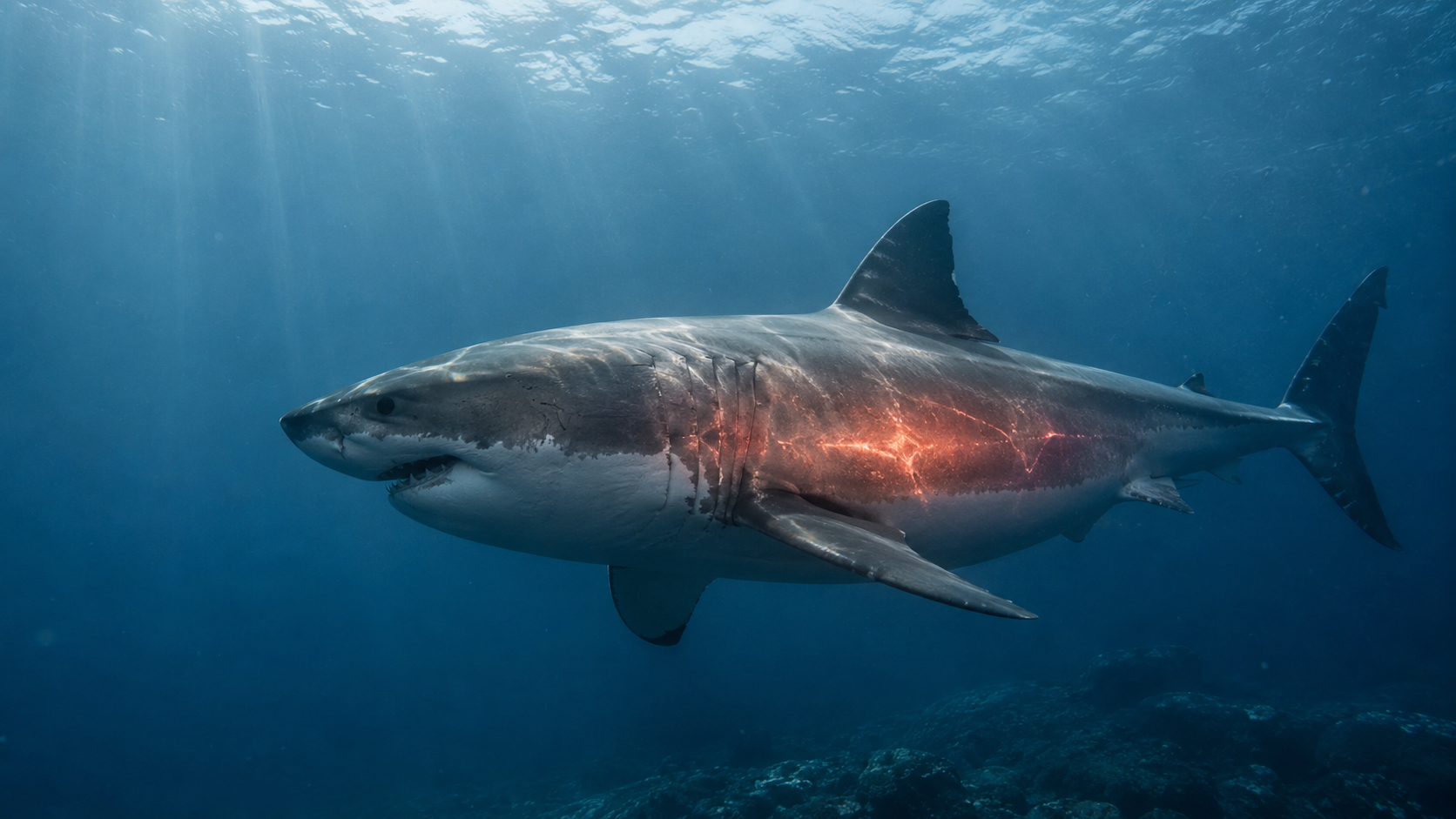
A white shark swims through the waters off Nova Scotia.
The sea around it may be cold.
Very cold.
Yet inside the shark, some of the muscles powering its movement can remain considerably warmer than the water passing across its skin.
Its skeleton contains no conventional bone.
Its skin is covered in thousands of microscopic tooth-like structures.
It has no swim bladder.
Its teeth are disposable.
And some sharks can travel through temperatures that would dramatically slow many other fishes.
Almost everything about the animal seems slightly different from the vertebrate blueprint most of us learned in school.
In our first Shark Science interlude, we explored how sharks read the ocean.
Now we look beneath the skin.
Because understanding how a shark senses its world is only half the story.
The other half is understanding the remarkable machine carrying those senses through it.
Are Sharks Cold-Blooded?
The simple answer is:
Most are.
The better answer is:
It depends on what you mean.
The phrase “cold-blooded” is commonly used to describe animals whose body temperature is strongly influenced by the surrounding environment.
Scientists generally use the term ectothermic.
For most sharks, seawater temperature largely determines body temperature.
Put an ectothermic shark into colder water and its tissues cool.
Move it into warmer water and they warm.
But several sharks have evolved an extraordinary exception.
White sharks.
Shortfin and longfin makos.
Porbeagles.
Salmon sharks.
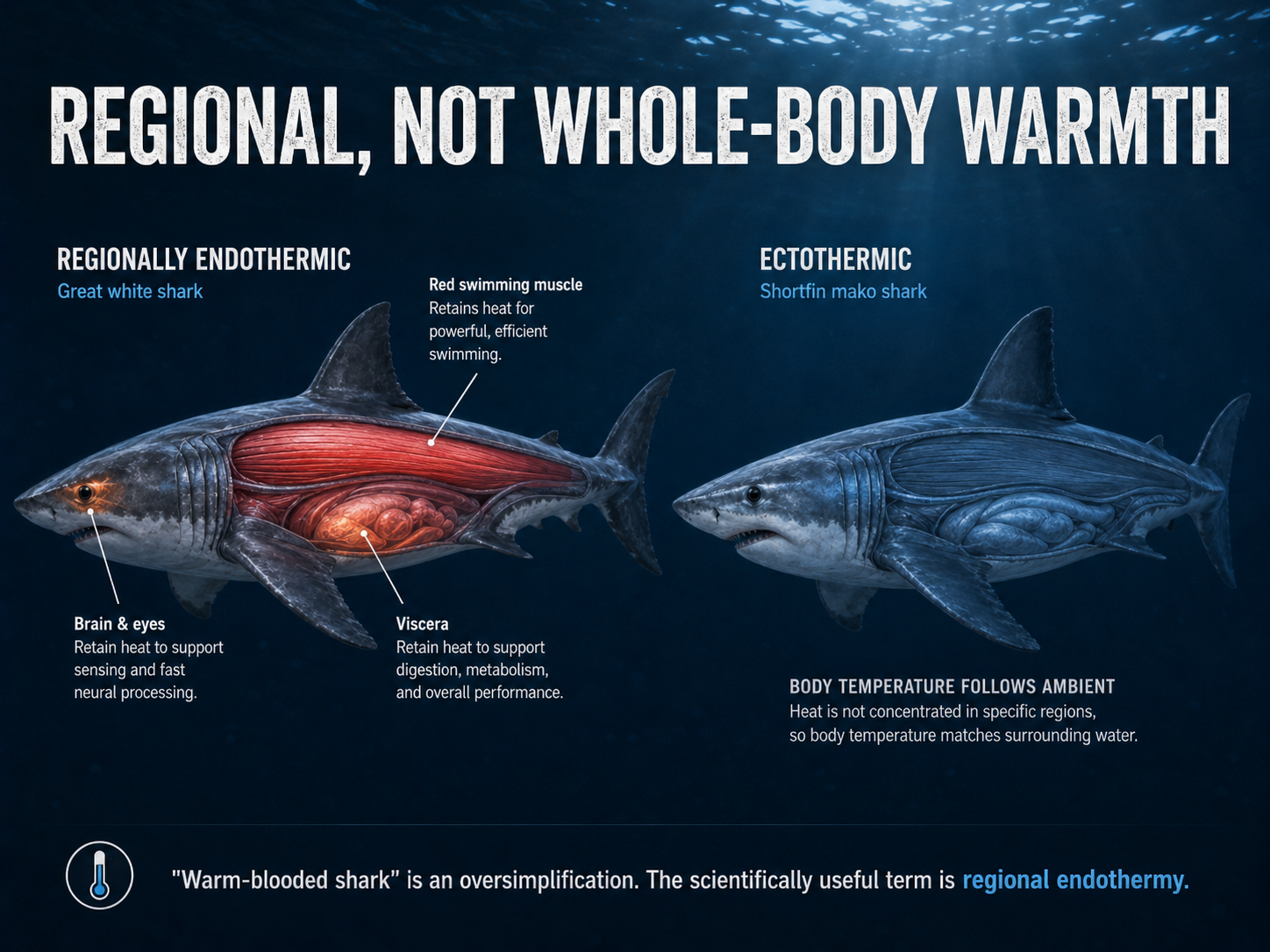
And some other highly active pelagic sharks possess varying degrees of regional endothermy.
That does not mean they are warm-blooded like mammals.
They do not maintain one uniformly warm body temperature from nose to tail.
Instead, they retain metabolic heat in particular parts of the body, allowing selected tissues to remain warmer than the surrounding seawater.
The distinction matters.
A white shark is not a giant underwater mammal.
It is something much more unusual:
a fish capable of carrying pockets of warmth through a cold ocean.
The Rete Mirabile — Nature's Heat Exchanger
The secret lies partly in blood vessels.
Working muscles generate heat.
In most fishes, much of that heat is quickly lost as blood moves toward the gills, where it comes into close contact with cold seawater.
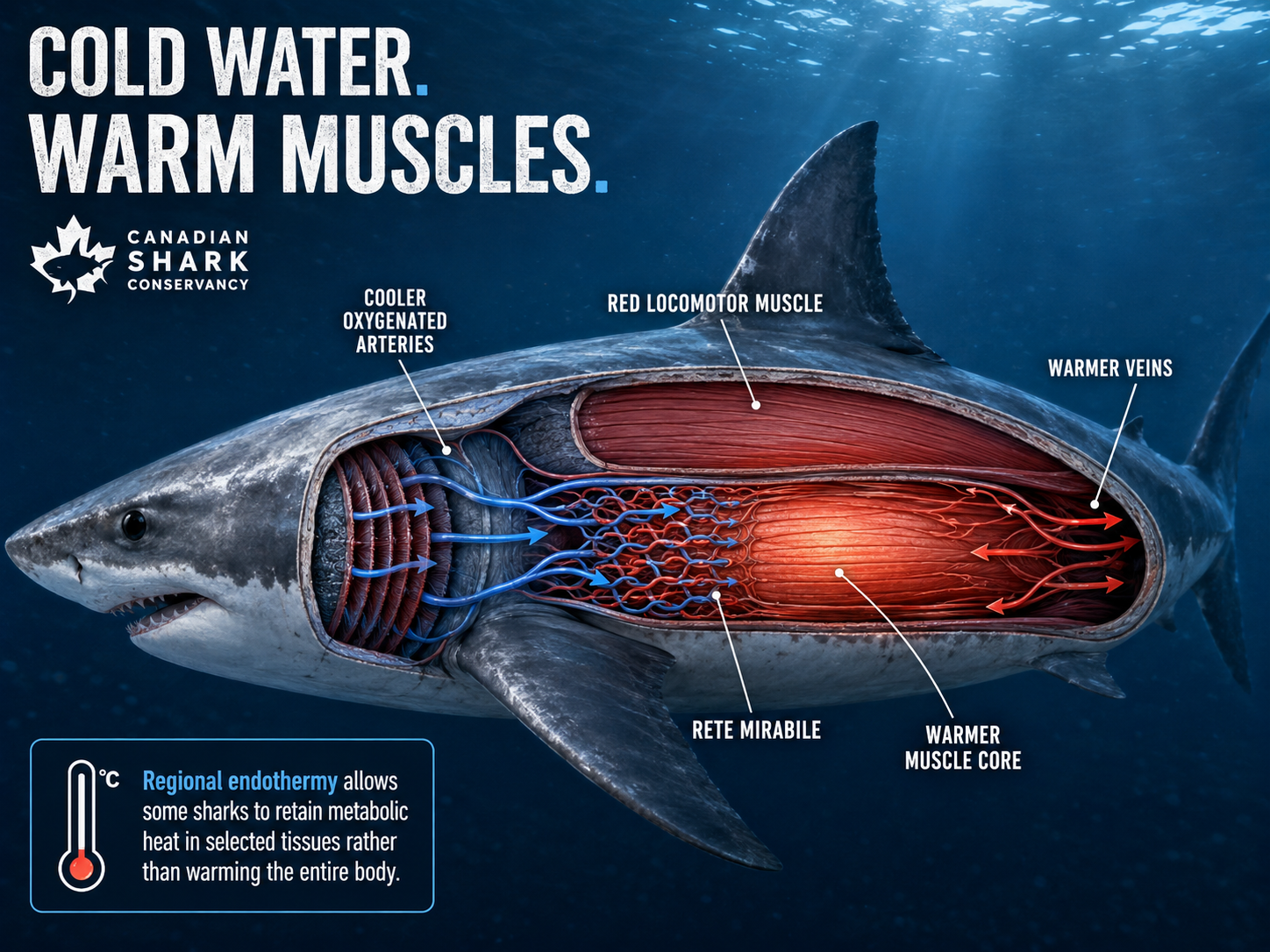
Regionally endothermic sharks have evolved arrangements of closely associated arteries and veins known as retia mirabilia — literally, “wonderful nets.”
Warm venous blood travelling away from active muscles passes beside colder arterial blood returning from the gills.
Heat moves between them.
Instead of allowing that warmth to escape into the environment, the shark effectively recycles part of it back toward the body.
It is a counter-current heat exchanger built from blood vessels.
The result can be striking.
The red swimming musculature of some lamnid sharks can remain substantially warmer than ambient seawater, while specialized vascular systems can also help warm internal organs and, in some species, the eyes and brain.
The Salmon Shark — Built for Cold
Salmon sharks occupy the North Pacific and can spend extended periods in remarkably cold water.
Satellite-tagged animals have been recorded using waters from roughly 2°C to 24°C, including winter habitat between approximately 2°C and 8°C.
Yet their swimming musculature functions very differently from that of a typical cold-bodied fish.
Research has shown that the red aerobic muscles powering routine swimming in salmon sharks are highly specialized for warm operating temperatures.
Their muscles perform best at temperatures far above the surrounding seawater.
In effect, the shark carries its preferred muscle environment with it.
Its heat-retention system makes that possible.
Salmon sharks also possess cardiac adaptations that allow the heart itself to continue functioning effectively despite exposure to cold blood returning from the gills.
That combination allows them to occupy cold, productive northern waters while maintaining the performance expected of an active pelagic predator.
This is not simply:
“A shark that tolerates cold.”
It is an animal anatomically built to exploit it.
White Sharks Carry Some of the Same Technology North
Now return to White Sharks in Canada.
Why can a white shark move into the comparatively cool waters of Atlantic Canada and remain an effective predator?
Regional endothermy is part of the answer.
White sharks are members of the same lamnid shark family as makos, porbeagles and salmon sharks.
Their heat-exchange systems help maintain important tissues above ambient temperature.
They can therefore operate across a broader thermal landscape than a similarly sized ectothermic predator might.
This does not mean temperature becomes irrelevant.
It means white sharks have more physiological options.
They can enter cooler environments while keeping key biological machinery running at temperatures different from the water around them.
That helps explain why cold Canadian water does not automatically equal an inactive white shark.
Warm Eyes in a Cold Ocean
Muscle is not the only tissue worth protecting from cold.
For a fast-moving predator, sensory processing matters too.
Lamnid sharks possess vascular heat exchangers associated with the cranial region that can help warm blood supplying the eyes and brain. Research on shark physiology has documented orbital retia in species including makos and porbeagles, while white sharks also possess specialized cranial heat-exchange systems.
Why might that matter?
Neural and visual processes are temperature-sensitive.
A predator tracking moving prey in cold or deep water could benefit if its sensory system remains warmer than the surrounding environment.
That links our two Shark Science interludes beautifully.
In Part 1 we asked:
What does a shark see?
Part 2 adds another question:
At what temperature is the eye doing the seeing?
Shark Skin Is Made of Teeth — Almost
Run your hand in one direction across shark skin and it may feel relatively smooth.
Move the opposite way and it can feel rough.
Almost like sandpaper.
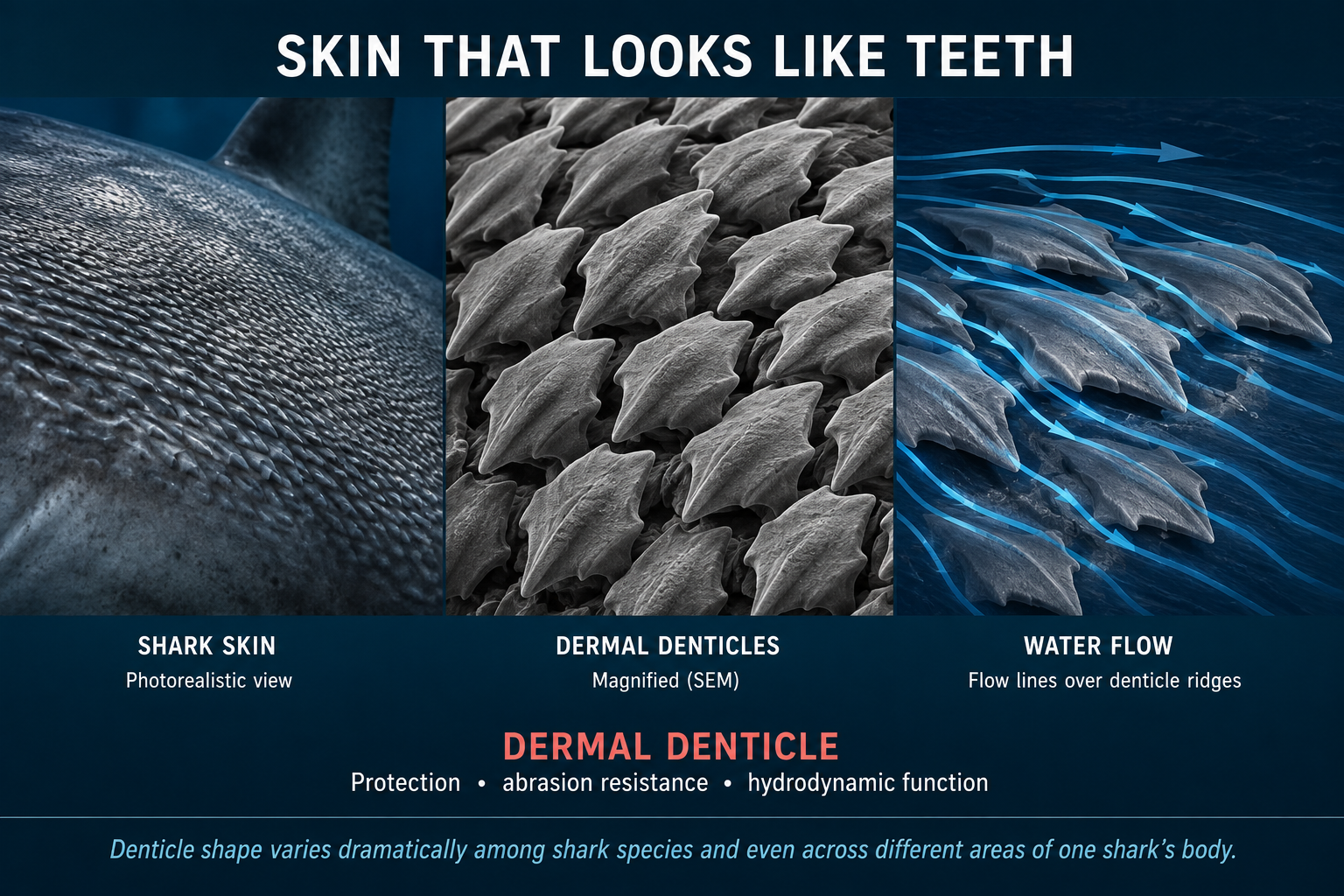
That texture comes from structures called dermal denticles, also known as placoid scales.
Under magnification they look remarkably tooth-like.
That resemblance is not superficial.
Teeth and denticles belong to the same broader class of mineralized structures called odontodes and share important developmental biology.
Each denticle has a hardened outer structure and is oriented along the body.
But saying:
“Shark skin reduces drag.”
is another example where the simple version misses something interesting.
Different sharks have very different denticles.
Fast-swimming pelagic sharks may possess ridged denticles associated with hydrodynamic performance.
Slow-moving bottom sharks may have denticles that appear more important for abrasion protection and defence.
Denticles vary even across different parts of the same animal.
Their function depends upon species, location and lifestyle.
A White Shark's Hydrodynamic Skin
The dermal denticles of white sharks are particularly interesting.
A 2024 study used micro-CT imaging to examine the three-dimensional structure of white-shark denticles and found different ridge arrangements potentially suited to different swimming speeds.
Hydrodynamic modelling suggested that some configurations could be advantageous around cruising speeds, while others could provide benefits at much higher burst speeds associated with hunting.
Think about what that means.
Shark skin is not simply armour wrapped around a swimmer.
The surface itself may participate in how water moves around the animal.
Engineers have spent decades trying to reproduce aspects of this design.
Evolution got there first.
So Sharks Have No Bones?
Here is another familiar statement:
Sharks don't have bones.
Broadly true.
But potentially misleading.
Sharks belong to the cartilaginous fishes, the Chondrichthyes.
Their internal skeletons are built primarily from cartilage rather than the bony tissue forming most of our skeleton.
But shark cartilage is not equivalent to the soft cartilage in your ear.
Much of the skeleton is reinforced.
The core may remain relatively unmineralized cartilage, while the exterior is covered in tiny mineralized tiles called tesserae.
Imagine a flexible structural core wrapped in microscopic armour.
That creates a composite material capable of resisting substantial mechanical loads while retaining properties different from conventional bone.
Even shark vertebrae contain heavily mineralized cartilage capable of enduring millions of swimming cycles and considerable repeated strain.
So the better statement is:
Sharks don't build their skeletons from conventional bone.
They build them from a highly specialized, often mineral-reinforced cartilage system.
That is not an inferior skeleton.
It is a different solution.
Why Cartilage?
It is tempting to assume cartilage evolved because it is simply lighter than bone.
Reality is more complicated.
The shark skeleton needs to:
support powerful muscles,
transmit swimming forces,
flex repeatedly,
resist compression,
grow with the animal,
and survive millions upon millions of movement cycles.
Tessellated cartilage provides a remarkable combination of stiffness and flexibility.
Scientists studying shark and ray skeletons increasingly view the structure as a sophisticated biological composite rather than primitive scaffolding.
Sharks have survived with variations of this skeletal strategy for hundreds of millions of years.
That alone should make us cautious about calling it primitive.
No Swim Bladder
Most familiar bony fishes possess a gas-filled swim bladder that helps control buoyancy.
Sharks do not.
So how do they avoid simply sinking?
Part of the answer lies in one of their largest organs.
The liver.
Shark livers can contain substantial quantities of low-density oils, particularly squalene and other lipids, which reduce the animal's overall density.
The liver can therefore function as part of the shark's buoyancy system.
But again, there is no universal shark design.
Many sharks combine liver buoyancy with dynamic lift generated by body shape, pectoral fins and forward swimming.
And the old assumption that sharks are always negatively buoyant is not universally true.
Researchers studying deep-sea bluntnose sixgill and prickly sharks found evidence that those species could actually be positively buoyant in their natural environments, allowing them to glide upward with little swimming effort.
Evolution has produced multiple solutions depending upon lifestyle.
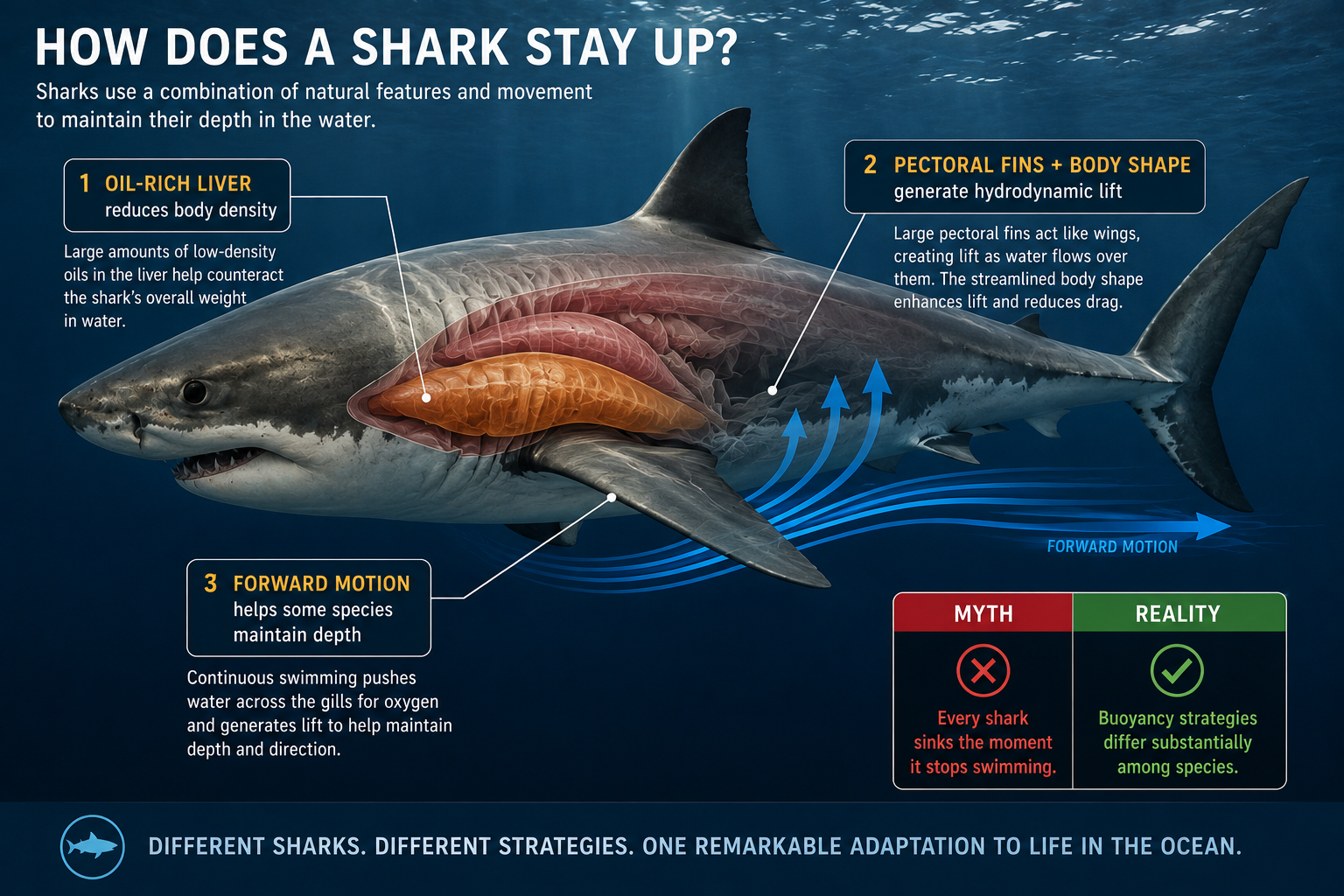
Does Every Shark Have to Keep Swimming?
No.
Another classic shark myth.
Some sharks do rely heavily—or entirely—on forward movement to push water across the gills.
This is called ram ventilation.
But many shark species can actively pump water across their gills while resting.
A bamboo shark lying on the bottom is not suffocating.
A nurse shark resting under a ledge is not breaking some fundamental rule of shark biology.
Different sharks ventilate differently.
That diversity reflects the same theme appearing throughout this article:
there is no single way to build a shark.
A mako built for sustained high-speed swimming has very different engineering requirements from a benthic bamboo shark spending hours resting on a reef bottom.
The Teeth Are Disposable
Now we arrive at perhaps the most famous part of shark anatomy.
The mouth.
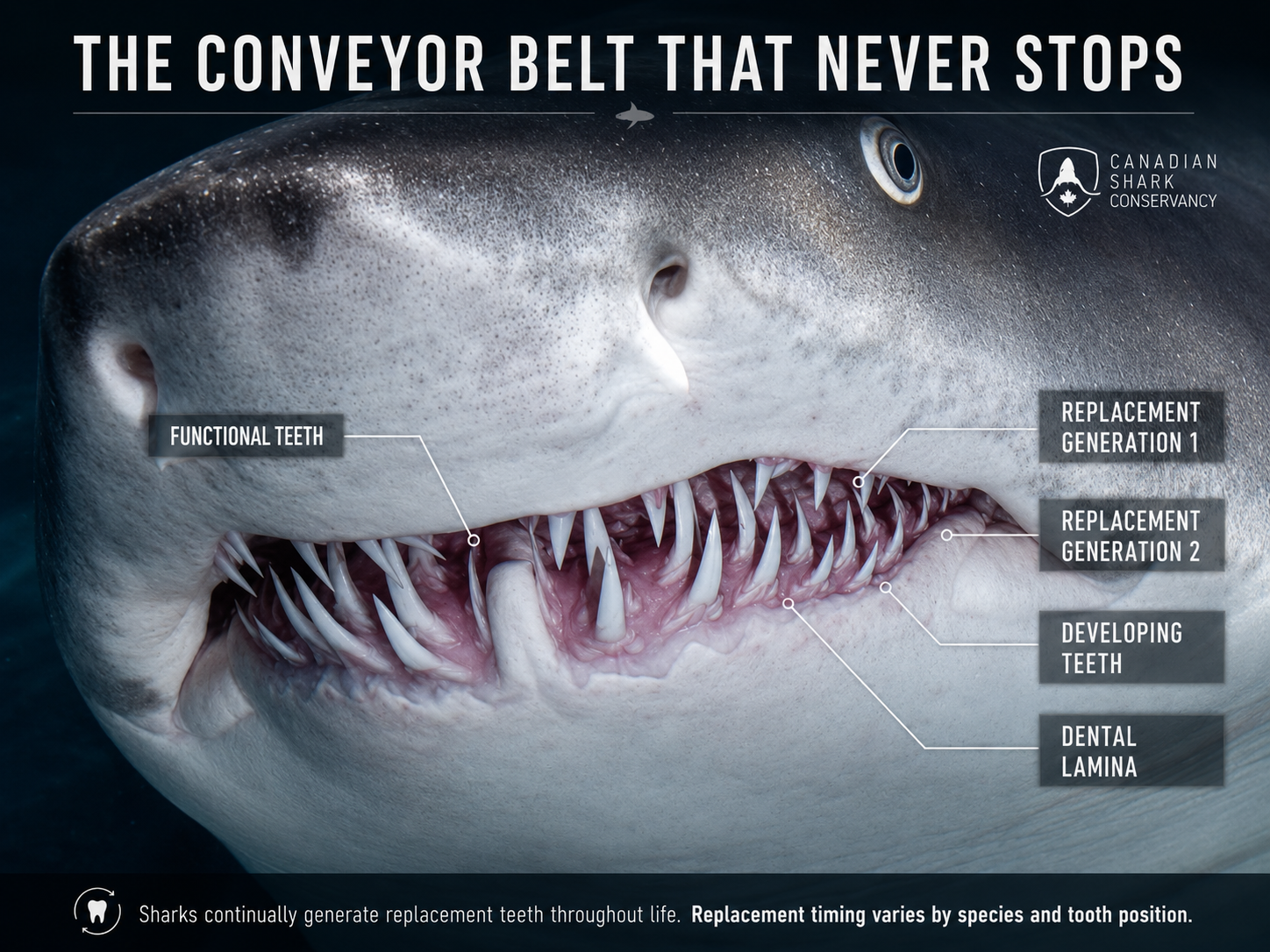
Shark teeth are not built to last a lifetime.
They are built to be replaced.
Behind the functional teeth lie developing generations organized within a structure called the dental lamina.
As teeth are lost or worn, replacements move forward into functional positions.
The process has often been compared to a conveyor belt—and while the actual developmental biology is more sophisticated than that analogy suggests, it captures the basic idea remarkably well.
Sharks are polyphyodont:
they continually generate replacement teeth throughout life.
Different species replace them at different rates and arrange them in different patterns, so claims like “every shark loses X teeth per week” should be treated cautiously.
There is no universal shark replacement rate.
What is universal among modern sharks is the extraordinary regenerative system behind the dentition.
Teeth Built for the Job
Not every shark tooth looks like a white shark's triangular serrated blade.
Because sharks eat very different things.
A white shark needs teeth suited to gripping and cutting large prey.
A mako has slender piercing teeth adapted for grasping fast-moving fishes.
Some bottom-feeding sharks possess flatter teeth suited for crushing hard prey.
Cookiecutter sharks possess a remarkable lower cutting arrangement capable of removing plugs of tissue.
Tooth morphology reflects feeding ecology.
The shark mouth is therefore another reminder that the word “shark” describes a wildly diverse group rather than one biological design.
A Shark Is Not One Design
Put four sharks beside one another.
A Greenland shark.
A salmon shark.
A mako.
An epaulette shark.
All four are sharks.
Yet the bodies solve completely different ecological problems.
The Greenland shark moves slowly through deep, cold northern water.
The salmon shark carries warm swimming muscles through the subarctic Pacific.
The mako is engineered for speed in the open ocean.
The epaulette shark can use its fins to move across shallow reef habitats in a manner that looks remarkably like walking.
There is no single perfect shark body.
There is only the body suited to the life each species lives.
That may be one of the most important lessons in shark biology.
Ancient Does Not Mean Primitive
Sharks belong to an ancient evolutionary lineage.
That sentence is often followed by another:
“They haven't changed for hundreds of millions of years.”
That is not really true.
Sharks have continued evolving.
Species have appeared.
Others disappeared.
Body forms changed.
Sensory systems diversified.
Teeth specialized.
Thermal physiology evolved.
Migration strategies developed.
Modern sharks are not prehistoric animals accidentally surviving into our world.
They are modern animals descended from an ancient lineage.
White sharks themselves are products of evolutionary history just as contemporary whales, birds and humans are.
Their body plans succeeded not because evolution stopped.
They succeeded because evolution continued refining them.
Built for the Ocean They Inhabit
In our first Shark Science interlude, we discovered that a shark's ocean is filled with information.
Sound.
Smell.
Light.
Movement.
Electricity.
Magnetic information.
But detecting those signals would mean little without a body capable of acting on them.
Regional endothermy allows certain sharks to carry high-performance tissues into cold water.
Dermal denticles turn skin into a complex biological surface.
Tessellated cartilage creates a skeleton unlike ours.
Oil-rich livers contribute to buoyancy without a gas-filled swim bladder.
Continually regenerating teeth ensure that losing one does not permanently compromise the feeding apparatus.
Every feature solves part of the same problem:
How do you build an animal that can survive in an ocean?
Evolution did not produce one answer.
It produced hundreds.
And that is why a slow Greenland shark beneath Arctic darkness and a white shark hunting off Nova Scotia can belong to the same extraordinary lineage while living almost completely different lives.
There is no single way to build a shark.
There is only the body each species needs for the ocean it inhabits.
RETURNING TO WHITE SHARKS IN CANADA
Part 4 — The Canadian Feeding Grounds
Where white sharks spend their northern season — and why those places matter
We now know how white sharks find their way through the ocean.
We know more about the extraordinary body that allows them to operate within it.
So we are ready to return to their journey.
When a white shark reaches Atlantic Canada, where does it actually go?
Nova Scotia.
The Scotian Shelf.
The Bay of Fundy.
The Gulf of St. Lawrence.
Newfoundland.
Some places appear repeatedly in sightings and telemetry.
Others remain tantalizing questions.
In Part 4 of White Sharks in Canada, we begin exploring the Canadian waters at the northern end of the migration—and ask which of them may matter most.
Research & Further Reading
Bernal and colleagues / lamnid physiology research. Lamnid sharks use counter-current vascular heat exchangers to retain metabolic heat in red muscle and other tissues, producing regional endothermy rather than whole-body mammalian-style endothermy.READ SOURCE ↗Bernal et al. — Mammal-like muscles power swimming in a cold-water shark. Research on salmon sharks demonstrates the extraordinary specialization of their warm aerobic swimming musculature.READ SOURCE ↗Weng et al. — Satellite tagging and cardiac physiology reveal niche expansion in salmon sharks. Salmon sharks use habitats ranging from subarctic waters near 2°C into much warmer temperate waters and possess cardiac adaptations supporting cold-water performance.READ SOURCE ↗Tokunaga et al. (2025) — Enhanced thermoregulation abilities of shortfin mako sharks. Modern biologging shows makos actively retaining and managing muscle heat as they move through strong ocean temperature gradients.READ SOURCE ↗Wen et al. / white-shark denticle research (2024). Three-dimensional analysis of white-shark dermal denticles suggests different ridge arrangements may confer hydrodynamic advantages at different swimming speeds.READ SOURCE ↗Dean and colleagues — Tessellated cartilage research. Shark and ray skeletons are built largely from cartilage reinforced by microscopic mineralized tesserae, creating a mechanically sophisticated alternative to a conventional bony skeleton.READ SOURCE ↗Nakamura et al. — Deep-sea shark buoyancy. Research on bluntnose sixgill and prickly sharks challenges the assumption that all sharks are negatively buoyant and demonstrates how diverse shark buoyancy strategies can be.READ SOURCE ↗Smith et al. / shark dental-lamina research. Sharks maintain an active dental lamina capable of producing replacement teeth throughout life.
Protect Sharks. Protect Our Oceans. Protect Our Future.