
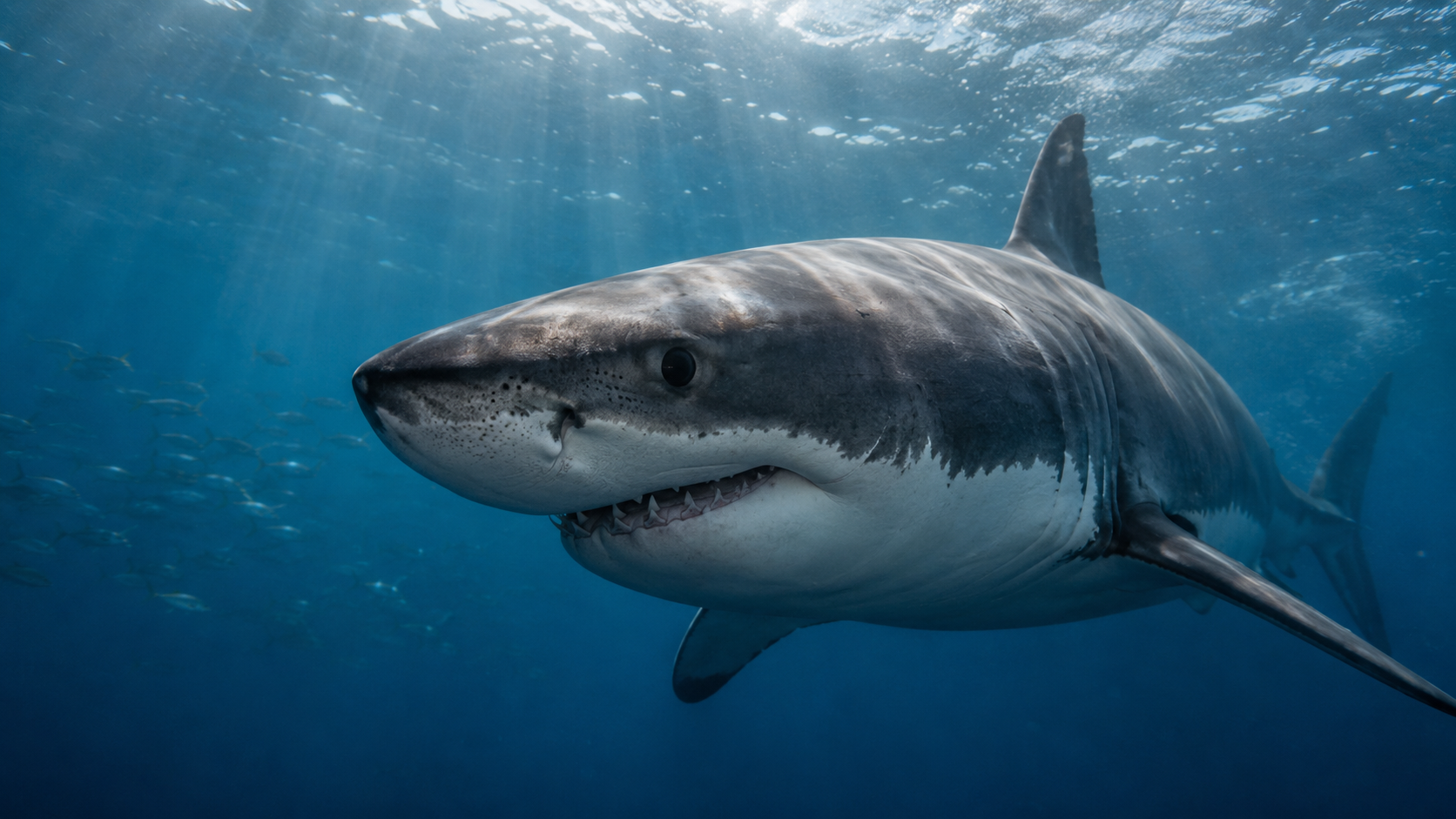
A white shark leaves Nova Scotia.
Months later, it may be hundreds or thousands of kilometres away.
Then, somehow, the direction changes.
It moves north again.
Past the southeastern United States.
Past the Carolinas.
Past New England.
Eventually, some of those sharks return to Atlantic Canada — sometimes to remarkably familiar parts of the coastline.
In White Sharks in Canada, we have been following that journey.
But there is another question hiding beneath the migration:
What does the ocean actually feel like to the shark making it?
We experience the sea primarily through our eyes.
A shark does not.
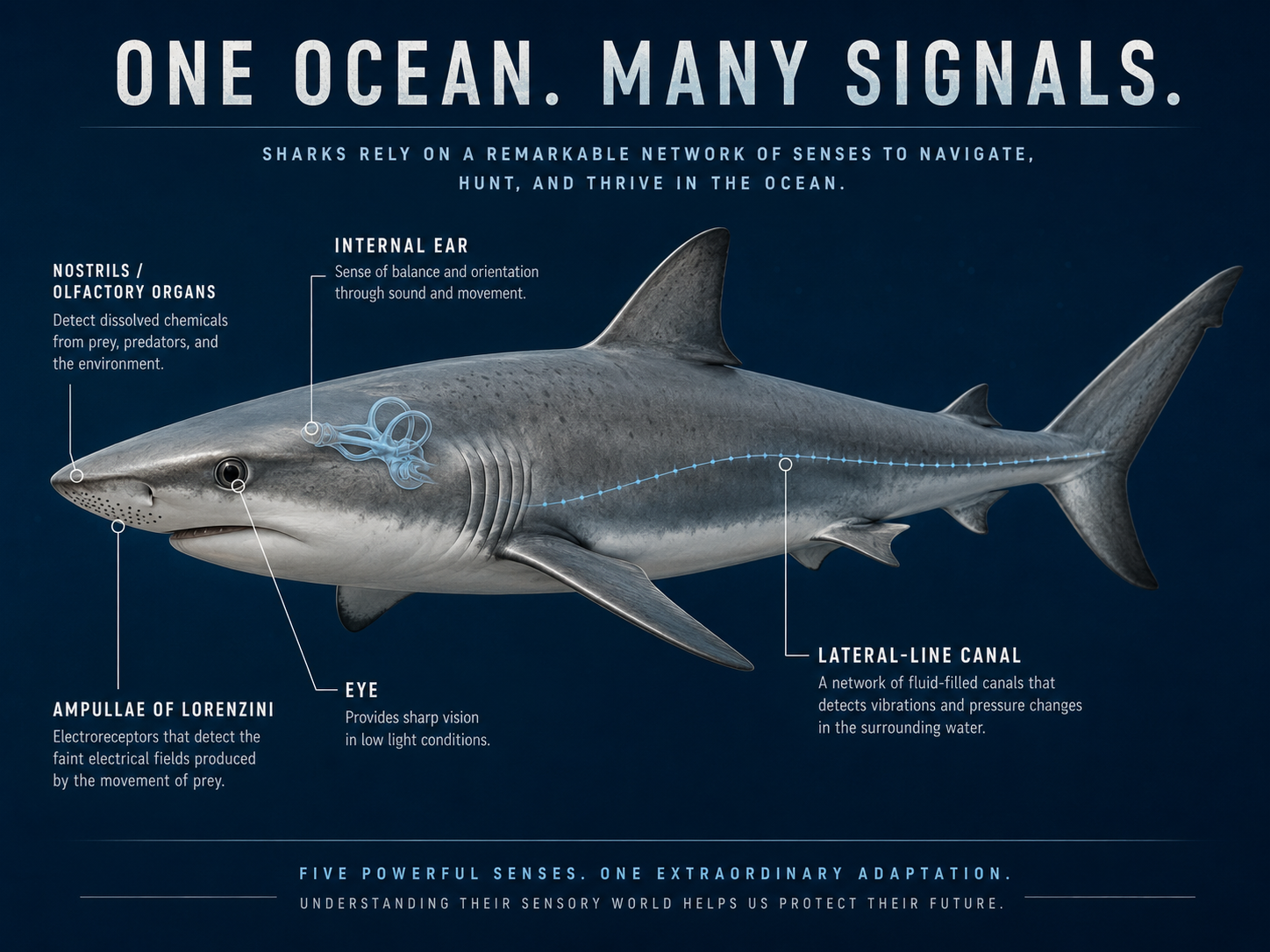
Its world is assembled from overlapping layers of information: sound and water movement, chemicals carried by currents, light and silhouette, pressure disturbances, tiny electrical fields — and perhaps even information contained in the Earth's magnetic field.
A shark is not swimming through an empty blue space.
It is swimming through a landscape filled with signals.
To understand how sharks cross oceans, locate prey and return to places they have visited before, we first need to understand something much more fundamental.
How does a shark read the ocean?
Hearing — Something Is Happening Out There
Look at a shark and one feature seems conspicuously absent.
Where are its ears?
There are no visible ear flaps.
No external openings resembling ours.
But sharks absolutely have ears.
Their paired inner ears are contained within the skull and contribute both to hearing and equilibrium. Behavioural experiments show that sharks respond particularly well to relatively low-frequency acoustic stimuli. In a 2023 study, scalloped hammerheads showed their greatest measured sensitivity around 200 Hz and responded to frequencies up to about 800 Hz. Other shark species differ, but low-frequency sensitivity is a recurring feature of elasmobranch hearing research.
That matters because the underwater world is full of low-frequency information.
A struggling fish.
An animal thrashing near the surface.
Movement around a reef.
Fishing activity.
A boat.
Something feeding.
Sound propagates extremely effectively through water, meaning hearing may provide information about activity before other short-range sensory systems become useful.
But sound does not necessarily tell a shark:
“There is food precisely 17 metres in that direction.”
It tells the animal something more fundamental:
Something is happening.
The shark can investigate.
And as it moves closer, additional senses begin joining the conversation.
Smell — Is There Really Blood in the Water?
No shark myth may be more persistent than this one:
A shark can smell a single drop of blood from miles away.
It is an irresistible story.
It also turns a sophisticated sensory system into something almost supernatural.
Sharks do have highly developed olfactory organs. Experiments have demonstrated responses to very small concentrations of biologically relevant chemicals, including amino acids and bile salts. Studies of scalloped hammerheads, for example, recorded measurable olfactory responses to amino acids at low concentrations and showed that sensitivity differs substantially depending on the particular chemical being detected.
But there is no universal scientific rule that says:
one drop + one shark + one mile = detection.
Odour underwater does not radiate outward in a perfect sphere.
It is transported by currents.
It becomes diluted.
It forms filaments, patches and turbulent plumes.
And even after a shark detects an odour, it still has to determine where the source is.
One remarkable experiment with smooth dogfish demonstrated exactly that. Sharks could smell an odour plume, but locating its source efficiently required information from the lateral line system as well. When lateral-line information was disrupted, their ability to track the odour source deteriorated substantially.
That tells us something important.
The shark's nose does not operate independently.
It works as part of a sensory network.
VERDICT
Sharks have an excellent sense of smell — FACT.
A universal ability to smell one drop of blood from miles away — MYTH.
The interesting truth is not that sharks possess a magical blood detector.
It is that they can extract useful chemical information from an extraordinarily complicated moving body of water.
Vision — What Does a Shark Actually See?
Sharks are sometimes portrayed as animals that barely need vision because their other senses are so remarkable.
That is wrong too.
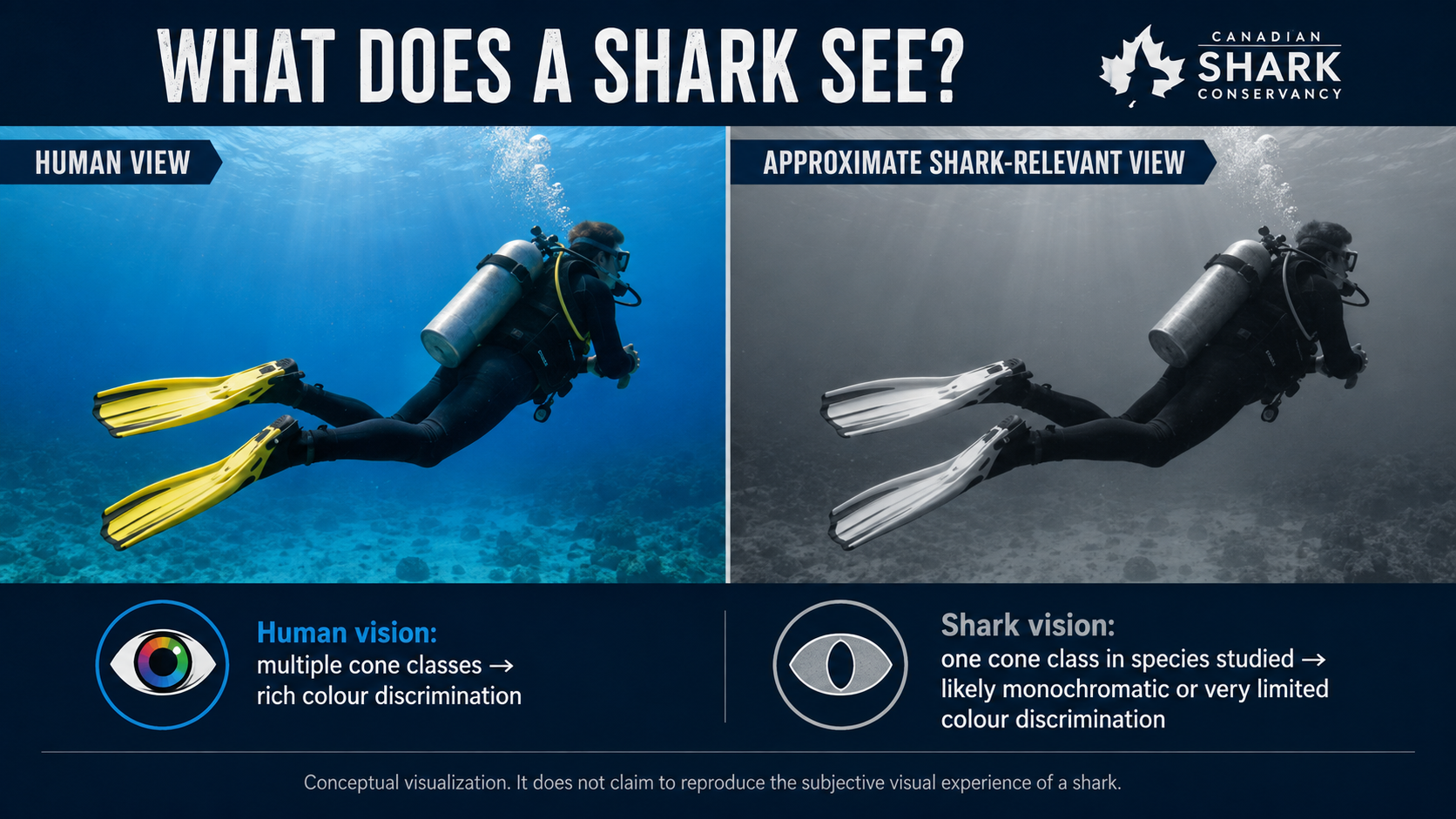
Shark eyes contain rods and cones, the same broad classes of retinal photoreceptors found in many vertebrates.
Rods are particularly important under low-light conditions and contribute strongly to detecting changes in brightness and movement.
Cones operate more effectively under brighter conditions and, in animals possessing multiple spectral cone types, can support colour discrimination.
Here is where shark vision becomes fascinating.
Researchers examining the retinal pigments of 17 shark species found that each possessed only one spectral class of cone. Subsequent molecular work across additional shark species has reinforced the conclusion that cone monochromacy is widespread among sharks studied so far.
Humans normally compare signals from three cone classes to perceive our rich world of colour.
A shark with only one cone class cannot perform that same comparison.
That means many sharks probably experience colour very differently from us — and may lack conventional colour vision altogether.
Which brings us to one of diving's favourite pieces of shark folklore.
Yum-Yum Yellow?
For decades divers, surfers and sailors have joked about:
“Yum-yum yellow.”
The idea is that sharks have some particular attraction to bright yellow.
Yellow fins.
Yellow wetsuits.
Yellow life jackets.
Yellow rafts.
Even yellow equipment.
But if a shark cannot perceive colour in the way humans do, how can it have a special preference for yellow?
The better answer is probably contrast.
The International Shark Attack File notes that bright or highly contrasting equipment can be conspicuous underwater, while the idea of a unique attraction to yellow is not supported by what is known about shark colour vision.
And experiments with white sharks provide an especially interesting clue.
In 2024, researchers working with white sharks in South Africa tested seal-shaped decoys viewed from below. By illuminating the underside of the decoys and reducing their dark silhouette against the brighter surface, researchers substantially reduced shark bites on the targets.
That suggests the shark may care less about:
“What colour is that?”
and more about:
“How strongly does that object stand out?”
Shape.
Movement.
Brightness.
Contrast.
Silhouette.
Those cues may be far more important than hue.
VERDICT
Sharks have a special appetite for yellow — MYTH.
Bright yellow equipment may sometimes be highly visible because of contrast — PLAUSIBLE.
Contrast and silhouette matter to white sharks — SUPPORTED BY EXPERIMENTAL EVIDENCE.
The Lateral Line — Feeling Movement Without Touching It
Now imagine visibility disappears.
The water becomes murky.
Something moves nearby.
The shark still has another way of knowing.
Running along each side of its body and around portions of the head is the lateral line system.
Inside canals and surface structures are sensory hair cells known as neuromasts.
They respond to mechanical disturbances in the surrounding water.
A swimming animal pushes water.
A struggling fish produces irregular movement.
Something turning nearby changes pressure and flow.
The lateral line allows a shark to detect part of that mechanical world without touching the object creating it.
Experiments have demonstrated that this system is not simply an anatomical curiosity. When researchers interfered with lateral-line function in sharks attempting to find an odour source, their ability to accurately locate that source declined. Olfaction told them something interesting was present; hydrodynamic information helped tell them where to go.
Once again, we find senses cooperating.
Smell does not replace the lateral line.
The lateral line does not replace vision.
They overlap.
Electroreception — Something Alive Is Right Here
Look closely at the snout of a shark.
You may notice tiny dark pores scattered across the skin.
They are openings to one of the most remarkable sensory systems among vertebrates.
The ampullae of Lorenzini.
Each pore leads into a gel-filled canal connected to sensory receptor cells.
Together these organs allow sharks and other elasmobranchs to detect extremely weak electrical fields in their surroundings.
And living animals produce electrical fields.
Every muscle contraction involves electrical activity.
So does nerve activity.
A fish buried beneath sand may be visually hidden.
Its body's electrical activity is not.
Classic experiments demonstrated that sharks respond to artificial dipole electric fields designed to mimic the fields associated with prey, helping establish electroreception as a genuine prey-detection sense rather than speculation.
But there is a crucial limitation.
This is primarily a close-range sensory system.
The ampullae are extraordinary.
They are not magic radar.
And that distinction brings us directly into some of the strangest claims being made about sharks today.
The Electric Ocean
Electroreception sounds so extraordinary that it is easy to turn it into an explanation for almost anything a shark does.
A shark approaches fishing gear?
Electricity.
A shark bites a boat engine?
Electricity.
A shark swims toward a diver with a camera?
Electricity.
A ship sinks?
Somebody eventually claims the sharks somehow “felt” it.
Some of these ideas contain reasonable questions.
Others stretch the biology far beyond the evidence.
So let's investigate them.
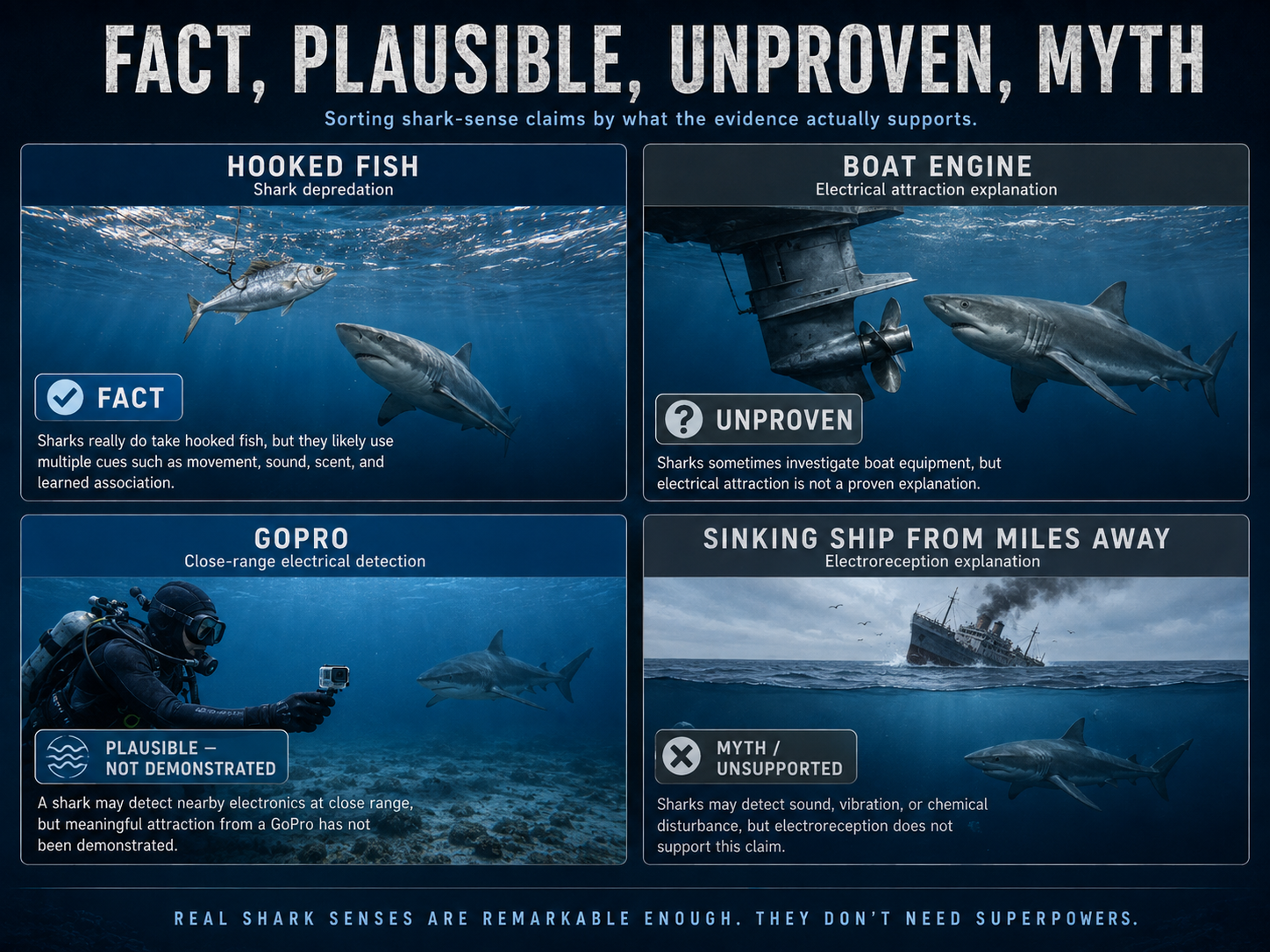
Are Sharks Stealing Fishermen's Fish?
FACT — the behaviour is real.
When a shark takes or damages a hooked fish before the angler can retrieve it, the event is known as shark depredation.
It has become important enough in U.S. fisheries that NOAA Fisheries is developing a national strategy to better understand the phenomenon. NOAA notes that increasing reports may involve several factors, including learned behaviour, fishing effort, fish-release practices and changes in some shark populations.
But what sensory cue tells the shark a meal is available?
Probably not just one.
A hooked fish can produce:
- abnormal movement;
- low-frequency vibration;
- hydrodynamic disturbance;
- scent;
- visual cues;
- biological electric fields.
Fishing itself can also provide repeatable cues.
The International Shark Attack File notes that struggling hooked fish generate vibrations capable of drawing sharks toward fishing activity.
And sharks may learn.
If an animal repeatedly discovers an easy meal around boats or fishing activity, association and experience could become part of the behaviour. NOAA specifically identifies potentially learned behaviour as one of the questions being investigated in depredation research.
There is also a wonderful twist.
If electricity automatically attracted sharks, then electrical shark deterrents should make depredation worse.
Instead, a randomized 2026 fishing experiment at the Cocos (Keeling) Islands found that a purpose-built electrical deterrent reduced shark depredation around hooked fish.
So the lesson is:
Sharks detect electricity.
That does not mean:
electricity = food.
Depending on strength and context, an electrical field may help a shark investigate something — or drive it away.
VERDICT
Sharks take hooked fish — FACT.
They find those fish solely because they detect fishing-line electricity — UNSUPPORTED.
Multiple sensory cues and potentially learned behaviour are better explanations.
Why Do Sharks Bite Boat Engines?
Sharks sometimes bite or investigate boats and submerged equipment.
The International Shark Attack File even maintains boat bites as a distinct incident category; four were documented in its 2025 worldwide summary.
But here we need to separate the observation from the explanation.
An operating motor creates:
sound,
vibration,
water displacement,
turbulence,
movement,
visual contrast,
and electrical activity.
A shark possesses sensory systems capable of detecting several of those.
Which one caused a particular shark to investigate an engine?
We generally don't know.
I could find no strong experimental evidence demonstrating that sharks bite boat motors specifically because they are attracted to the motor's electromagnetic field.
VERDICT
Sharks sometimes bite or investigate boat equipment — FACT.
Electrical fields are the proven reason — UNPROVEN.
A scientifically responsible answer is less dramatic but more interesting:
the shark may be evaluating an unusually strong multisensory object.
Can Sharks Detect a Sinking Ship From Miles Away?
This story has existed in different forms for generations.
A ship is damaged.
Somehow sharks “know.”
The modern version occasionally attributes the phenomenon to electroreception.
That explanation does not fit what we know about the ampullae of Lorenzini.
Electroreception is exquisitely sensitive to weak local electrical fields, and experimental work demonstrates responses to prey-like electric dipoles. It does not provide evidence for a shark detecting the tiny electrical signature of a distant vessel across miles of ocean.
Could sharks become aware of a maritime disaster?
Certainly.
A damaged or sinking vessel can create:
massive mechanical disturbance,
low-frequency sound,
vibration,
objects and animals entering the water,
food or biological material,
and chemical cues dispersed by currents.
The International Shark Attack File maintains a separate category for air/sea disasters, reflecting that shark interactions can occur in these circumstances.
But that is very different from saying:
“The shark's electrical sense told it a ship was sinking several miles away.”
VERDICT
Sharks may detect disturbances associated with a maritime disaster — PLAUSIBLE.
Ampullae of Lorenzini detect a sinking ship from miles away — MYTH / UNSUPPORTED.
Can a Shark Detect Your GoPro?
Now we reach one of the most interesting questions for divers.
A recurring claim is that sharks may investigate GoPros or other battery-powered cameras because the electronics produce small electrical fields.
Is that possible?
At close range, it is biologically plausible that an artificial electric field could fall within the sensory world of an electroreceptive shark. Experiments have repeatedly shown sharks responding behaviourally to artificial electrical stimuli.
But I could find no peer-reviewed experiment demonstrating that a normally operating GoPro attracts sharks from a meaningful distance.
And even if a shark approaches a camera, there are several competing explanations.
The camera may:
move;
reflect light;
create strong contrast;
sit at the end of a pole extending away from the diver;
produce vibration;
or simply be an unfamiliar object positioned directly in the animal's path.
This is a perfect example of why we should not take a real biological ability and automatically assign every shark behaviour to it.
VERDICT
Could a shark potentially detect electrical activity from electronics at sufficiently close range? — PLAUSIBLE.
Do we have evidence that GoPros act as meaningful long-range shark attractants? — NO.
Does a shark approaching a GoPro prove it detected the battery? — NO.
That doesn't mean a dive operator is wrong to establish conservative equipment rules.
It means the proposed biological explanation should not be presented as established fact without evidence.
Then There Is the Earth's Magnetic Field
Everything we've discussed so far involves detecting information relatively nearby.
But sharks also undertake extraordinary migrations.
Some white sharks cross huge portions of ocean and later return toward areas used in previous years.
How?
One possibility sounds almost unbelievable.
The planet itself may provide part of the map.
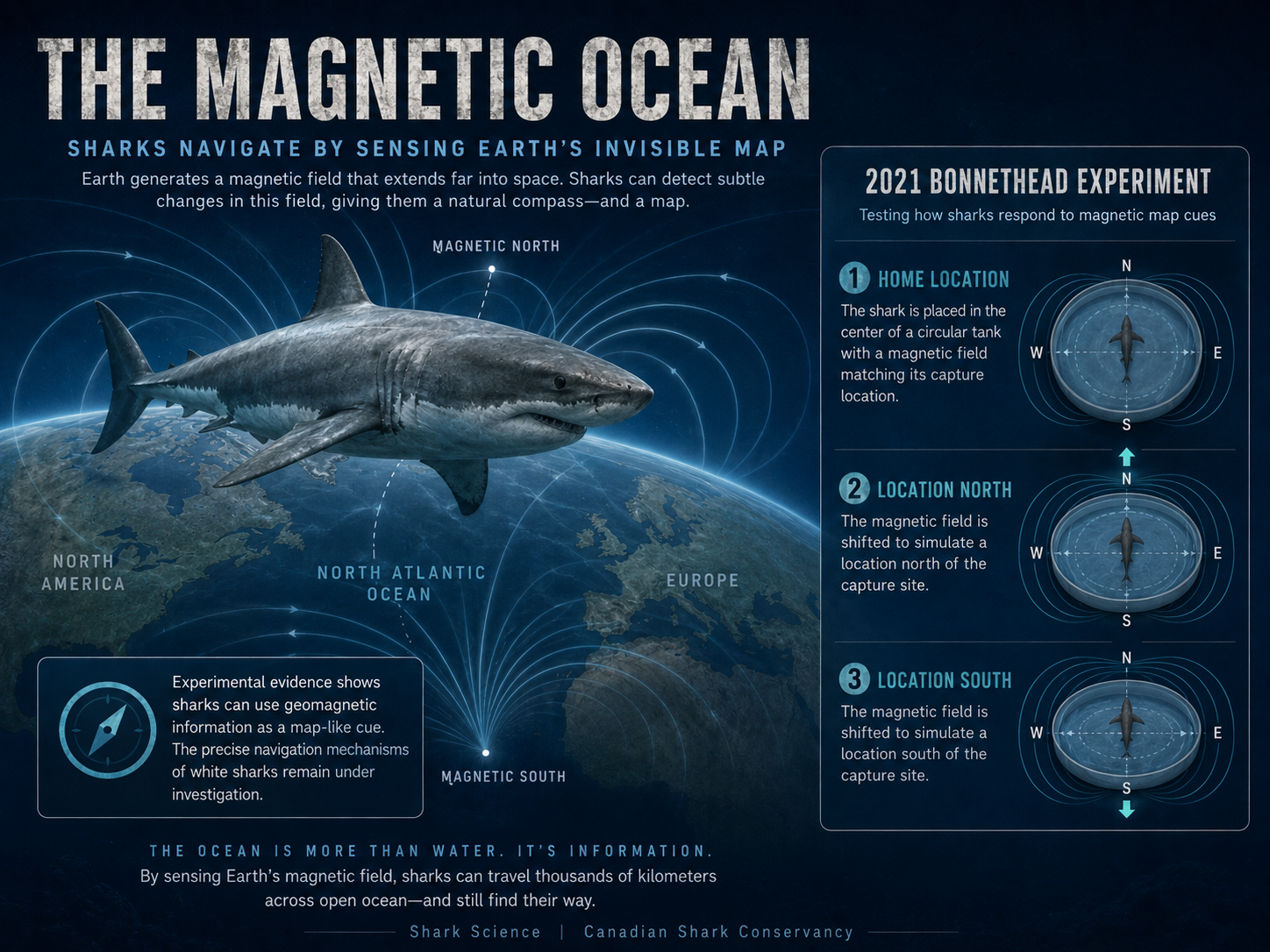
In 2021, researchers conducted magnetic-displacement experiments with wild-caught bonnethead sharks.
Instead of physically transporting the sharks hundreds of kilometres, they altered the magnetic field surrounding the animals so that it mimicked magnetic conditions from distant geographical locations.
When exposed to a magnetic field representing a location south of their home area but within their natural range, the sharks oriented in the direction that would take them home.
The experiment provided evidence that sharks can use spatial information contained within Earth's magnetic field as a map-like navigational cue.
This does not prove that every shark species uses exactly the same system.
And it does not yet tell us precisely how white sharks navigate between the southeastern United States and Canada.
But it demonstrates that at least one shark species can extract geographical information from the geomagnetic environment.
Suddenly the migration we've been following in White Sharks in Canada looks different.
A shark leaves Nova Scotia.
Thousands of kilometres pass beneath it.
Months go by.
Then it turns north again.
The ocean may appear featureless to us.
To the shark, it may contain information everywhere.
A Shark Does Not Have One Super Sense
Perhaps the greatest misconception about shark senses is not any one myth.
It is the idea that sharks depend upon one extraordinary sense at a time.
The smell of blood.
An electrical field.
A vibration.
A silhouette.
Real animals are more sophisticated than that.
A shark approaching a potential prey item may first become aware of low-frequency activity.
Chemical information may tell it that something biologically interesting is present.
The lateral line may reveal how something nearby is moving through the water.
Vision may supply shape, movement and contrast.
Electroreception may become especially useful during the final close-range investigation.
And on the much larger scale of migration, environmental and possibly geomagnetic information may help orient the journey.
The senses overlap.
They confirm.
They contradict.
They fill gaps left by one another.
That is why a shark can function in darkness, murky water, open ocean and complicated coastal environments.
It does not merely see the ocean.
It reads it.
Seeing the Ocean Differently
Imagine standing beside the Atlantic.
To us, the surface may appear almost empty.
A blue horizon.
Waves.
Wind.
Perhaps a seabird.
A white shark beneath that surface inhabits a very different informational world.
It can hear disturbances we cannot hear.
Detect chemical traces we cannot smell.
Feel movements we cannot feel.
See contrasts differently than we do.
Sense electrical fields our bodies do not consciously perceive.
And perhaps extract navigational information from a planetary magnetic field invisible to us.
No single one of those abilities makes a shark supernatural.
Together they make it exquisitely adapted to the ocean it inhabits.
And perhaps that is the larger lesson.
For centuries, we have explained sharks by imagining what we would experience if we were underwater.
The shark has never experienced the ocean that way.
Its ocean is richer.
More layered.
Filled with signals.
And once we begin understanding those signals, behaviours that once seemed mysterious start becoming biological.
The shark does not need mythology.
The science is extraordinary enough.
NEXT — SHARK SCIENCE INTERLUDE 2
Cold Blood, Warm Muscles
How a shark's body is built to survive its ocean
We have explored how sharks perceive their world.
Next we look inside the animal itself.
Are sharks really cold-blooded?
Why can a white shark, porbeagle or salmon shark keep parts of its body warmer than the surrounding sea?
Why does shark skin feel like sandpaper?
Why is the skeleton cartilage instead of bone?
How does a shark stay afloat without a swim bladder?
And how can it replace thousands of teeth during a lifetime?
The first interlude explains how a shark reads the ocean.
The second will explain how its body lets it conquer it.
Research & Further Reading
Hart et al. (2011) — Microspectrophotometric evidence for cone monochromacy in sharks. Researchers examined 17 shark species and found a single spectral cone class in each, providing strong evidence that many sharks lack conventional colour vision.READ SOURCE ↗Hart et al. (2025) — Widespread and convergent evolution of cone monochromacy in sharks. More recent work expanded the evidence that cone monochromacy is widespread in sharks.READ SOURCE ↗Ryan et al. (2024) — Counterillumination reduces bites by Great White sharks. Experimental work demonstrated the importance of silhouette and contrast in white-shark predatory responses.READ SOURCE ↗Gardiner & Atema (2007) — Sharks need the lateral line to locate odor sources. The study provides an excellent demonstration of different shark sensory systems operating together.READ SOURCE ↗Kalmijn (1982) — Electric and magnetic field detection in elasmobranch fishes. Foundational experimental work established shark responses to artificial electric fields resembling those generated by prey.READ SOURCE ↗Keller et al. (2021) — Map-like use of Earth's magnetic field in sharks. Magnetic-displacement experiments with bonnetheads demonstrated that sharks can use geomagnetic information as a navigational map cue.READ SOURCE ↗Nieder et al. (2023) — Operant conditioning as a tool to assess hearing abilities in sharks. Behavioural experiments measured low-frequency hearing capabilities in scalloped hammerheads and rig sharks.READ SOURCE ↗NOAA Fisheries — Shark Depredation Strategy. Current federal research is examining increasing reports of sharks taking hooked catches and the roles of behaviour, fisheries and shark populations.READ SOURCE ↗Protect Sharks. Protect Our Oceans. Protect Our Future.