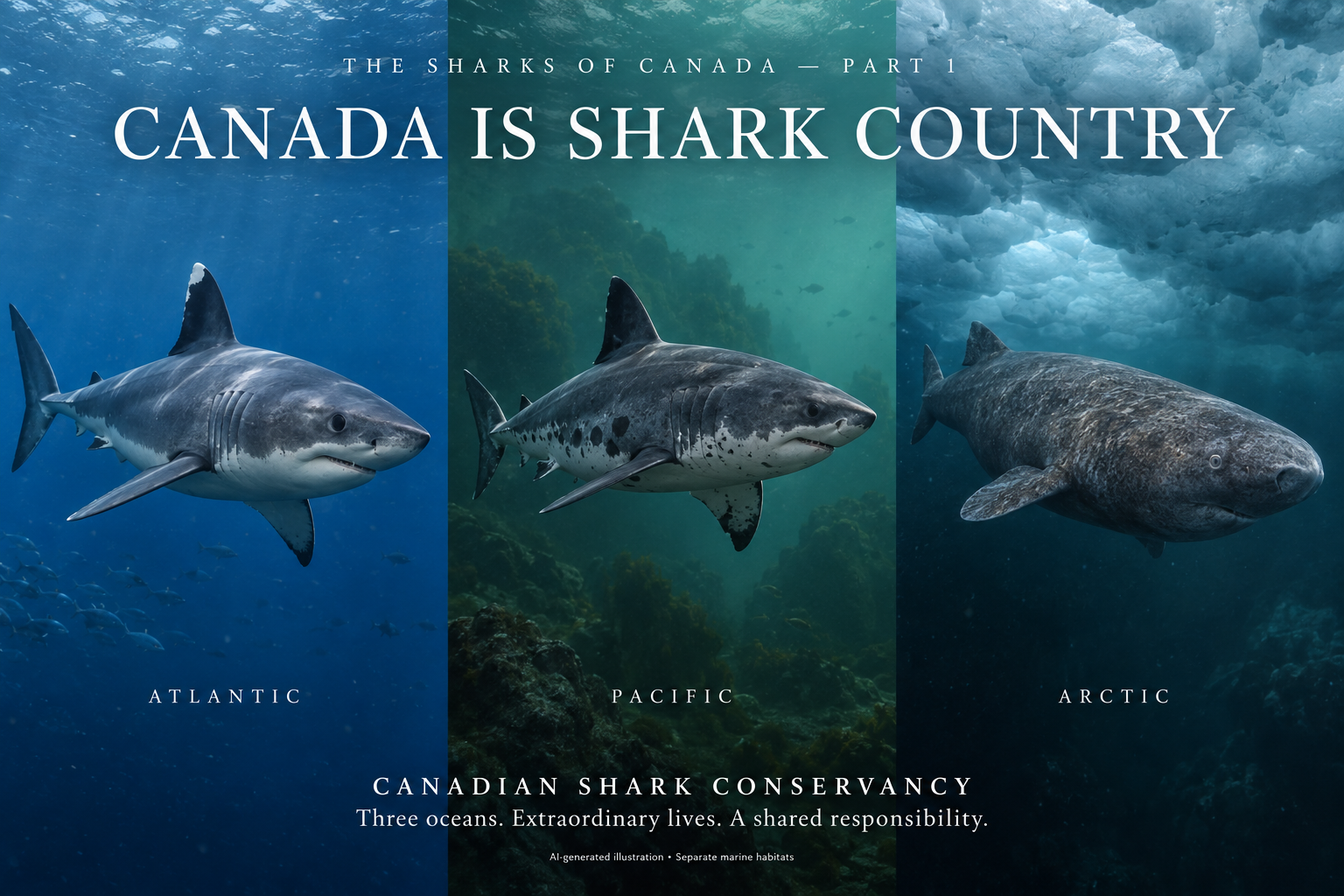
From Atlantic migration routes to Pacific coastal depths and Arctic waters, sharks are part of Canada’s marine wildlife. Three oceans, connected by a responsibility to understand and protect the lives beneath their surfaces.
Hero: AI-generated illustration of separate Canadian marine habitats; not a documentary photograph.
Stand on a Canadian shoreline and look outward.
On the Atlantic coast, fog softens the horizon. Swells move past rocky headlands, and seabirds circle above water whose surface reveals little of what lies beneath.
On the Pacific coast, forests meet salt water. Kelp moves with the surge, while beyond the shoreline, the seabed descends into channels and depths that sunlight barely reaches.
Farther north, ice, open water and long seasonal changes shape another ocean world.
These places look different. They feel different. Yet each belongs in the story of Canada’s sharks.
For many people, that connection still comes as a surprise. Sharks call to mind tropical reefs, Australian beaches, or the warm blue waters of the Caribbean. Canada brings other animals to the imagination: bears, moose, beavers, whales.
But sharks are part of this country’s wildlife, too.
They move through offshore waters, inhabit deep coastal environments, and follow seasonal opportunities across ocean boundaries. Some are enormous. Others could pass unnoticed beside the animals that usually capture our attention.
Their presence invites us to look at Canada differently—and to look beneath the surface for longer.
An ocean country with a hidden cast
Canada’s shark story extends well beyond the white shark.
In Atlantic waters, porbeagles undertake migrations that carry them through Canadian and international waters. Shortfin makos use offshore Canadian habitat seasonally, particularly in summer and autumn. Their movements connect the waters off our coast with a much larger North Atlantic world. Fisheries and Oceans Canada: porbeagle research, shortfin mako research
British Columbia has its own remarkable roster: salmon sharks, Pacific sleeper sharks, bluntnose sixgills, blue sharks, tope and North Pacific spiny dogfish. The brown catshark adds a smaller, less familiar presence to this diversity. DFO’s identification guide describes an animal reaching approximately 68 centimetres—an important reminder that the word “shark” encompasses far more than the large predators of popular imagination. DFO: Sharks of British Columbia
In Arctic and Atlantic waters, the Greenland shark brings another dimension. Its Canadian range includes waters around Baffin Island, the Gulf of St. Lawrence and the Scotian Shelf. A shark associated with the far north also belongs to the deep-water story of eastern Canada. DFO: Greenland shark
Together, these animals broaden our picture of Canadian marine life.
A shark may be travelling through a seasonal feeding area, moving along the continental shelf or living at depths where a person is unlikely ever to see it. A quiet surface tells us very little about the lives below.
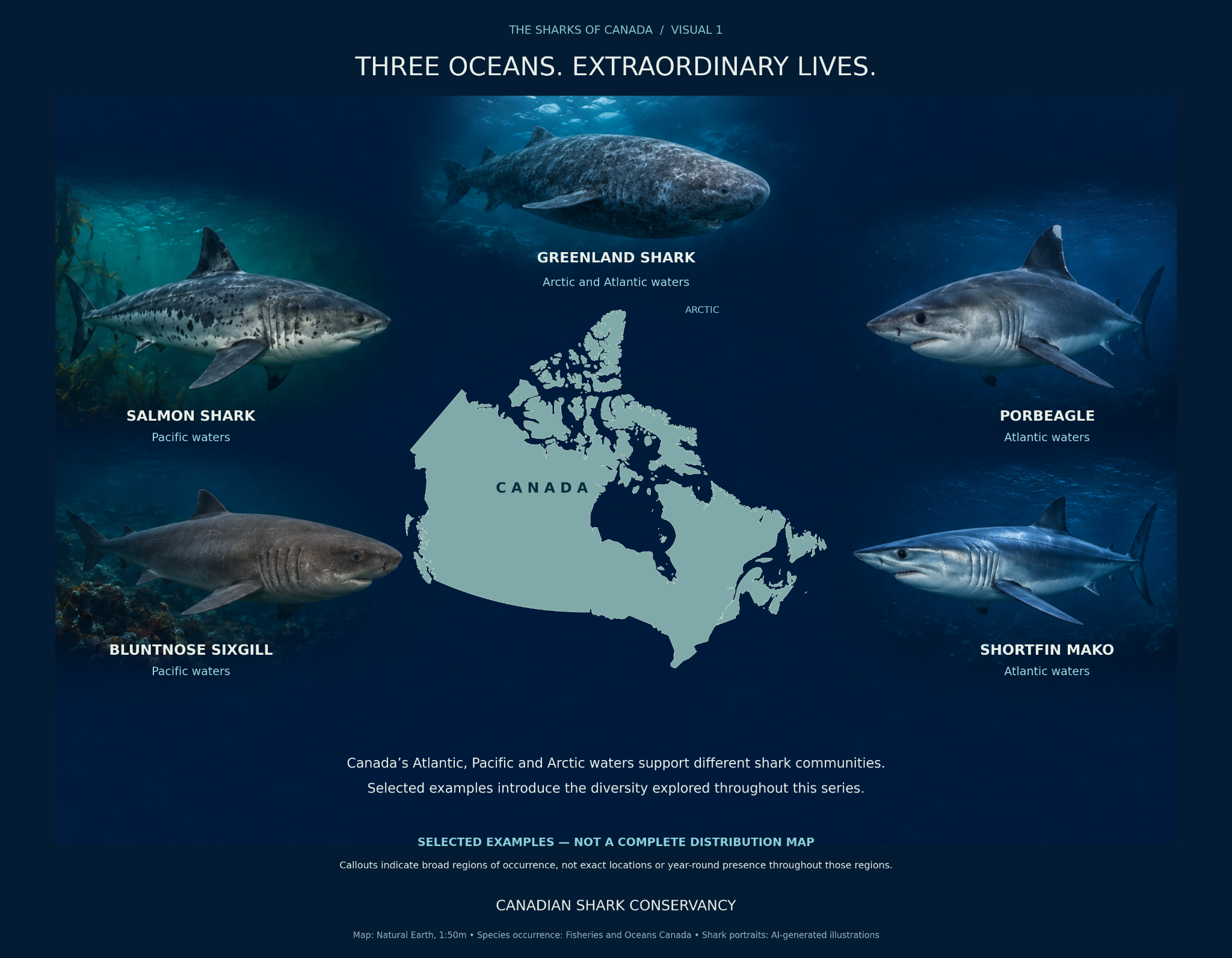
Canada’s Atlantic, Pacific and Arctic waters support different shark communities. These selected examples introduce the diversity explored throughout this series.
Selected examples—not a complete distribution map. Callouts indicate broad regions of occurrence, not exact locations or year-round presence throughout those regions.
Canadian Shark Conservancy · AI-generated shark illustrations · Map: Natural EarthView full-size visual ↗What does it mean to call a shark Canadian?
The title of this series describes a relationship with Canadian waters.
That relationship takes different forms.
Some sharks inhabit these waters throughout the year. Others arrive seasonally and leave when conditions change. Some species are represented by rare records, with long intervals between confirmed observations.
Those distinctions matter.
DFO’s British Columbia guide, for example, identifies white sharks, common threshers and Pacific angelsharks as rare in provincial waters. It also includes an unconfirmed lantern shark entry. A documented occurrence, a recurring pattern, and an unresolved identification are different kinds of evidence. DFO: Sharks of British Columbia
We should carry those differences into the stories we tell.
A single sighting cannot establish that a population is growing. An unusual visitor cannot, by itself, demonstrate that a species has established new habitat. Equally, a lack of photographs cannot tell us that a deep-water animal is absent.
Throughout this series, we will ask where the evidence comes from, what it supports and what remains uncertain.
That approach allows the wonder to survive scrutiny.
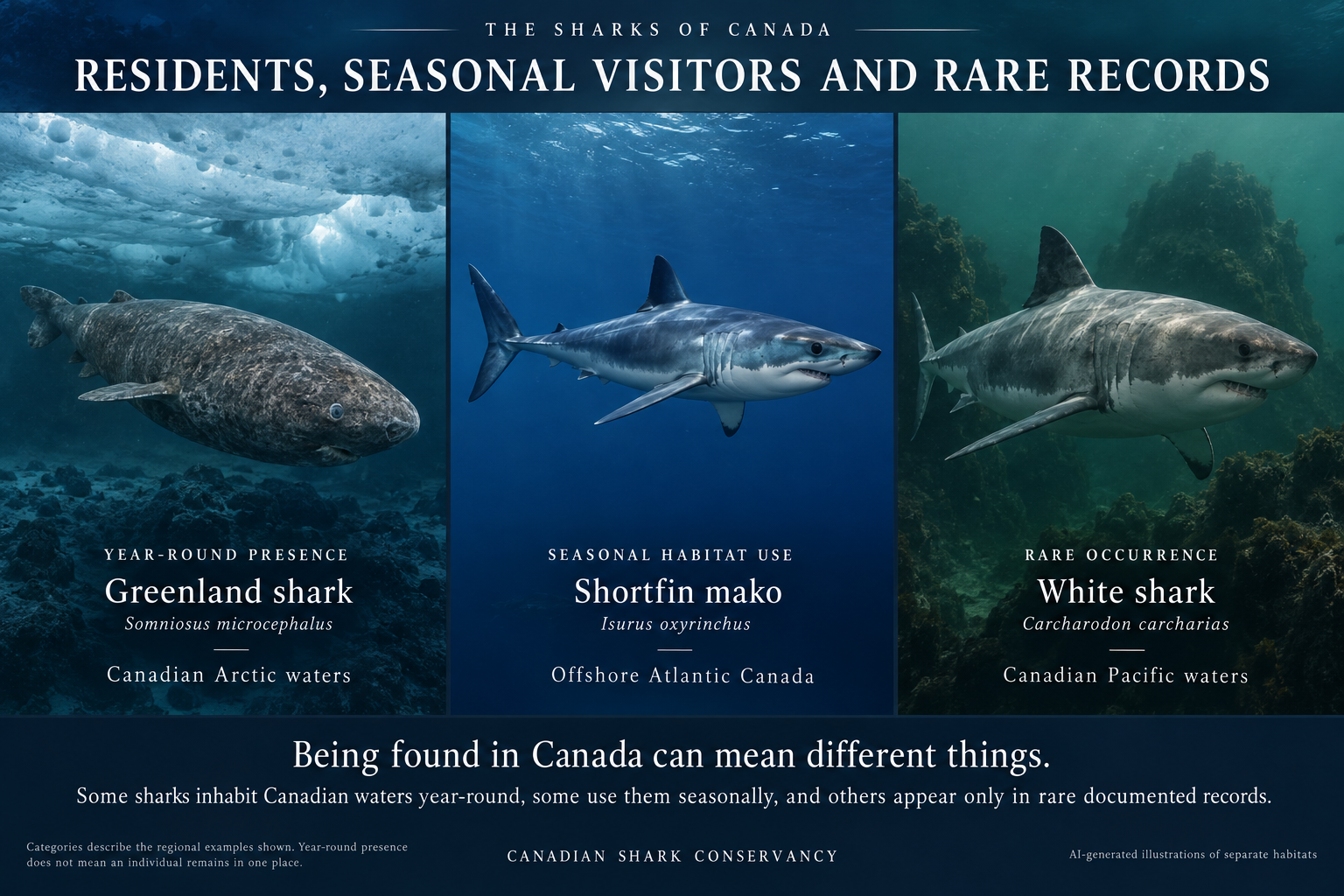
Being found in Canada can mean different things. Some sharks inhabit Canadian waters year-round, some use them seasonally and others appear only in rare documented records.
Categories describe the regional examples shown. Year-round presence does not mean an individual remains in one place.
Canadian Shark Conservancy · AI-generated shark illustrationsView full-size visual ↗Lives that challenge our sense of time
Some sharks ask us to reconsider something as familiar as a lifetime.
In 2016, researchers studying Greenland sharks used radiocarbon measurements from eye-lens tissue to investigate their ages. Their findings supported lifespans of at least 272 years, with substantial uncertainty around individual age estimates. The research provided evidence that these animals can live for centuries. Nielsen and colleagues, Science, 2016
It is difficult to hold that timescale in mind.
We measure plans in weeks, careers in decades and conservation projects in funding cycles. An animal capable of living across centuries asks us to consider consequences far beyond those familiar horizons.
Other sharks will introduce different questions: how they move through cold water, how they find food, where they reproduce, and how long it takes their populations to replace animals that are lost.
Many shark species grow relatively slowly, mature late, and produce comparatively few young. Those traits can make them vulnerable to excessive fishing and can mean that recovery takes considerable time. The details differ between species, which is why each deserves its own examination. NOAA Fisheries: Shark Conservation
Understanding a shark’s biology helps us understand the scale of our responsibility.
The history we need to remember
Canada’s relationship with sharks includes chapters that are uncomfortable to revisit.
Basking sharks were historically abundant in parts of British Columbia. Their immense bodies became entangled in salmon fishing gear, creating conflict with the fishing industry. Between 1955 and 1969, a government eradication program deliberately killed basking sharks in Barkley Sound. DFO: Basking shark
The animal at the centre of that campaign was a plankton-feeding giant.
Today, that history deserves a place in how we understand Canadian conservation. It shows how an animal’s perceived inconvenience can shape its treatment—and how decisions made within one period can leave consequences that extend far beyond it.
The federal recovery strategy documents the severe historical decline of Pacific basking sharks and the difficulties involved in their recovery. Government of Canada: Pacific basking shark recovery strategy
Remembering this history gives purpose to the work ahead.
It asks us to examine the assumptions behind our decisions while there is still time to change their effects.
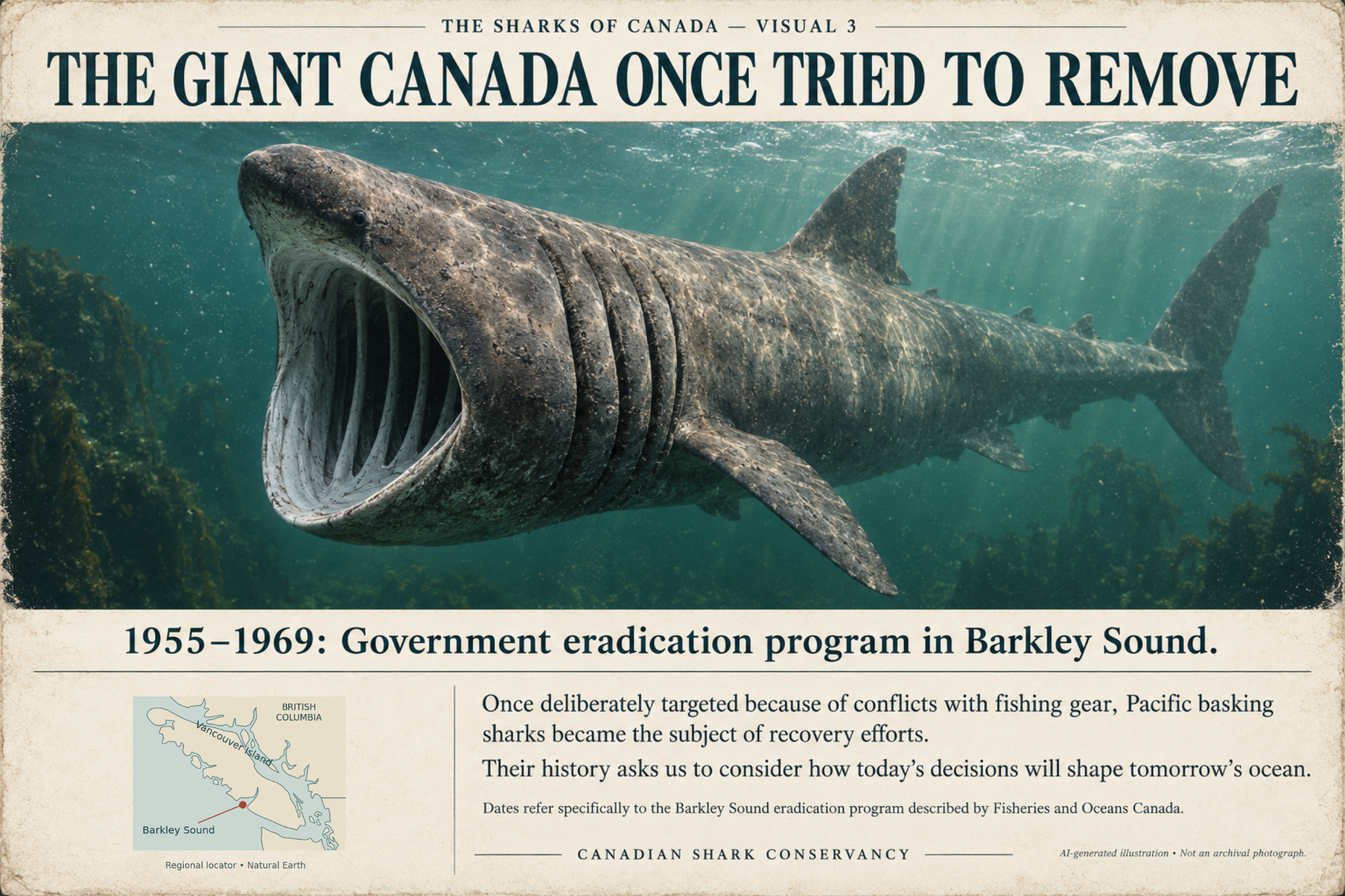
Once deliberately targeted because of conflicts with fishing gear, Pacific basking sharks became the subject of recovery efforts. Their history asks us to consider how today’s decisions will shape tomorrow’s ocean.
Dates refer specifically to the Barkley Sound eradication program described by Fisheries and Oceans Canada.
Canadian Shark Conservancy · AI-generated shark illustrations · Map: Natural EarthView full-size visual ↗The sharks that rarely receive attention
Large animals make compelling ambassadors. A white shark’s silhouette or the scale of a basking shark can stop someone mid-scroll.
A small dark shark from deep water faces a different challenge: persuading us to notice it at all.
Consider the black dogfish. DFO records its distribution from Baffin Island through Labrador and Newfoundland, southward into other Atlantic waters. It is also common in deep parts of the Gulf of St. Lawrence. Many Canadians may never have heard its name, despite its place in the marine environments around us. DFO: Black dogfish
This series will make room for those less familiar lives.
We will explore what researchers know about their feeding, reproduction, and habitat, and where the evidence remains thin. We will resist giving every shark the same ecological job or conservation story simply because they share a name.
An animal deserves careful attention even when it offers no dramatic photograph.
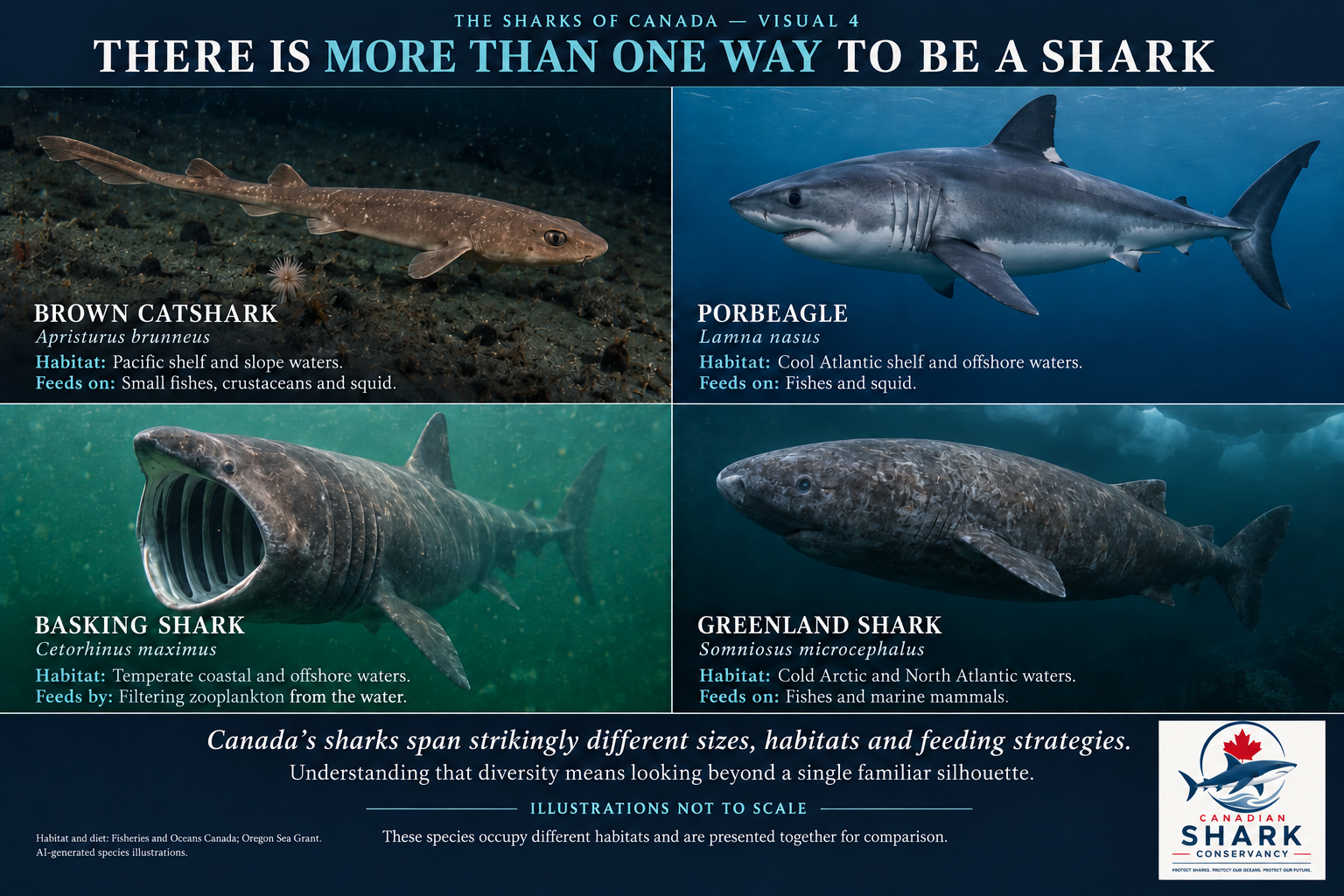
Canada’s sharks span strikingly different sizes, habitats and feeding strategies. Understanding that diversity means looking beyond a single familiar silhouette.
Illustrations not to scale. These species occupy different habitats and are presented together for comparison.
Canadian Shark Conservancy · AI-generated shark illustrationsView full-size visual ↗What we still do not know
There are questions that belong near the beginning of this series.
Where do different life stages spend their time? Which places are important for reproduction? How often do individuals return? What happens to animals after an encounter with fishing gear? How can researchers distinguish a real change in distribution from a change in observation effort?
The answers vary greatly by species and region.
Our commitment is to make those limits visible. Each profile will separate established findings from plausible explanations and unresolved questions. Where evidence comes from outside Canada, we will say so rather than assume that every finding applies unchanged to Canadian waters.
Scientific uncertainty can be an invitation to pay closer attention.
It shows us where the next observation, study or sustained research effort could matter.
An invitation beneath the surface
Over the coming articles, we will travel through Canada’s shark habitats one species at a time.
We will meet Greenland sharks, salmon sharks and porbeagles. We will follow blue sharks into the open ocean and explore the worlds of sixgills, sleeper sharks, dogfish and catsharks. We will return to the white shark with a wider Canadian perspective and examine the records of unusual visitors.
Along the way, we will consider the people who study these animals, encounter them, and make decisions that affect their future.
The invitation is simple: learn their names. Understand their lives. Ask what their presence means for the waters we share.
The next time you stand on a Canadian shoreline, allow the view to extend below the horizon.
Beyond the breaking waves and reflected sky is a country we rarely see clearly.
Sharks are part of it.
Canada is shark country.
Next: The Greenland Shark — A Life Beyond Our Timescale.
Three oceans. Extraordinary lives. A shared responsibility.
Canadian Shark Conservancy. Protect Sharks. Protect Our Oceans. Protect Our Future.