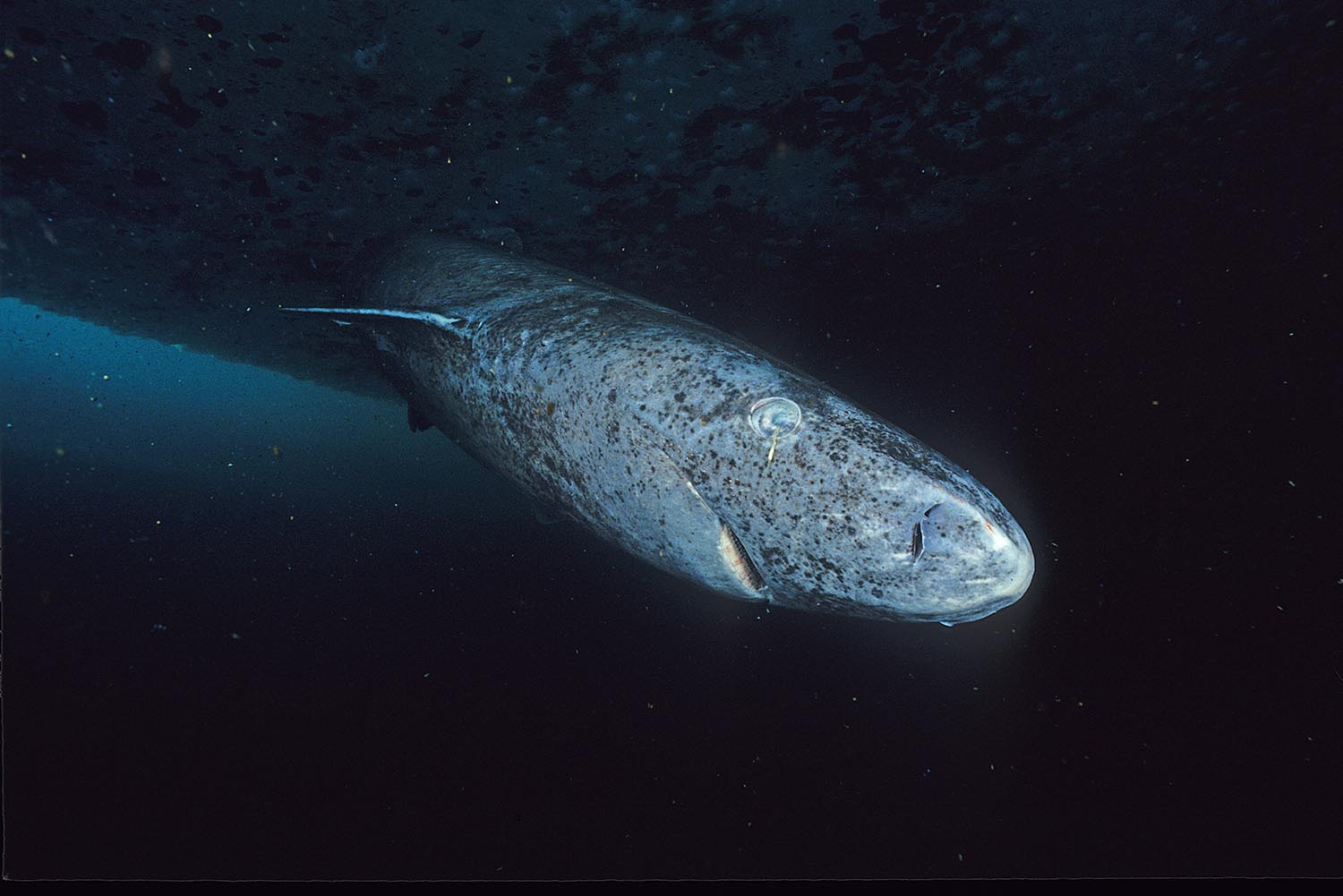
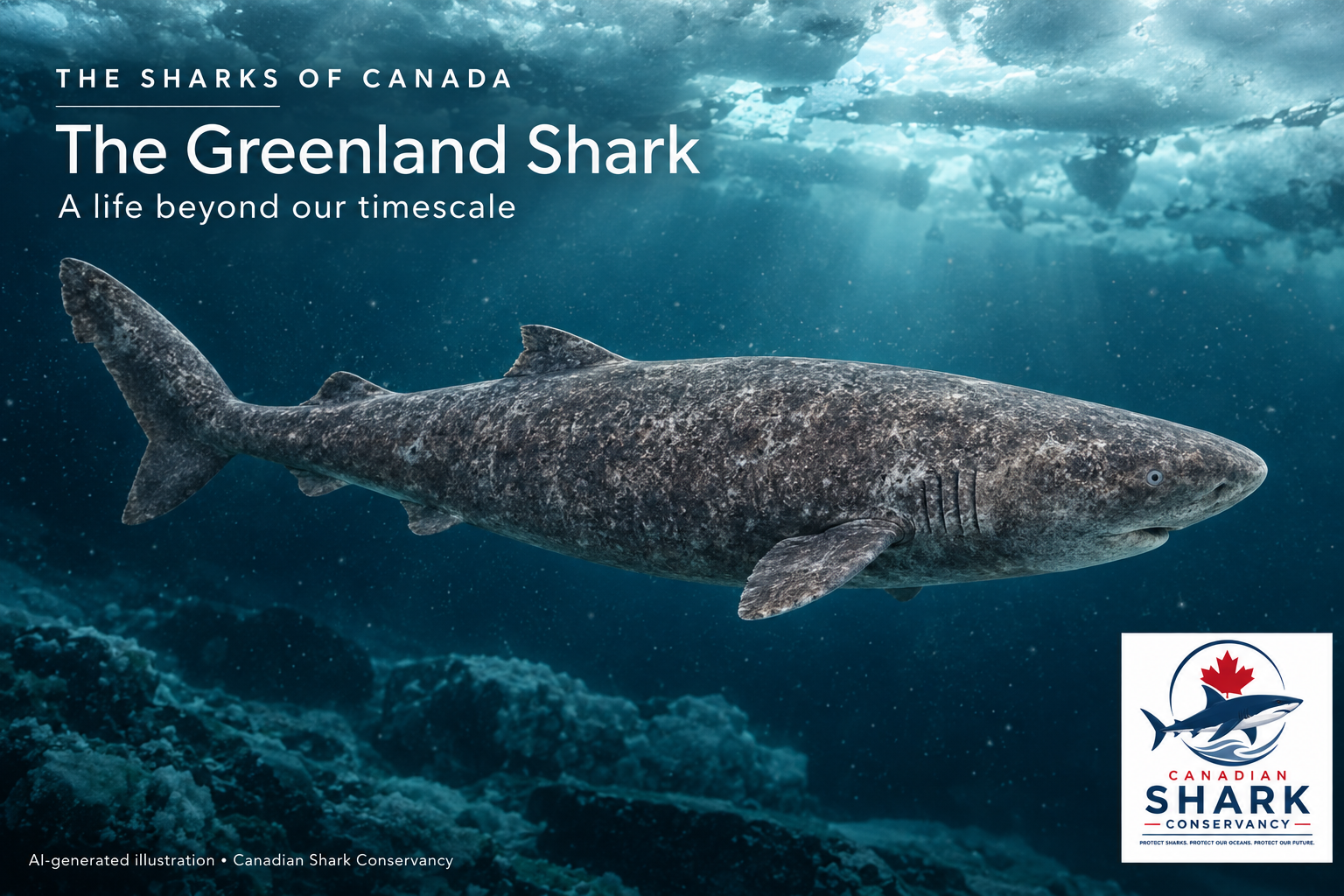
A Greenland shark moves beneath Arctic ice in this imagined underwater scene. Research suggests these sharks can live for centuries, giving their conservation a timescale that stretches far beyond our own.
AI-generated illustration; not a documentary photograph.
Canadian Shark Conservancy · AI-generated illustrationView full-size visual ↗Imagine descending beneath Arctic sea ice.
The surface becomes a pale ceiling. Light softens. Suspended particles drift through the water, and a large shape gradually separates itself from the blue.
A blunt snout. Small eyes. A thick body moving with unhurried strokes.
This is the Greenland shark.
Its name may suggest another country, but its story belongs in Canada, too. Fisheries and Oceans Canada documents its occurrence around Baffin Island, in the Gulf of St. Lawrence and along the Scotian Shelf. These are Canadian waters inhabited by an animal whose life may unfold across centuries. Fisheries and Oceans Canada
In the opening article of this series, we explored the idea that Canada is shark country. The Greenland shark takes us deeper into that idea—and into a very different experience of time.
Meet the Greenland shark
The Greenland shark, Somniosus microcephalus, has a heavy body, a rounded snout and two small dorsal fins. It lacks an anal fin. Adults commonly measure about 3.5 to 5 metres long, although larger individuals have been recorded. Its proportions give it a distinctive silhouette: substantial, understated and very different from the familiar outline of a white shark. DFO species profile
Knowing that silhouette changes how we picture Canadian marine wildlife.
An ocean can contain animals of remarkable size without making them familiar to the people living beside it. For most Canadians, the Greenland shark remains an unseen neighbour.
A Canadian life beyond the ice
Arctic imagery is only one part of this shark’s story.
Greenland sharks occupy coastal fjords, estuarine waters and offshore habitats. They also move through the water column rather than remaining exclusively on the seabed. Some tracked Canadian Arctic sharks shift between inshore and offshore waters seasonally. A species can be present in a region year-round while individual animals travel considerable distances. COSEWIC’s 2025 assessment
That distinction matters. Calling an animal a resident should never make its world seem smaller than it is.
A coastline is a boundary on our maps. Beneath the surface, depth, temperature, and access to food help shape a much more complicated landscape.
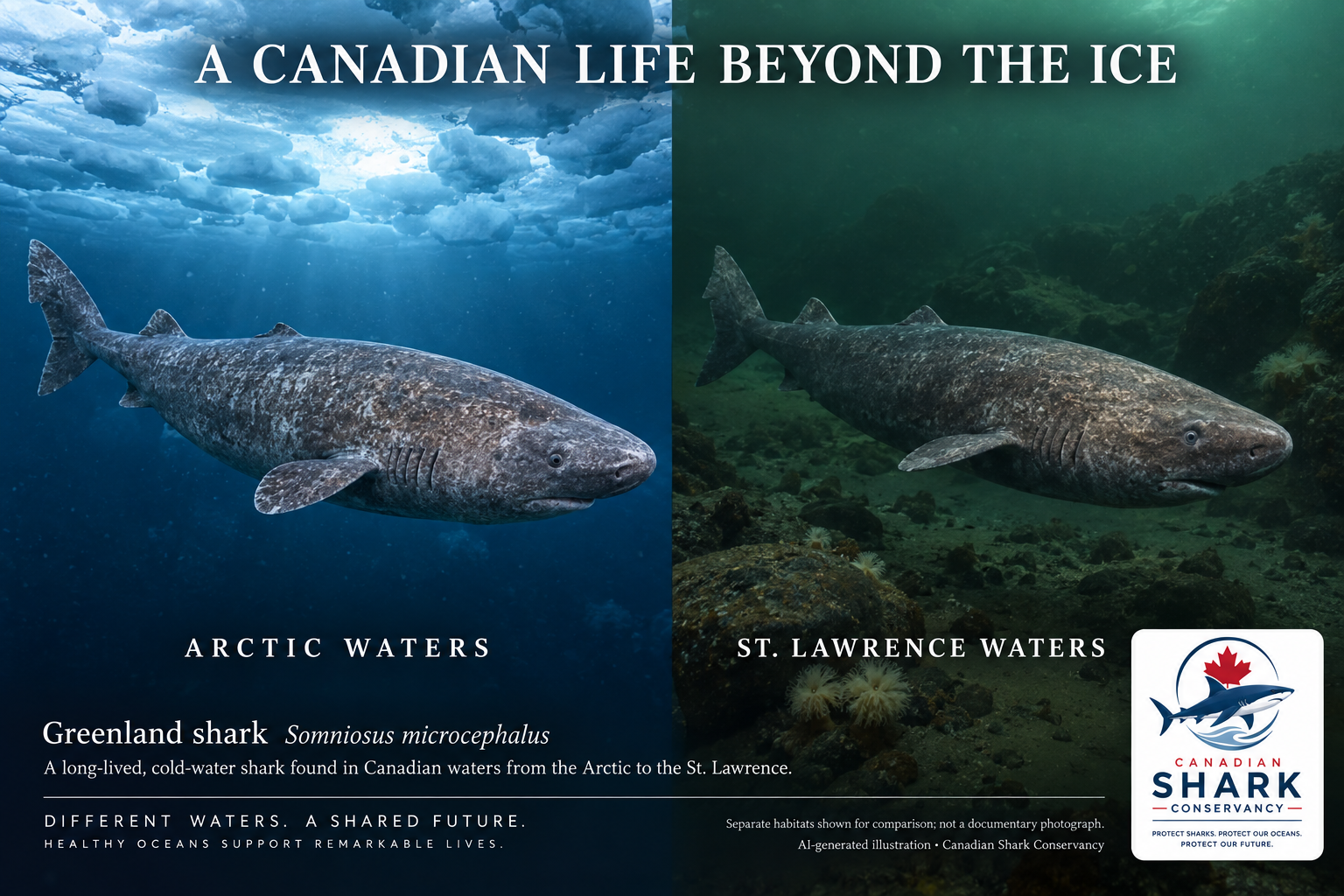
Greenland sharks occur in both Canadian Arctic waters and the St. Lawrence system. These separate scenes illustrate the variety of environments associated with the species.
AI-generated habitat illustrations, presented for comparison. They do not show exact locations, continuous distribution or a documented journey by one shark.
Canadian Shark Conservancy · AI-generated illustrationView full-size visual ↗How do you measure a life that may span centuries?
The Greenland shark’s longevity became international news following a study published in Science in 2016.
Researchers analysed radiocarbon in eye-lens nuclei from 28 female Greenland sharks. Their results supported a lifespan of at least 272 years. The largest shark examined, measuring 5.02 metres, received an age estimate of 392 years, with a reported uncertainty of ±120 years—the extent of the study’s 95.4% probability range. Nielsen and colleagues, 2016
The uncertainty belongs in the story.
“392 years” was an estimate for one animal, not its verified birthday. It was also not an average lifespan for every Greenland shark. The finding gives us evidence of exceptional longevity while leaving substantial uncertainty about individual ages.
We can appreciate the discovery without turning an estimate into a certainty.
Think about the difference between a photograph and a lifetime. A camera records a moment: a shark passing through a beam of light. Understanding that animal requires asking what happened before the encounter, and what might happen long after it.
For Greenland sharks, those questions may reach far beyond the span of any research project—or any researcher.
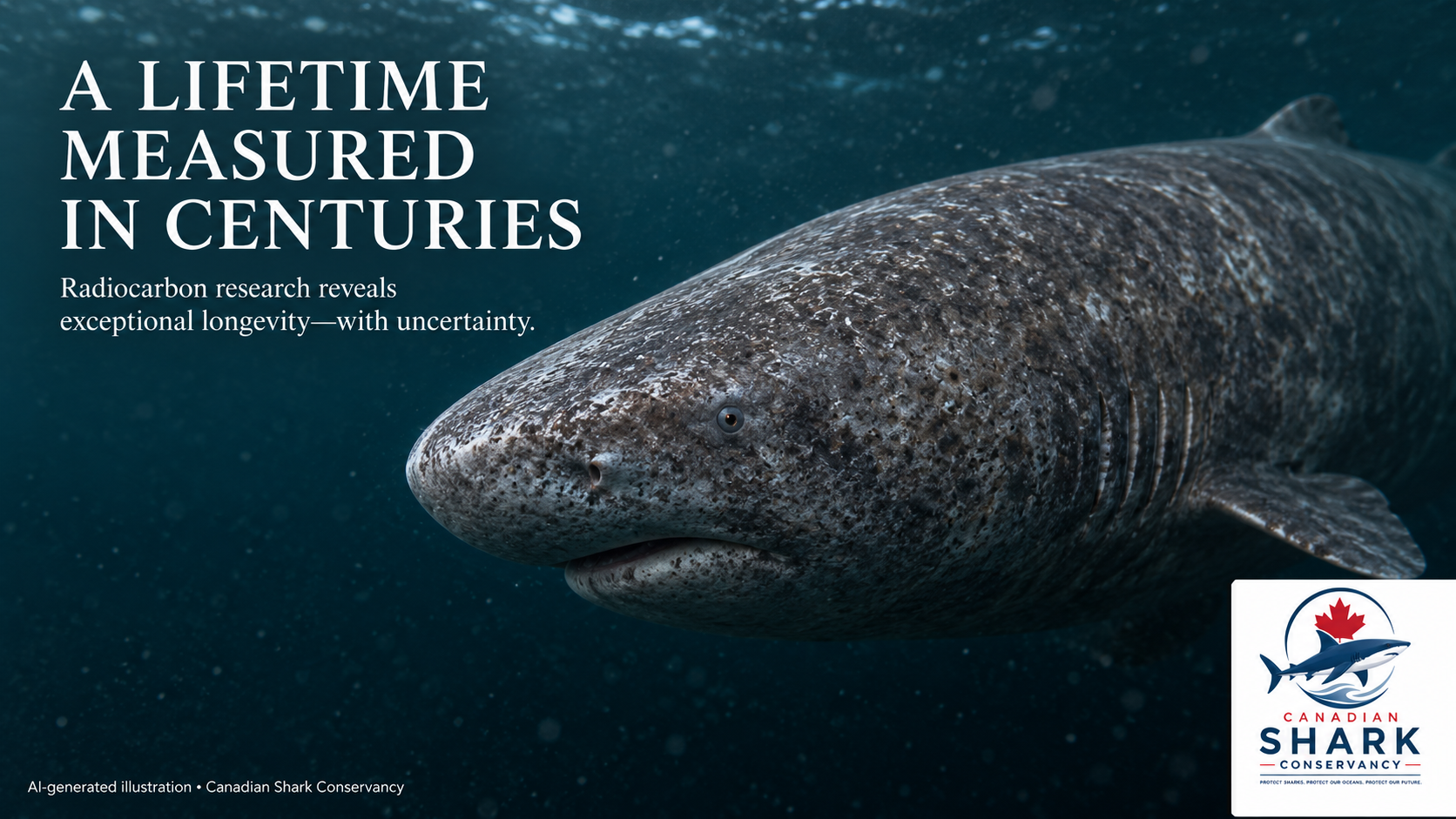
Radiocarbon analysis of Greenland shark eye-lens tissue provided evidence of extraordinary longevity. The estimates carry substantial uncertainty; a shark’s appearance cannot reveal its exact age.
AI-generated species illustration. This is not a photograph of an aged study specimen.
Canadian Shark Conservancy · AI-generated illustrationView full-size visual ↗An appetite beneath the surface
The Greenland shark’s diet includes fishes such as halibut, herring and capelin, as well as marine mammals. Scavenging is also documented, including historical observations around whaling and sealing stations. DFO feeding account
Those details invite questions about how food moves through cold-water ecosystems.
They also require careful interpretation. Finding an animal’s remains in a shark’s stomach establishes that it was eaten; by itself, it does not establish whether the shark captured it alive or encountered it after death.
That is a useful distinction whenever we tell stories about predators. An extraordinary stomach-content record can become a dramatic headline, but the most interesting scientific question often remains unanswered: how did the meal actually happen?
Why longevity changes the conservation conversation
A long life does not guarantee a secure future.
The 2016 study estimated female sexual maturity at at least 156 years, with substantial uncertainty. This was a research estimate, not a directly observed milestone that applies identically to every female. Nielsen and colleagues, 2016
Even allowing for uncertainty, such a slow life history demands patience from conservation.
In May 2025, the Committee on the Status of Endangered Wildlife in Canada assessed the Greenland shark as Special Concern. Its report identifies incidental capture in fisheries as a major threat and estimates that at least approximately 1,700 sharks are caught annually in Canada. That figure describes capture, not a confirmed annual death toll. Survival after release remains insufficiently understood. COSEWIC assessment and status report
For a species that takes so long to mature, losses can have consequences extending well beyond the season in which they occur.
The practical questions are immediate: How can encounters with fishing gear be reduced? Which handling practices improve survival? Where should monitoring be strengthened?
We should judge progress by what happens to sharks in the water, including after they disappear from view.
What we still need to learn
Canada’s assessment identifies major gaps: population size and trends remain unknown, and important details of reproduction—including mating sites and pupping grounds—are unresolved. COSEWIC’s research assessment
These gaps give future research a clear purpose.
A tracking record can help connect places that once seemed separate. A carefully documented fisheries encounter can improve our understanding of risk. Sustained observation can test assumptions that a single expedition cannot resolve.
For readers, there is a role as well: support careful research, ask for evidence behind dramatic claims, and make room for uncertainty in the stories we share.
The Greenland shark deserves curiosity that lasts longer than a headline.
A responsibility beyond our lifetime
Return to that imagined encounter beneath the ice.
The shark passes. Its outline fades, and the water appears empty again.
We may never know its age. We cannot reconstruct every place it has travelled or every change it has survived. Yet the encounter leaves a question that is entirely ours to answer:
What kind of ocean will we leave for the rest of its life?
Protecting Greenland sharks asks us to think beyond short funding cycles, immediate results, and the years we expect to witness ourselves. It asks us to care about futures we will never see.
Canada’s shark story stretches into that future.
Three oceans. Extraordinary lives. A shared responsibility.
Canadian Shark Conservancy Protect Sharks. Protect Our Oceans. Protect Our Future.
Next in The Sharks of Canada: the salmon shark and a different way of living in Canada’s cold Pacific waters.