
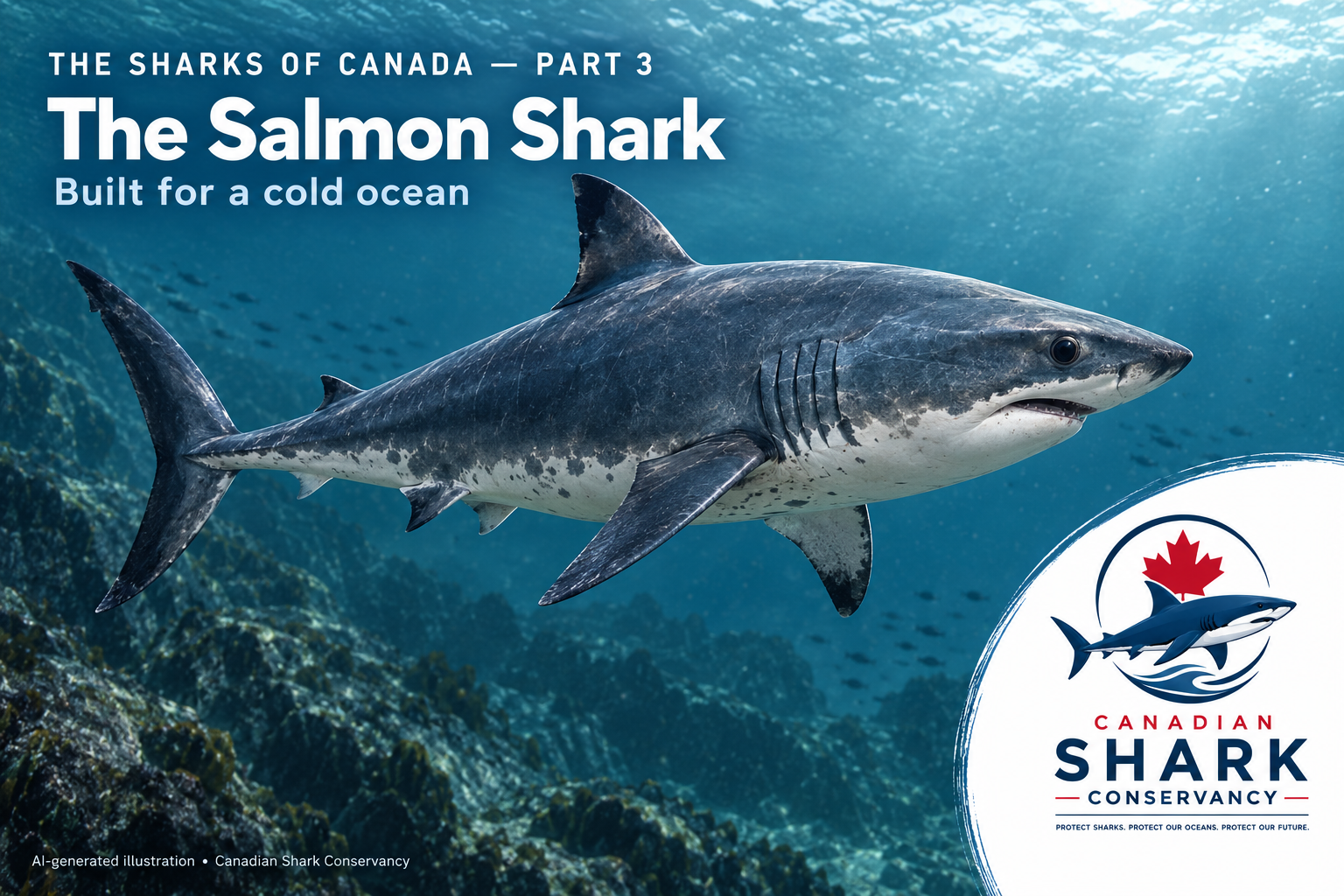
A salmon shark moves through an imagined Canadian Pacific scene. Its muscular body and ability to retain metabolic heat help support an active life in cold water.
Hero: AI-generated illustration; not a documentary photograph. Canadian Shark Conservancy.
Imagine slipping beneath the surface off British Columbia.
The water has a green-blue depth to it. Sunlight breaks into shifting patterns overhead. Beyond the rocky slope, the bottom disappears, leaving open water and the sense that something could approach from almost any direction.
Then a shape emerges.
A compact, muscular body. A pointed snout. A powerful tail moving steadily behind it.
For a moment, the silhouette seems familiar.
But look more closely.
This is a salmon shark—one of the predators that makes Canada’s Pacific waters shark country.
In Part 2, the Greenland shark asked us to imagine a lifetime extending across centuries. The salmon shark invites us to consider another remarkable possibility: a fish carrying warmth through a cold ocean.
Meet the salmon shark
The salmon shark, Lamna ditropis, belongs to the mackerel shark family, alongside white sharks, makos and porbeagles. It has a stout, streamlined body, a short conical snout and a crescent-shaped tail. Adults often show irregular dark blotches across their pale undersides. Those markings help distinguish them from white sharks, although identification should consider several features together. Florida Museum species profile
Many salmon sharks measure roughly two to two-and-a-half metres long. Their range spans the North Pacific, including British Columbia, and encompasses both coastal and oceanic habitats. Alaska Department of Fish and Game
A salmon shark deserves recognition on its own terms.
Seeing one should bring more than the question, “Is that a white shark?” It should bring curiosity about the animal actually in front of us: where it has travelled, what it is feeding on and how its body makes that life possible.
Warmth beneath the skin
Most people learn a simple distinction: mammals are warm-blooded; fish are cold-blooded.
The salmon shark makes that distinction more interesting.
It retains heat produced by metabolism through closely arranged blood vessels called retia mirabilia. Warm blood returning from active tissues transfers heat to cooler incoming blood flowing in the opposite direction. This counter-current exchange reduces heat loss. Goldman and colleagues, 2004
The result is regional endothermy: parts of the body, including swimming muscles, can remain warmer than the surrounding water. It does not mean every part of the shark stays at one uniform temperature.
The heart presents a particular challenge because it receives blood cooled at the gills. Research published in Science identified physiological features that may help salmon shark hearts continue functioning in cold conditions. Weng and colleagues, 2005
None of this would be visible during an underwater encounter.
There would be no glow, no steam, no outward sign of the temperature difference. The shark would simply keep swimming, carrying an extraordinary physiological system beneath an ordinary-looking skin.
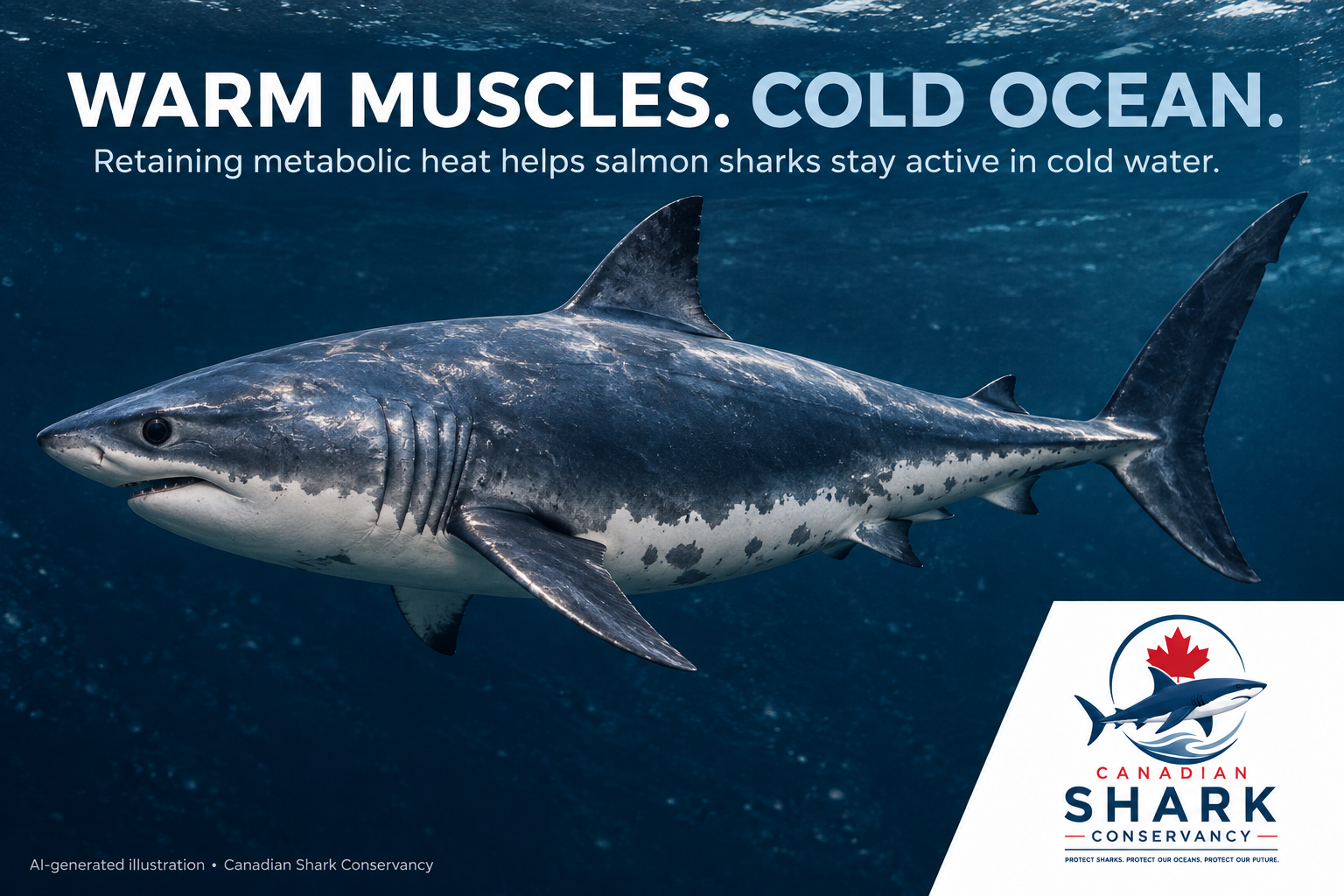
Counter-current heat exchangers help salmon sharks retain metabolic heat. Regional endothermy allows parts of their bodies to remain warmer than the surrounding water.
AI-generated illustration. Internal temperatures cannot be inferred from the animal’s appearance; this is not a thermal image.
Canadian Shark Conservancy · AI-generated illustrationView full-size visual ↗What researchers actually measured
A study published in 2004 recorded stomach temperatures in four free-swimming adult salmon sharks in Prince William Sound, Alaska.
Their mean stomach temperatures ranged from 25.0°C to 25.7°C, while surrounding water temperatures encountered during the study ranged approximately from 5°C to 16°C. Goldman and colleagues, 2004
These were measurements from particular adults over limited tracking periods. They were not whole-body temperatures, and they should not become a claim that every salmon shark always maintains the same temperature.
The finding is remarkable without exaggeration.
It reveals how an animal can experience a cold environment while maintaining a very different temperature internally.
A Canadian chapter in a much larger journey
British Columbia forms part of an ocean-wide story.
Electronic tracking of female salmon sharks tagged in Alaska revealed different seasonal strategies. Some remained in northern waters through winter. Others travelled south into temperate and subtropical regions. The study documented movements extending as far south as waters around Hawaii. Weng and colleagues, 2005
Those findings also remind us to be precise.
A journey recorded from an Alaskan tagging study is evidence about those tracked animals. It does not establish an identical migration schedule for every shark encountered off Canada.
For Canadian research, the useful questions become more specific: Which sharks use our waters? When do they arrive? How long do they remain? Which places provide feeding opportunities, and how do those patterns vary between years?
A species’ range tells us where its story can occur. Following individuals helps reveal how that story unfolds.
Salmon are part of the story
The salmon shark earns its name honestly, but salmon are only part of its diet. Other prey include herring, sablefish, pollock and squid. Alaska Department of Fish and Game
That broader appetite matters when we think about its place in the ocean.
A predator’s common name can make its ecological role sound narrower than it is. The salmon shark participates in a network of feeding relationships, with opportunities that change across places and seasons.
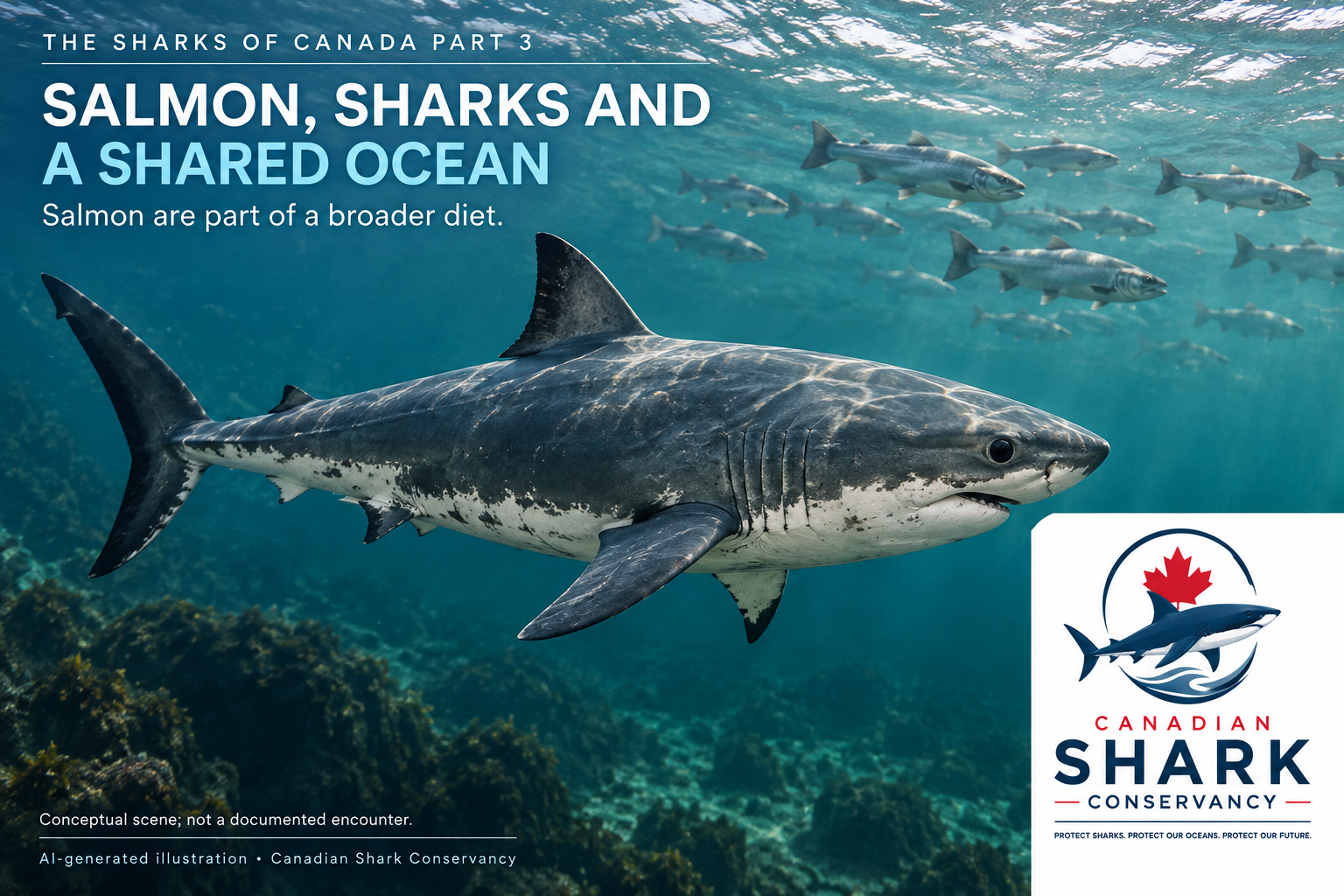
Pacific salmon are among the salmon shark’s prey, alongside other fishes and squid. Understanding that relationship requires studying the wider food web.
AI-generated conceptual scene; not a documented encounter or an estimate of predation rates.
Canadian Shark Conservancy · AI-generated illustrationView full-size visual ↗For communities concerned about salmon, a shark eating one can be an emotionally charged sight.
But observing predation and explaining a population decline are different scientific tasks.
To establish the contribution of shark predation, researchers need evidence about how many salmon are consumed, which populations are affected, and how those losses compare with other sources of mortality. A striking encounter cannot answer all those questions.
We can take salmon conservation seriously while asking equally careful questions about the predators sharing their ocean.
Powerful does not mean invulnerable
The salmon shark’s athletic appearance can hide a slower reproductive reality.
Females give birth to small litters of live young. Developing embryos obtain nourishment by consuming unfertilized eggs within the uterus—a reproductive strategy known as oophagy. Florida Museum
Small litters make each reproductive contribution matter.
Salmon sharks also encounter fishing gear, and their consumption of valuable fish can bring them into conflict with fishers. Alaska’s wildlife agency identifies fishing mortality and perceptions of the shark as a pest among conservation concerns. Alaska Department of Fish and Game
For Canada, the practical response should include careful recording of encounters, reliable species identification and efforts to reduce avoidable harm.
Conservation begins with knowing what is happening. It develops through the decisions we make with that knowledge.
What we should ask next
Several questions deserve sustained Canadian attention:
- How does salmon shark habitat use vary along British Columbia’s coast and offshore?
- Do juveniles and adults use different areas or conditions?
- How often do sharks encounter fisheries, and what happens after release?
- How might changing prey distributions alter the places sharks use?
Answering these questions requires more than collecting dramatic photographs. It requires observations that can be compared, tracking that connects encounters, and collaboration with people who spend their lives on the water.
For everyone else, there is a useful starting point: learn the animal’s name, understand the evidence and resist turning uncertainty into a convenient story.
Seeing our Pacific differently
Imagine the shark passing once more.
Light moves across its back. The pale underside turns briefly toward you. Its tail carries it beyond the edge of visibility.
The water seems empty again.
Yet your understanding of it has changed.
The Pacific beside Canada is home to an animal capable of retaining warmth, travelling widely and feeding within ecosystems whose complexity exceeds anything visible in a single encounter.
The salmon shark belongs in our picture of Canadian wildlife.
And once we learn to see it there, our responsibility becomes harder to overlook.
Three oceans. Extraordinary lives. A shared responsibility.
Canadian Shark Conservancy Protect Sharks. Protect Our Oceans. Protect Our Future.
Next in The Sharks of Canada: the porbeagle, the salmon shark’s Atlantic relative.