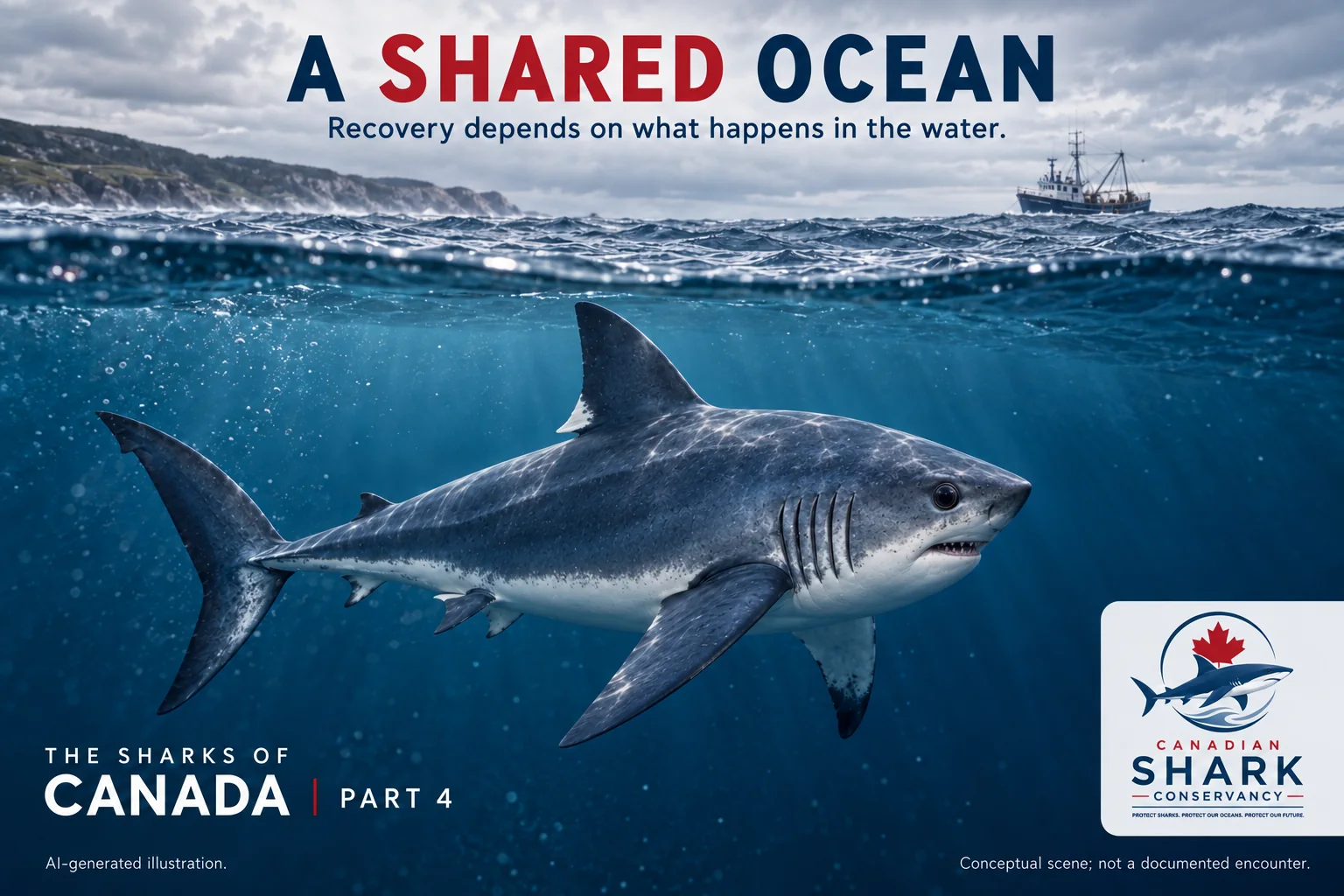
A porbeagle moves through an imagined Atlantic scene. This cold-water predator’s story connects remarkable biology with the lasting consequences of fishing pressure.
Hero: AI-generated illustration; not a documentary photograph. Canadian Shark Conservancy.
Imagine looking beneath the surface off Atlantic Canada.
Above you, wind moves across grey water. Below, the light becomes blue. A shark approaches with steady movements of its crescent-shaped tail. Its back catches the sunlight before its pale underside comes into view.
Then you notice a small detail: a white patch at the rear of its first dorsal fin.
This is the porbeagle.
In the previous instalment, we met the salmon shark of Canada’s Pacific waters. The porbeagle, Lamna nasus, is its close Atlantic relative. Together, they show how sharks have adapted to hunting in cold seas. Florida Museum species profile
But the porbeagle also brings another story into focus: what happens when a capable predator encounters fishing pressure faster than its population can replace the animals lost.
Meet the porbeagle
A porbeagle has a sturdy, streamlined body, a conical snout and a dark back above a pale belly. Its crescent-shaped tail supplies propulsion, while small secondary keels near the tail base help distinguish it from a white shark.
The pale free rear tip of the first dorsal fin is another useful identification feature. It sits on the fin’s trailing extension, rather than its uppermost point. Florida Museum identification account
Learning these details changes an encounter. What first appears to be simply “a shark” becomes a particular species with its own place in the ocean.
In Canada, documented occurrence includes continental-shelf and offshore waters from Newfoundland and Labrador to the Bay of Fundy, including the Gulf of St. Lawrence. These are broad regions of occurrence, rather than a promise that sharks occupy every part of them throughout the year. COSEWIC’s 2014 assessment
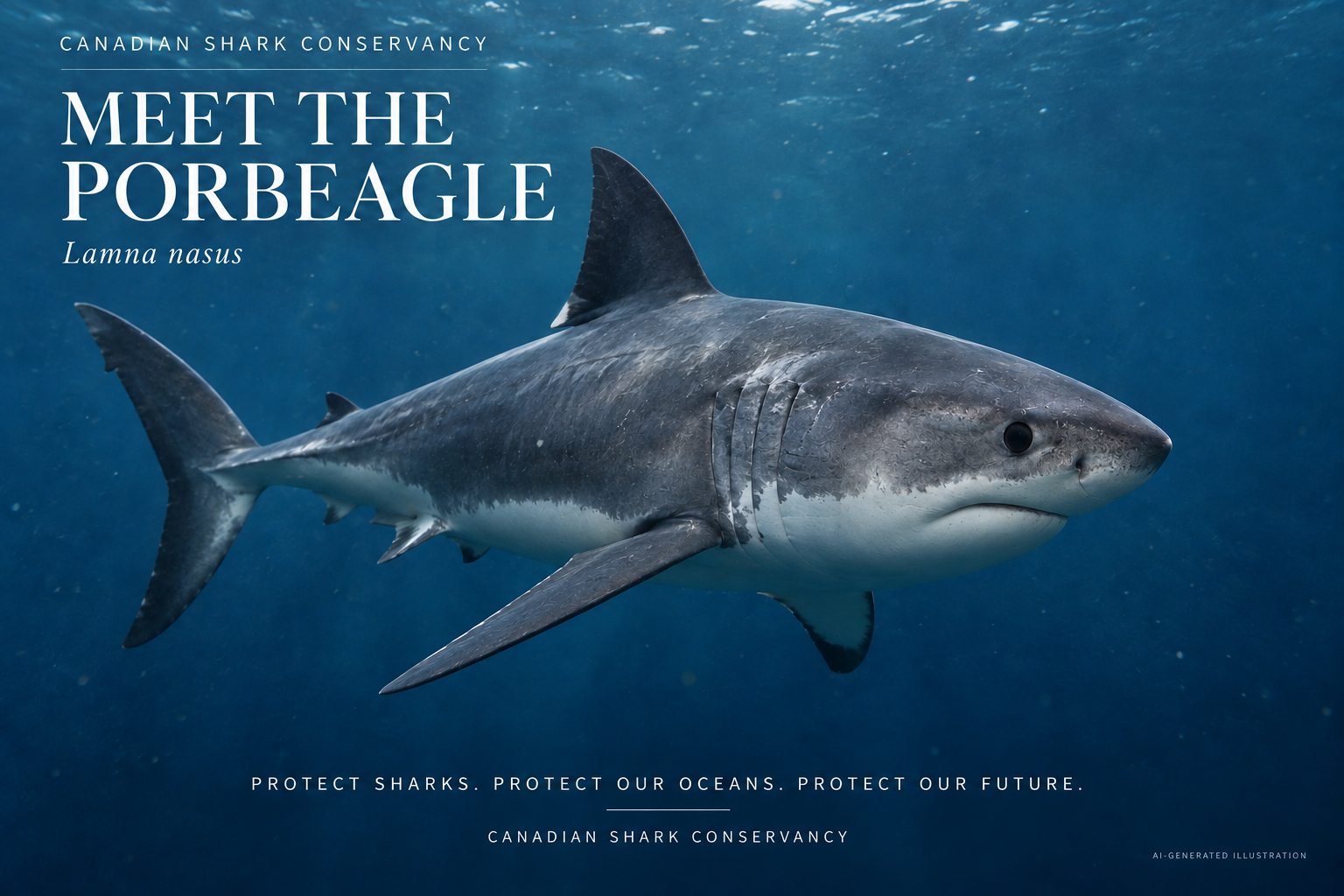
The porbeagle’s pointed snout, crescent-shaped tail and pale free rear tip of the first dorsal fin help distinguish its silhouette. Identification depends on several features together.
AI-generated species illustration; not a documentary photograph or a substitute for an identification guide.
Canadian Shark Conservancy · AI-generated illustrationView full-size visual ↗Carrying warmth into cold water
Like the salmon shark, the porbeagle can retain metabolic heat through specialised arrangements of blood vessels. These heat exchangers help keep parts of its body warmer than the surrounding water.
Its prey includes bony fishes and squid. Florida Museum biology account
Cold water, then, can be a place of opportunity.
Picture a school of fish turning beneath the surface. Each movement changes the shape of the school, briefly opening and closing spaces between individual animals. A predator moving through that scene needs to find food, respond to movement and keep swimming.
The porbeagle’s biology helps us picture Canadian waters as active habitat, full of interactions that usually happen beyond our view.
A life that takes years to replace
The pace of population growth depends on much more than swimming ability.
Research on Northwest Atlantic porbeagles places typical maturity at approximately eight years for males and thirteen years for females. These are population estimates, with variation among individuals. Fisheries and Oceans Canada research
Females give birth to live young, with a typical litter of about four pups. Florida Museum reproduction account
Consider what those numbers mean.
A young female may spend more than a decade growing before contributing offspring to the next generation. Each animal lost before maturity represents years of survival that never lead to reproduction. Losing a mature female also removes her potential future contribution.
That is why conservation needs to consider the ages and reproductive roles of animals, alongside their total number.
A population’s future depends on enough sharks surviving long enough to reproduce.
The legacy of two declines
The porbeagle’s fishing history makes that vulnerability tangible.
COSEWIC’s 2014 assessment describes severe declines following targeted fishing in the 1960s, partial recovery during the 1980s, and another collapse in the 1990s. Canada’s directed porbeagle fishery was suspended in 2013. The committee reaffirmed its assessment of the species as Endangered in May 2014. COSEWIC assessment and status report
These dated findings describe the history behind the conservation challenge.
More recently, ICCAT’s 2025 porbeagle summary continued to classify the Northwest Atlantic stock as overfished, drawing on assessment estimates for 2018. It reported uncertainty about whether overfishing was occurring. ICCAT porbeagle executive summary
Those terms describe different things. Overfished concerns a population’s depleted condition relative to a reference level. Overfishing concerns the pressure being applied to it.
Reducing fishing pressure can create an opportunity for rebuilding. The population still needs time to respond.
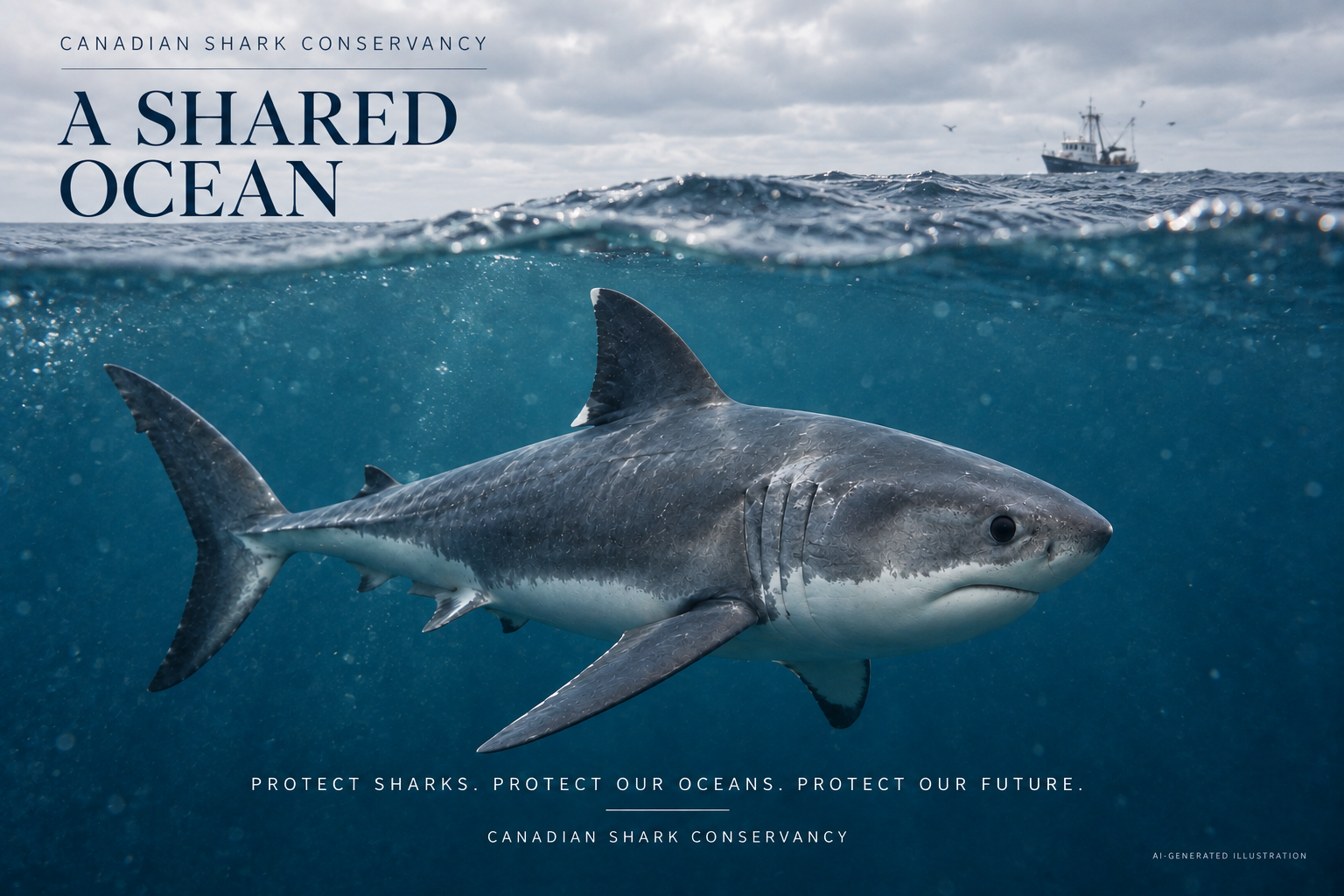
Porbeagles and fisheries use overlapping ocean spaces. Supporting recovery requires attention to incidental capture, handling and survival after release.
AI-generated conceptual illustration; the vessel and shark do not depict a documented encounter.
Canadian Shark Conservancy · AI-generated illustrationView full-size visual ↗What happens after release matters
Ending a targeted fishery does not eliminate every encounter with fishing gear.
Porbeagles can be caught incidentally in fisheries pursuing other species. Understanding the consequences requires looking beyond landed catches and beyond the moment a shark swims away.
A study published in 2020 examined post-release mortality in porbeagles caught by the Canadian pelagic longline fishery. Researchers used satellite-tag records to investigate survival and recovery following capture. They found evidence that handling practices mattered: among surviving porbeagles, those tagged aboard vessels took longer to recover than those tagged in the water. Bowlby and colleagues, 2020
The study’s observation period was limited, so its findings cannot establish lifelong survival. They nevertheless demonstrate why a release should be the beginning of a scientific question: what happened next?
For conservation, that question has practical value. Better information can help assess handling methods, account for mortality and identify opportunities to reduce harm.
Knowledge built through cooperation
Canada’s porbeagle research has drawn on collaboration between scientists and the fishing industry. Fisheries and Oceans Canada describes industry support for work on the species’ biology and population dynamics, alongside research using vertebrae and tagged animals to investigate age and growth. DFO’s porbeagle research programme
That cooperation deserves a place in the story.
People working at sea encounter animals that most Canadians will never see. Carefully recorded observations can help turn those encounters into evidence. Researchers can use that evidence to test assumptions and improve assessments.
For readers, useful questions follow: Are incidental catches being documented? Are released sharks surviving? Are monitoring programmes consistent enough to detect change?
These questions keep attention on outcomes in the water.
Making room for a future
Return to the imagined porbeagle passing beneath the surface.
For a moment, its outline is clear. Then the tail turns, the light changes and the shark disappears into blue water.
The encounter lasts seconds. The responsibility extends much further.
The porbeagle’s history asks us to recognise depletion early, learn from past decisions and sustain the work required for recovery. Its future depends on enough animals surviving, growing and reproducing across many years.
For Canada, caring about sharks includes making room for that time.