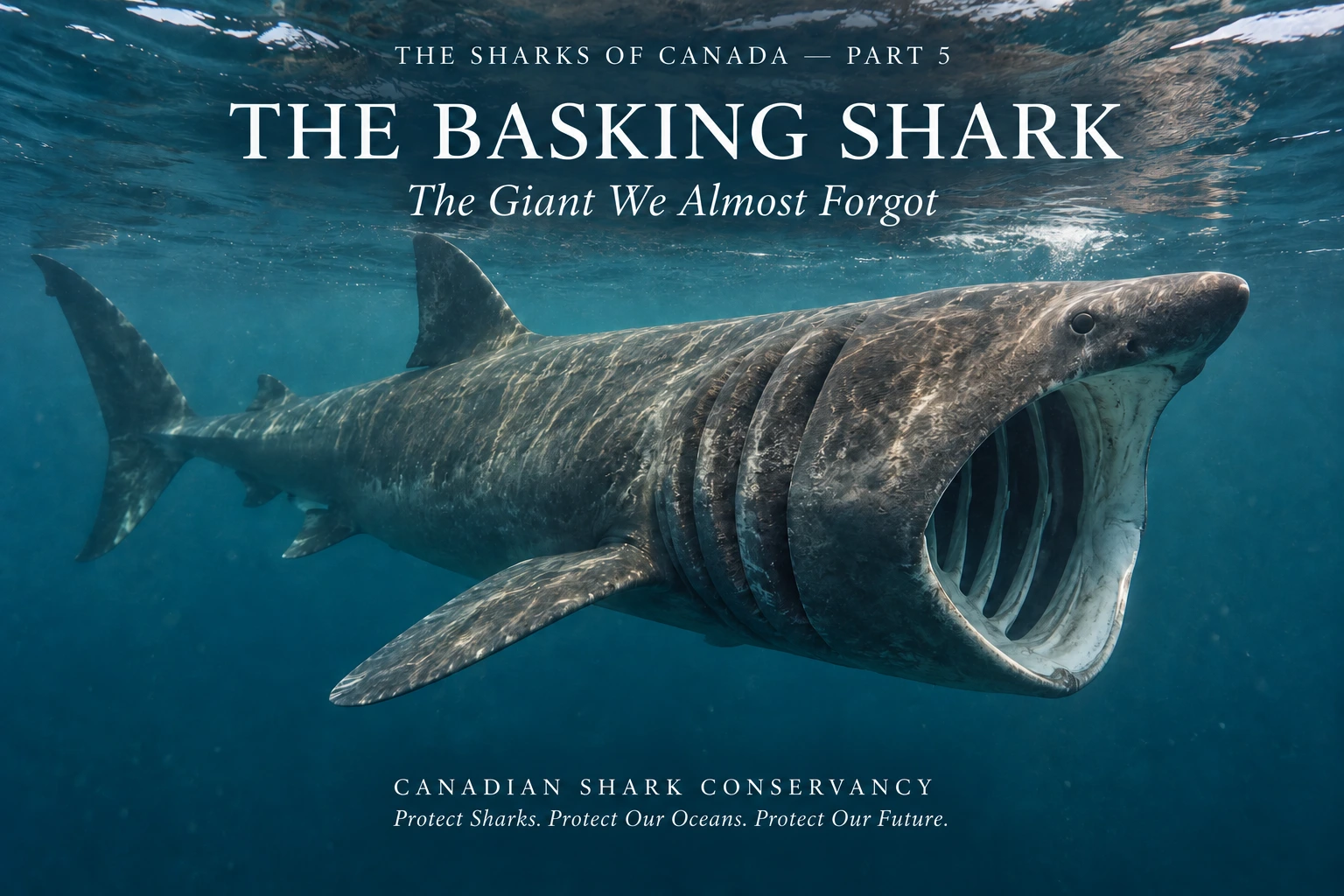
A basking shark filters food from the water in an imagined Canadian ocean scene. The world’s second-largest fish depends on some of its smallest inhabitants.
Imagine standing beside a quiet stretch of British Columbia’s coast.
Mist softens the trees. The water folds against the rocks. Beyond the shoreline, a dark fin breaks the surface.
Then you notice the length of the animal beneath it.
The shape keeps going.
An immense head. A broad body. A tail moving slowly through green water.
This is a basking shark.
In Part 4, the porbeagle showed us why rebuilding a shark population takes sustained care. The basking shark brings that responsibility closer to home, into a chapter of Canadian history in which people deliberately worked to remove an extraordinary animal from the sea.
Before we revisit that history, we should meet the shark itself.
An enormous mouth, a very small meal
The basking shark, Cetorhinus maximus, is the world’s second-largest fish, after the whale shark. Its most striking features include a cavernous mouth and exceptionally long gill slits that almost encircle its head. Fisheries and Oceans Canada species profile
Those features make more sense when we understand the meal.
As the shark swims with its mouth open, water passes through. Bristle-like structures called gill rakers retain small planktonic prey while water exits through the gill slits. Copepods and other small crustaceans are important food. DFO feeding account
Picture that exchange: an animal large enough to dominate our attention, feeding on life we might barely notice.
It changes what we mean by an ocean rich in wildlife.
Sometimes that richness is a fin breaking the surface. Sometimes it is suspended throughout the water, almost invisible to us.
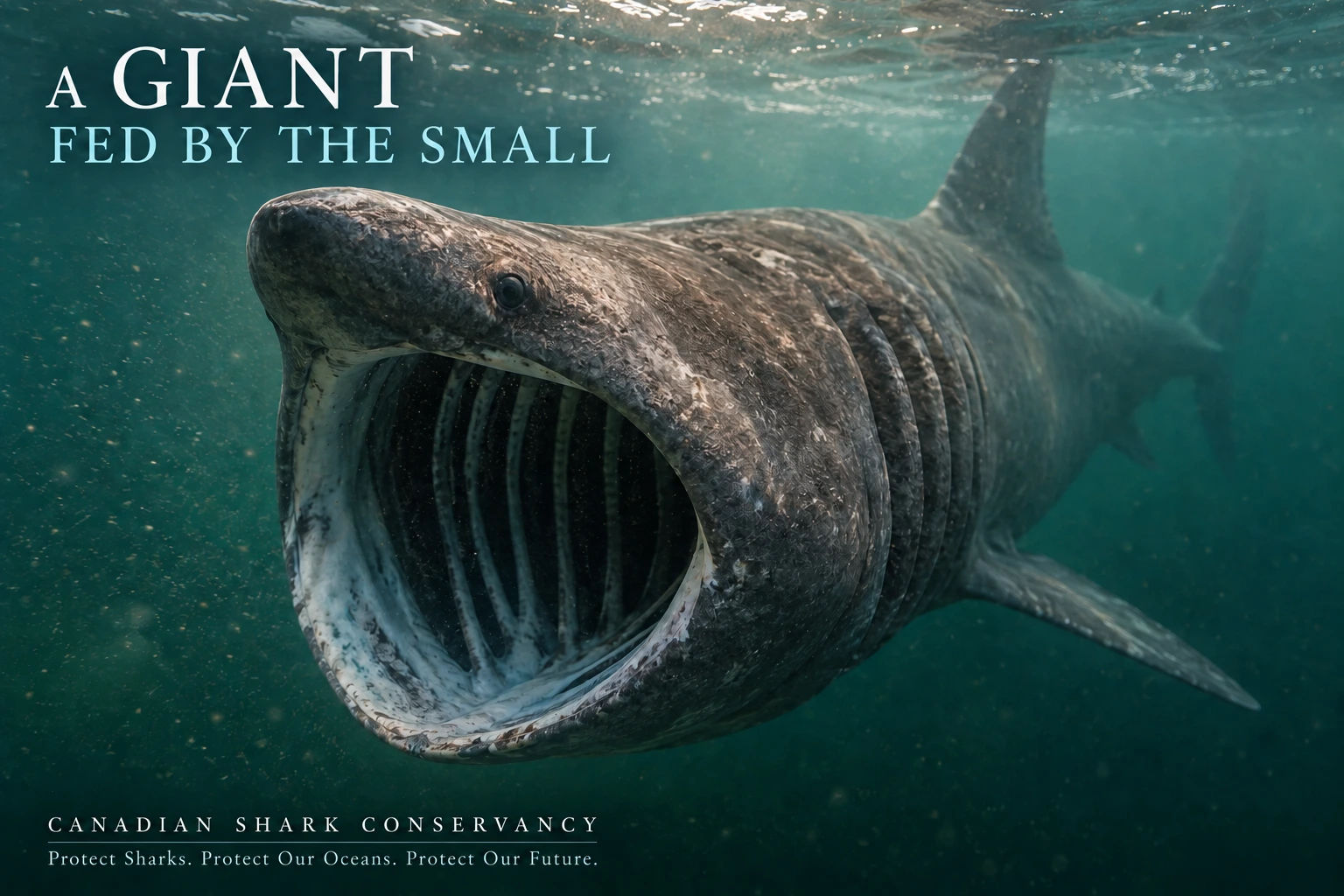
The basking shark’s open mouth and expansive gill region reflect its feeding strategy. Fine gill rakers retain planktonic prey as water passes through.
Canadian Shark ConservancyView full-size visual ↗A Canadian story on two coasts
Basking sharks also belong in our picture of Atlantic Canada. DFO documents their occurrence around Newfoundland, the Gulf of St. Lawrence, the Scotian Shelf and the Bay of Fundy. DFO distribution account
Their Pacific history carries a particularly difficult lesson.
DFO’s 2016 scientific review describes large seasonal aggregations that were historically common in Canadian Pacific waters. It also records how infrequently sharks were being observed by the time of that review. DFO habitat and recovery review, 2016
The two coasts should not be treated as interchangeable. Seeing basking sharks in the Atlantic cannot tell us whether their Pacific population is rebuilding.
Each region needs its own evidence.
When a giant became an inconvenience
From 1955 to 1969, a government eradication program targeted basking sharks in Barkley Sound. Sharks became entangled in salmon gillnets, damaging fishing gear. Other pressures, including liver fisheries and harassment, also contributed to their decline. DFO’s historical account
Pause over the word eradication.
The damage to fishing gear was real. So was the decision to respond by killing the animals.
That history deserves more than a moment of disbelief. It asks us to examine how an animal’s value can narrow until its inconvenience becomes the only thing we see.
A shark becomes a problem.
Removing it becomes progress.
Years later, people look across the same water and hope to see one.
We cannot undo those decisions. We can remember them accurately—and question the assumptions behind our own.
The difficulty of rebuilding what we barely understand
The Pacific population was listed as Endangered under Canada’s Species at Risk Act in 2010. A recovery strategy followed in 2011. DFO’s subsequent habitat review described substantial gaps in knowledge, including the locations needed for reproduction, pupping and rearing. DFO recovery and habitat review
Protection begins with a decision. Recovery requires animals to survive and reproduce.
For basking sharks, even the biological timetable remains difficult to describe precisely. DFO’s research account cautions that important life-history parameters, including growth and reproductive output, are inadequately known. It nevertheless identifies the species as having low productivity and limited capacity to withstand additional mortality. DFO basking shark research
That uncertainty should shape how we communicate.
A confident age estimate or recovery deadline can sound reassuring. If the evidence cannot support it, the number gives readers certainty that researchers do not have.
The more useful commitment is sustained work: reducing avoidable losses, improving observations and learning which habitats matter.
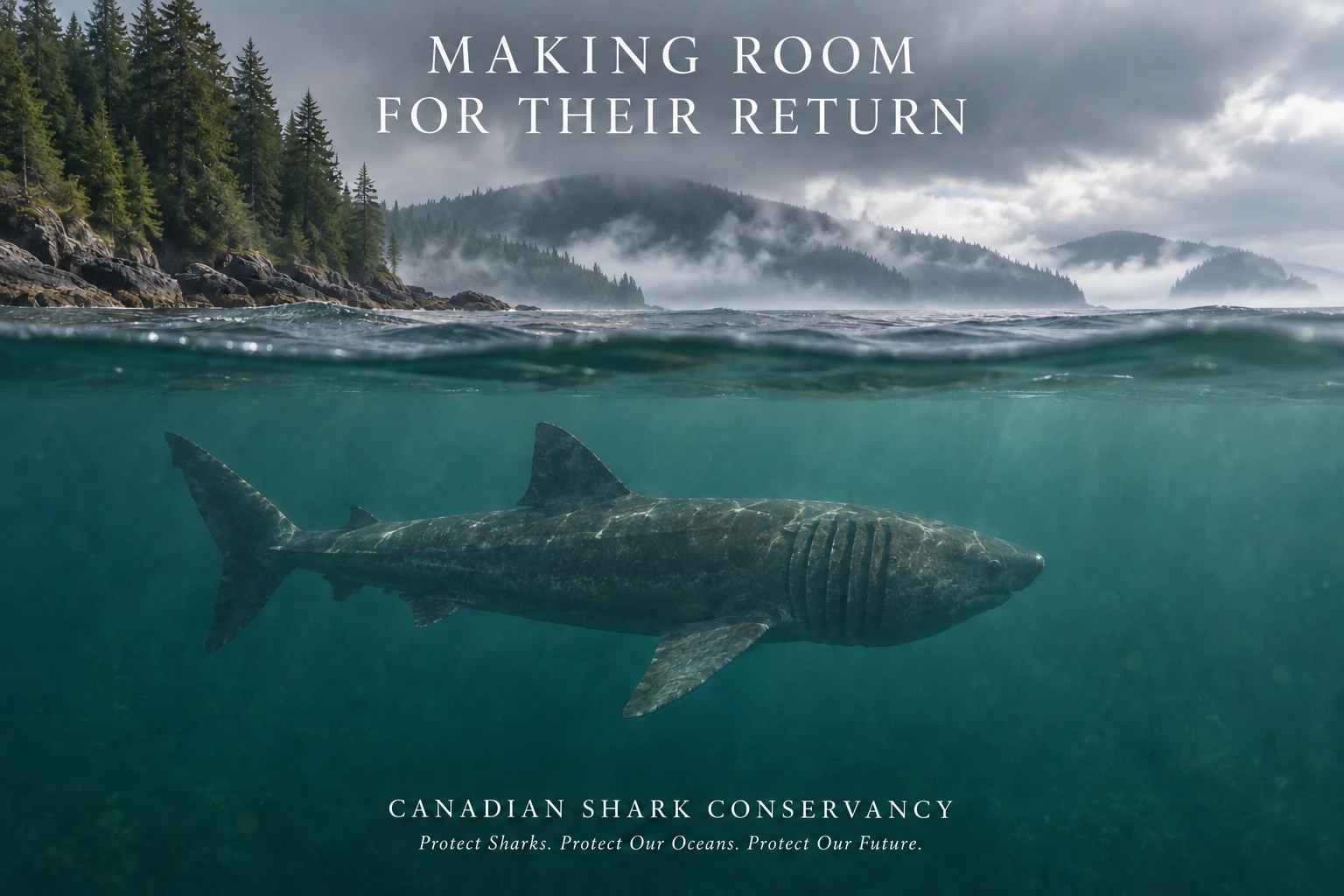
A basking shark moves through an imagined British Columbia coastal scene. The illustration expresses the possibility of recovery; it does not document a sighting or demonstrate a population increase.
Canadian Shark ConservancyView full-size visual ↗A sighting is a beginning
Imagine that fin appearing again.
A photograph could confirm an encounter. A location and time could make the record more useful. Repeated observations, interpreted alongside research, could help reveal a larger pattern.
But one sighting cannot establish population recovery.
Nor does an empty surface prove that no sharks are present below it. DFO’s habitat review highlights the limits of surface observations and the difficulty of studying animals that spend time out of view. DFO scientific review
The question is what we can learn across encounters, seasons and years.
Are sharks using an area repeatedly? Are the same individuals returning? Have observation efforts changed? What happens beyond the places people routinely watch?
Hope gives us a reason to look. Evidence helps us understand what we are seeing.
An encounter worth reporting
DFO encourages people to document shark sightings while maintaining a safe distance. Useful details include photographs or video, the date and time, a precise location and distinguishing features. Its reporting page provides contacts for Pacific Canada, the Maritimes, and Newfoundland and Labrador. Report a shark sighting to DFO
The encounter should remain on the animal’s terms.
Avoid approaching closely, touching or pursuing it. DFO specifically warns that basking sharks are vulnerable to vessel strikes while moving slowly near the surface. DFO encounter guidance
A useful record does not require a closer encounter.
Sometimes the most valuable thing we can do is observe carefully, give the animal space and pass the information to people who can use it.
What should become familiar again?
Return to that quiet coastline.
The trees are still there. Mist still gathers above the water. The surface can look beautiful without revealing what has changed beneath it.
That is why remembering matters.
If our understanding begins only with what we see today, absence can become ordinary. We may stop asking what used to live here—or what could belong here again.
The basking shark asks us to keep those questions open.
To see an immense mouth and wonder about plankton.
To see a rare encounter and support the patient work of understanding it.
To remember that Canadian waters once held gatherings of giants, and that their future deserves more than our surprise.
What would it take for the next generation to find their presence familiar?
All accompanying images are AI-generated educational illustrations, not documentary photographs. Graphic credit: Canadian Shark Conservancy.