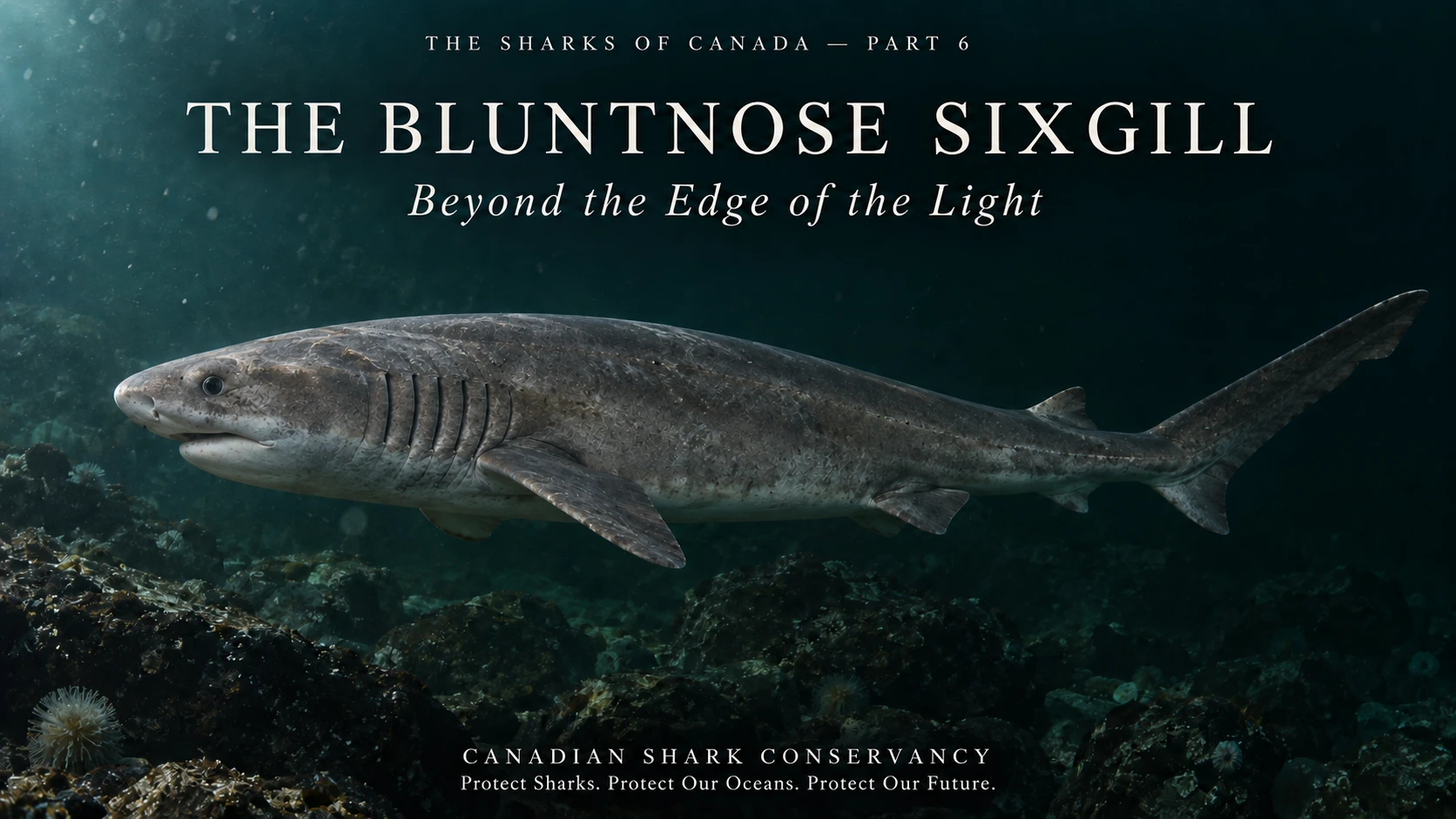
A bluntnose sixgill shark moves above a rocky seabed in an imagined Canadian Pacific scene. Much of this species’ life unfolds beyond ordinary human observation.
Imagine a rocky shoreline in British Columbia.
There are trees above the water, seabirds overhead and the familiar movement of waves against stone. From the shore, the ocean appears to end at its surface.
Beneath it, another landscape begins.
Rock descends into green water. Light weakens. The distance becomes difficult to judge. Then a broad head emerges, followed by a heavy body and a long, sweeping tail.
This is the bluntnose sixgill shark.
In Part 5, we met the basking shark, a giant whose surface appearances became part of Canada’s conservation history. The sixgill takes us into a less visible world—and asks how we care for an animal we rarely encounter.
A different kind of shark
The bluntnose sixgill, Hexanchus griseus, has a distinctive shape: a short, blunt snout, a substantial body and one dorsal fin positioned far back towards the tail.
Its name points to another feature. It has six pairs of gill slits, with six openings along each side of the head. Its long upper tail lobe and relatively small lower lobe give it a different outline from the crescent-tailed salmon shark and porbeagle encountered earlier in this series. Large individuals can exceed four metres. ReefQuest Centre for Shark Research
These details matter because “shark” so often brings one familiar silhouette to mind.
Canada’s waters contain much greater variety. Learning to recognise that variety helps us replace a general impression with knowledge of particular animals.
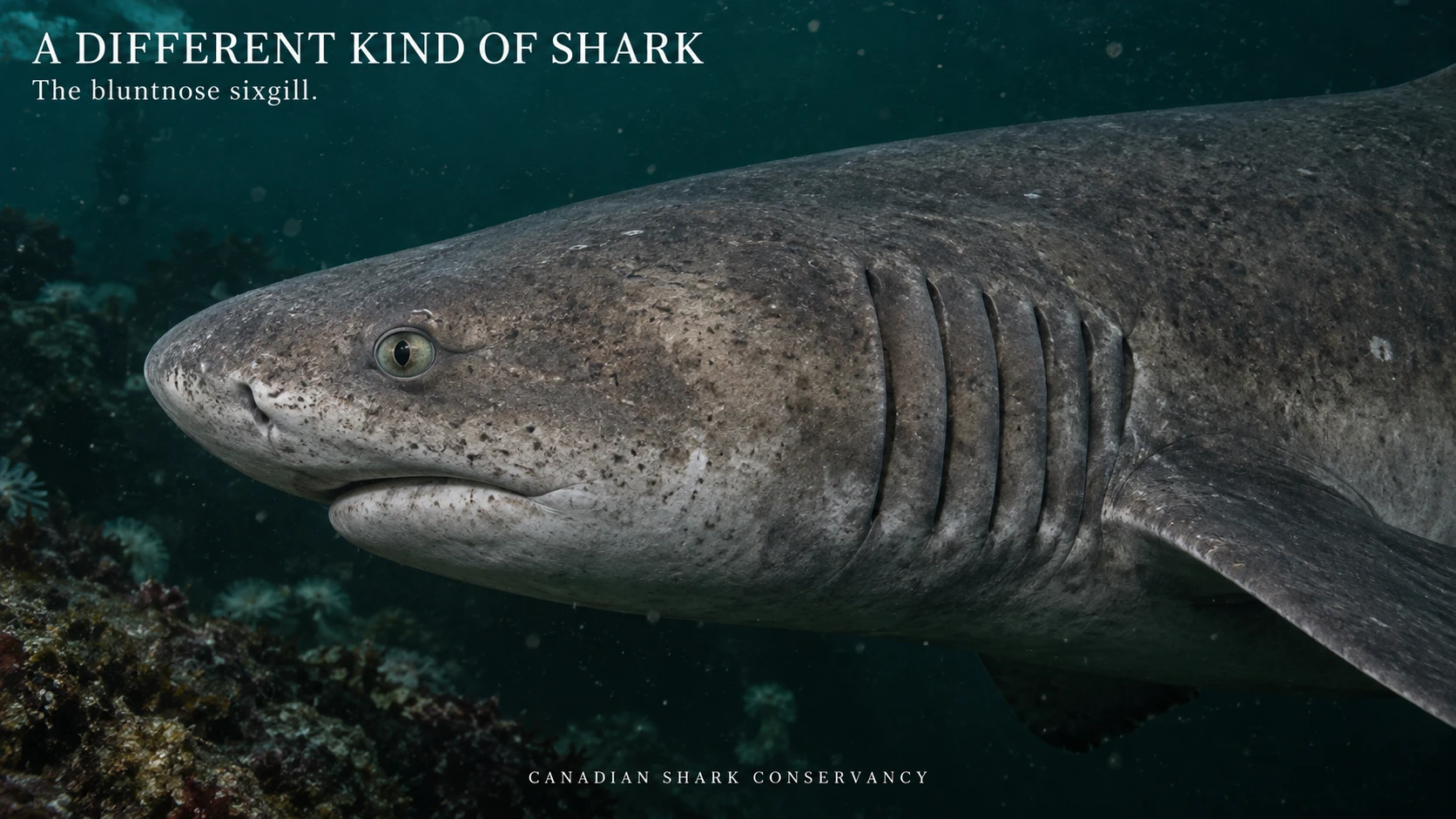
A close view highlights the bluntnose sixgill’s broad snout and six gill openings on each side. Its distinctive features reward a closer look.
Canadian Shark ConservancyView full-size visual ↗Deep water beside a familiar coast
The sixgill’s Canadian story is closely connected to British Columbia.
A 2024 Fisheries and Oceans Canada report describes adults in deeper waters around Queen Charlotte Sound and the west coasts of Vancouver Island and Haida Gwaii. Younger sharks also use shallower bays and inlets, including parts of the Strait of Georgia. DFO’s study of shark distribution in British Columbia
That geography changes how we imagine deep-water wildlife.
We might picture distant expeditions and remote stretches of ocean. Yet a familiar coastline can sit beside habitat that remains difficult to observe. The places people know from ferries, beaches and waterfront communities have underwater dimensions few of us experience.
For a shark, depth is part of its living space.
For researchers, depth helps determine which animals can be seen, sampled or followed—and which remain outside the reach of a particular study.
A remarkable window at Flora Islets
Occasionally, sixgills come within reach of divers.
Research published in 2005 documented sharks visiting a shallow reef at Flora Islets, near Hornby Island, during summer. Using stereo video, researchers measured 35 free-swimming sharks. The measured animals were large juveniles and subadults. Dunbrack and Zielinski, The Canadian Field-Naturalist
Such encounters offer an extraordinary opportunity: studying large sharks alive in their habitat.
They also come with limits. A reef visited by certain sizes of shark at certain times provides a view of part of the population.
Imagine trying to understand an entire city by watching one street for several afternoons. Your observations could be accurate and useful, while leaving whole neighbourhoods and daily routines unseen.
The same care belongs in underwater research.
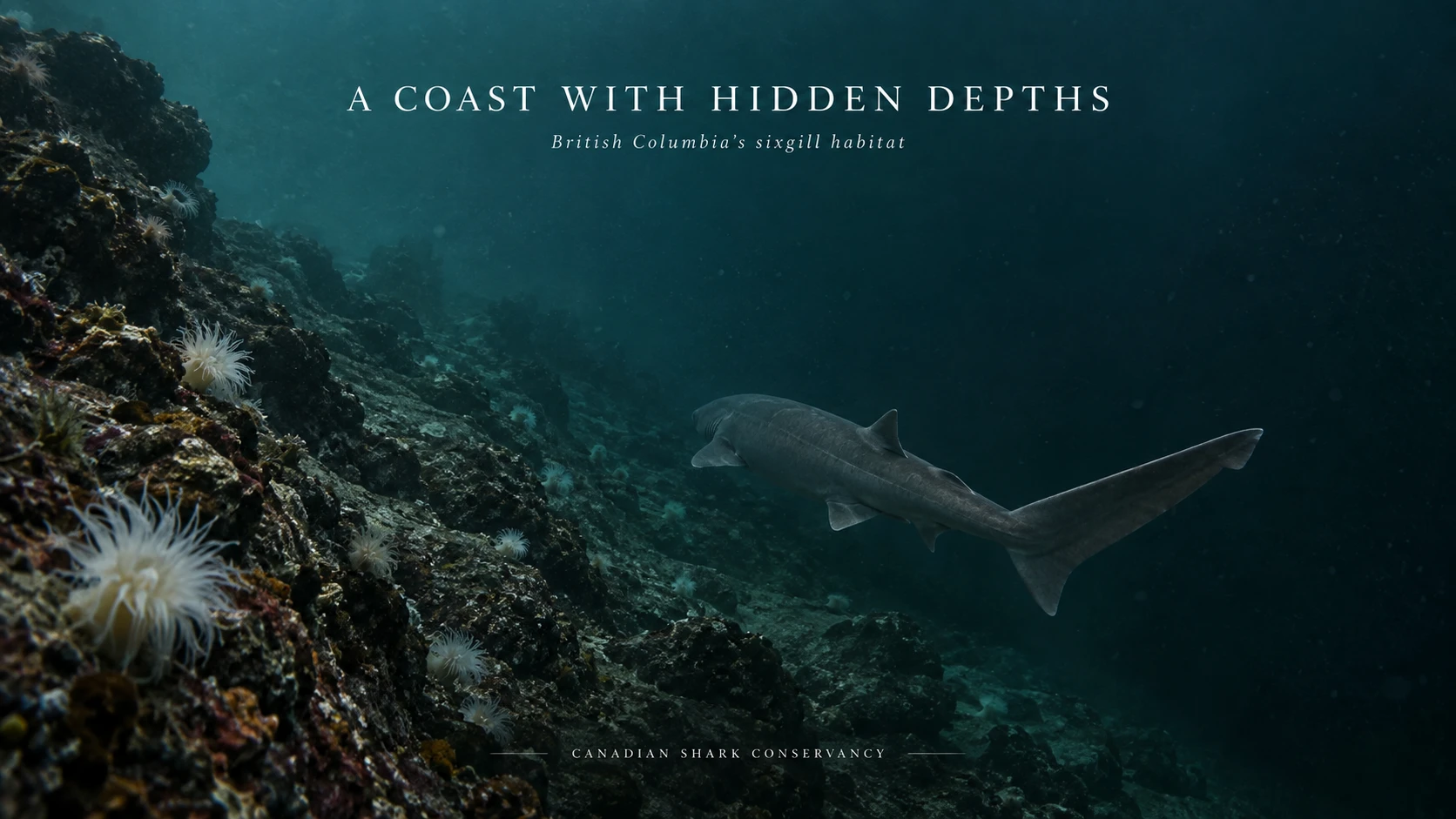
A sixgill passes along an imagined rocky slope in British Columbia. Coastal observations provide valuable glimpses into a species whose habitat extends into deeper water.
Canadian Shark ConservancyView full-size visual ↗What a sighting can—and cannot—tell us
Canada’s 2007 assessment reported a steep decline in sixgill encounters at one shallow Strait of Georgia site. It also cautioned that this measure was unlikely to represent the overall population trend: the observations involved immature sharks at a site shallower than much of the species’ habitat. COSEWIC’s assessment, reproduced in DFO’s management progress report
That distinction remains useful whenever wildlife sightings make headlines.
Fewer encounters should prompt investigation. They do not, by themselves, explain whether animals have died, moved elsewhere or become harder to detect.
Likewise, a spectacular new sighting cannot establish that a population has recovered.
To interpret change, researchers need to understand how observations were collected: where people looked, how often they looked, what conditions they encountered and which animals their methods could detect.
The uncertainty gives the next study its purpose.
An appetite in the depths
Sixgills are predators and scavengers with a varied diet. DFO’s 2024 review describes prey including fishes, cephalopods and crustaceans, as well as records involving other sharks and marine mammals. DFO’s British Columbia shark report
A feeding record can raise as many questions as it answers.
When remains are found in a shark’s stomach, they establish that the animal was eaten. More evidence may be needed to determine whether it was hunted alive or encountered after death.
That difference is easy to lose in a dramatic story about a large predator.
For the sixgill, careful interpretation makes the story richer. It encourages us to ask how food becomes available, how sharks find it and how feeding opportunities vary across habitats.
Out of sight does not mean beyond our influence
The bluntnose sixgill was assessed as Special Concern by COSEWIC in 2007 and listed under Canada’s Species at Risk Act in 2009. DFO’s 2022 management progress report identifies fishing as the principal known threat and describes continuing incidental capture. It also highlights uncertainty about survival after release. DFO management progress report
The Flora Islets research offers a more personal view of that overlap. Of the 35 measured sharks, 13 carried scars consistent with hooking or entanglement in commercial fishing gear. Those observations concern the sharks examined at that site; they are not a coast-wide injury estimate. Dunbrack and Zielinski
Even so, they make something tangible.
An animal can spend much of its life beyond our view and still carry evidence of human activity.
Learning enough to act
Useful Canadian research questions follow naturally.
Which places support young sixgills? How does habitat use change as sharks grow? How often do they encounter fishing gear? What happens after release?
Answering these questions requires sustained observation and cooperation among researchers, fishing communities and others who encounter sharks at sea.
There is also a role for public understanding.
We can learn the species’ name. We can value a careful observation without demanding an exaggerated story. We can support research that produces gradual improvements in knowledge, even when it offers no dramatic new photograph.
An elusive animal deserves attention between sightings.
Beyond the edge of the light
Return to that rocky shoreline.
The forest is still there. Waves still move against the stones. Nothing visible tells you that a large shark may be travelling through the water below.
But knowing about the sixgill changes the view.
The coast now has another inhabitant, another set of movements and another future to consider.
We will never watch every shark or map every journey. We can still make decisions that give these animals room to live—and invest in the knowledge needed to judge whether those decisions are working.
Canada’s shark country continues beyond the edge of the light.
Three oceans. Extraordinary lives. A shared responsibility.
Canadian Shark Conservancy
Protect Sharks. Protect Our Oceans. Protect Our Future.
All accompanying images are AI-generated educational illustrations, not documentary photographs. Graphic credit: Canadian Shark Conservancy.