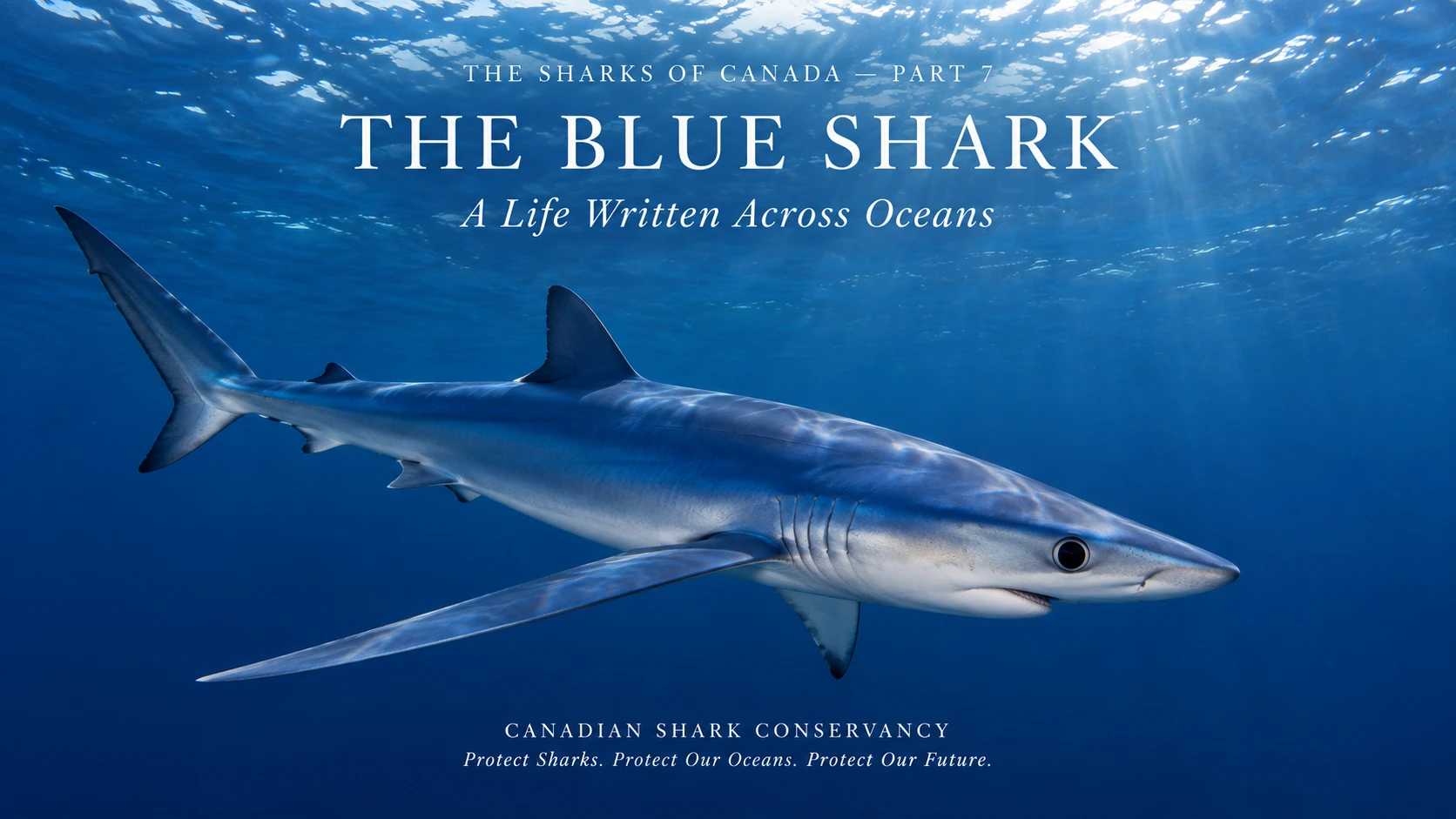
A blue shark glides through an imagined offshore scene. Its slender body, blue colouring and exceptionally long pectoral fins give it a distinctive presence in the open ocean.
Imagine looking down into water with no seabed in sight.
Sunlight breaks across the surface. Below it, blue deepens into blue. There are no rocks to measure distance against, no shoreline to suggest direction.
Then something moves.
A narrow head. A long body. Two sweeping pectoral fins held out into the water.
As the animal turns, its back seems to borrow the colour of the ocean itself.
This is the blue shark.
In Part 6, the bluntnose sixgill brought us into British Columbia’s hidden coastal depths. The blue shark opens another chapter: a life spent travelling through waters that connect Canada to a much larger world.
Recognising the traveller
The blue shark, Prionace glauca, is notable for its slender build, elongated snout and long, narrow pectoral fins. Its colour grades from dark indigo above to brighter blue along the sides and white underneath. Adults commonly measure approximately two to three metres, although larger individuals occur. Fisheries and Oceans Canada species profile
There is something striking about seeing an animal so closely associated with one colour.
Yet recognition involves more than colour alone. The proportions matter: the narrow body, the extended fins, the length of the snout.
Once those details become familiar, the blue shark stops being a generic shark in blue water. It becomes an animal with an identity of its own.
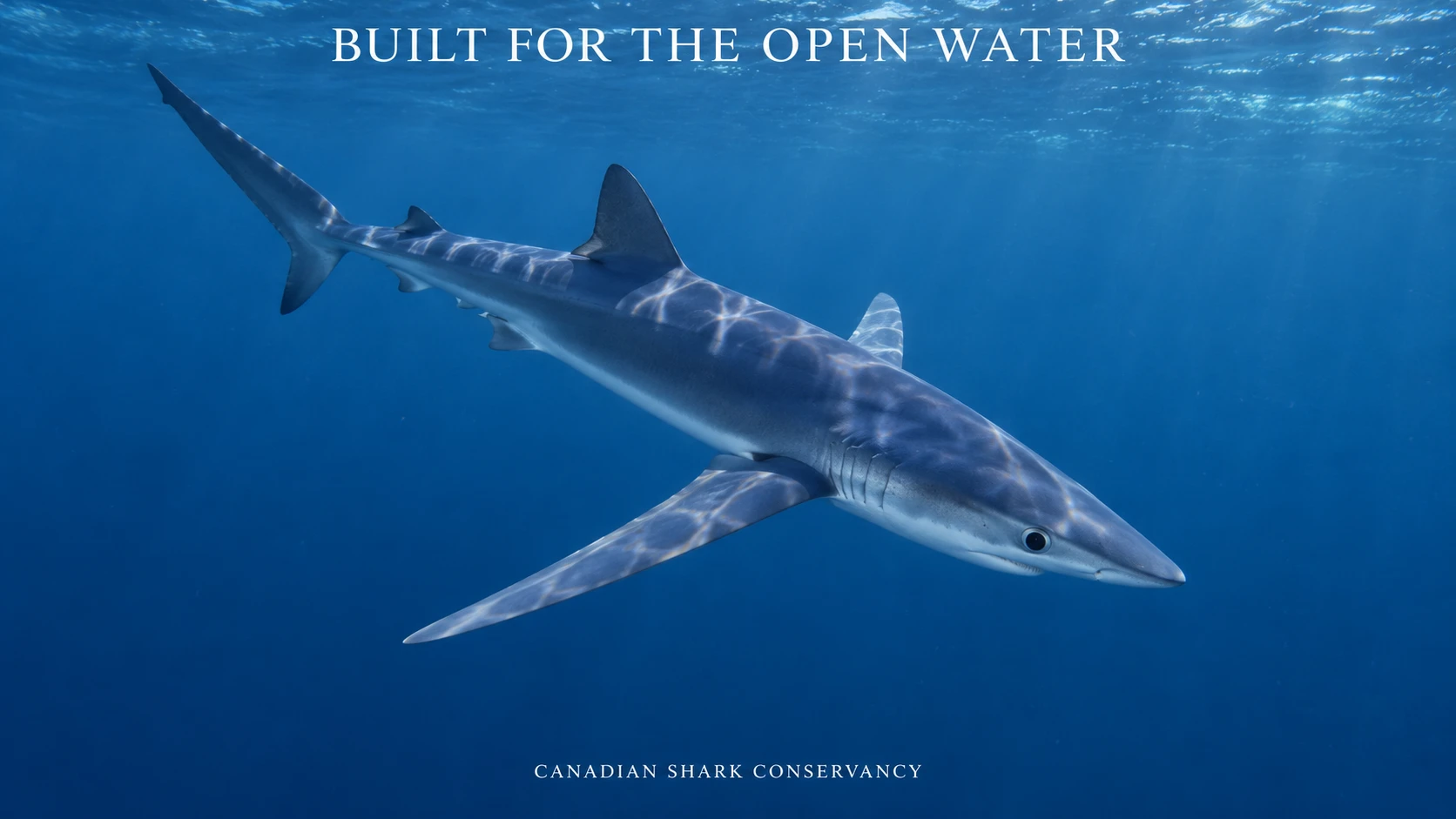
The blue shark’s slender body and long pectoral fins form a recognisable silhouette. This imagined view highlights the proportions that help distinguish the species.
Canadian Shark ConservancyView full-size visual ↗A Canadian story on two coasts
Blue sharks occur off both Atlantic and Pacific Canada.
In the Atlantic, documented locations include the Scotian Shelf, Grand Banks and waters around southeastern Newfoundland. They are commonly seen near the surface over deep water off Nova Scotia and Newfoundland during summer and autumn. In the Pacific, summer occurrences include offshore waters west of Vancouver Island. DFO’s Canadian range and habitat account
These are different parts of a widely distributed species’ range. They do not imply that an individual shark routinely travels between Canada’s two coasts.
The distinction is useful.
A species can connect places in our understanding without every animal sharing the same journey. To learn about individual movements, researchers need more than a distribution map.
They need records that follow animals through time.
A border crossed without a pause
DFO’s research account describes blue shark migrations across the North Atlantic and explains why Canadian observations must be understood within an international population. DFO blue shark research
Consider what that means for an encounter off Nova Scotia.
We see an animal at one moment, within waters we have named and divided. We may photograph it, identify it or record its position.
The shark continues.
Its next feeding opportunity may lie beyond the area being monitored. Its next encounter with fishing gear may occur under another country’s jurisdiction.
A Canadian sighting is one sentence in a much longer story.
That does not make our responsibility smaller. It makes cooperation part of the work.
What the stomach can reveal
Blue sharks feed on fishes and squid, and they also scavenge. DFO feeding account
Canadian research adds local detail. An analysis of stomach contents from 706 sharks caught in Nova Scotia recreational tournaments between 1999 and 2001 found differences associated with sex, maturity and sampling location. The recorded diet included pelagic fishes such as mackerel and herring, alongside groundfish. DFO’s summary of the dietary study
These findings describe sampled animals during a particular period. They cannot become a fixed menu for every blue shark throughout its range.
Instead, they invite a more interesting picture: feeding relationships that vary with the shark, the place and the opportunities available.
The encounter does not end at release
For a shark caught in fishing gear, swimming away is an important moment. Understanding what happens afterwards requires additional evidence.
Canadian researchers used satellite tags to investigate blue shark survival following capture in a pelagic longline fishery. The work, published in 2009, estimated post-release mortality at 19% among sharks released alive. That estimate belongs to the study’s animals and fishing conditions; it is not a universal rate for every fishery or release. Campana, Joyce and Manning, 2009
The study illustrates why conservation cannot count only the animals brought ashore.
Some consequences remain underwater, unfolding after a vessel has moved on.
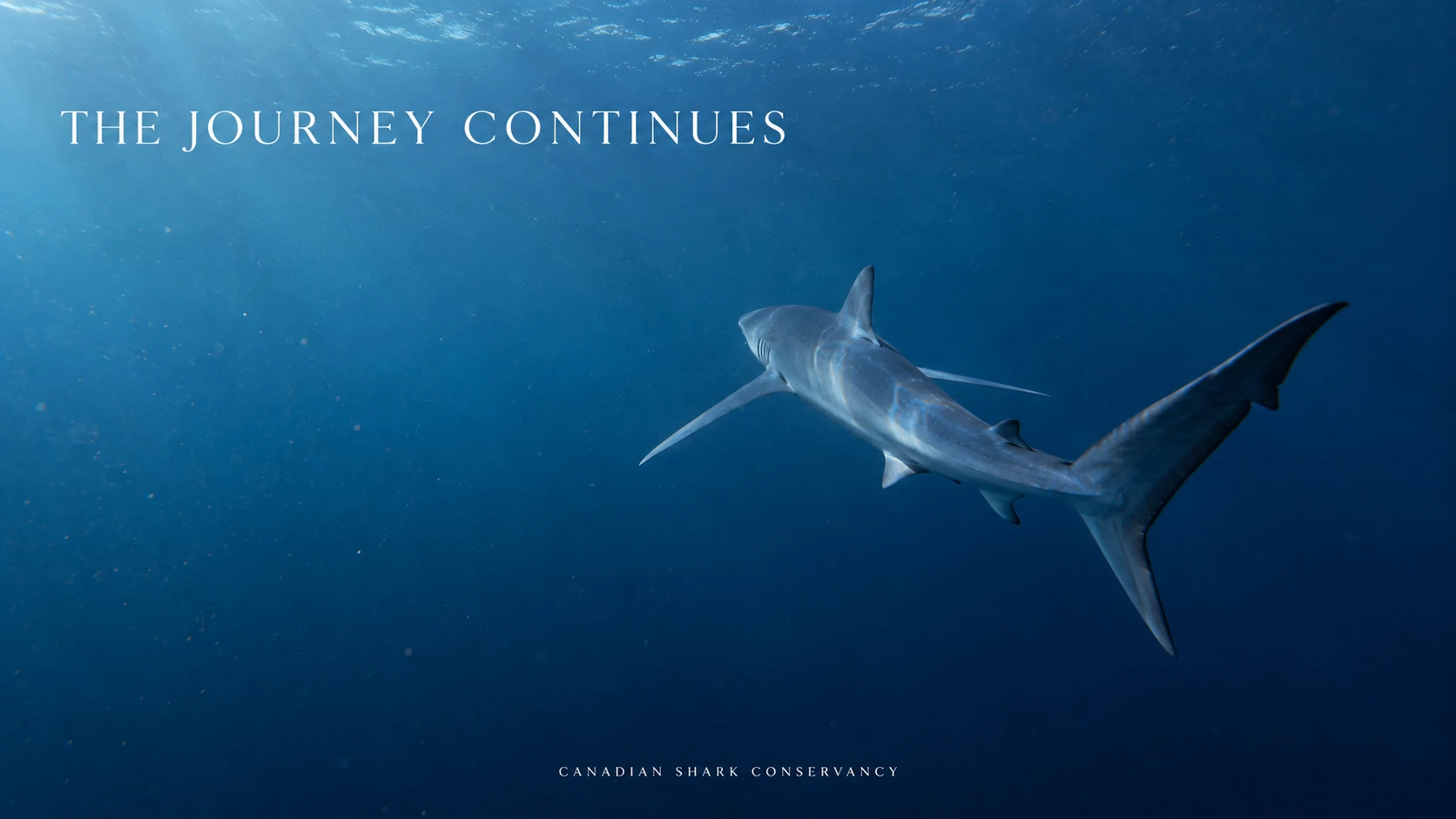
A blue shark disappears into open water in this conceptual scene. Research following captured sharks helps reveal whether their journeys continue after release; this image does not depict a documented release.
Canadian Shark ConservancyView full-size visual ↗Reading the assessment carefully
The blue shark’s conservation story also requires care with reassuring headlines.
ICCAT’s 2025 summary reports a North Atlantic assessment conducted in 2023 using data through 2021. Its median estimates placed fishing pressure below the overfishing threshold and biomass approximately at the reference level used to distinguish an overfished stock. However, uncertainty around biomass was substantial, with roughly equal probability on either side of that boundary. ICCAT blue shark executive summary
Those findings concern the North Atlantic stock. They should not be applied automatically to Pacific sharks.
They also show why an assessment deserves more attention than a single status label. Dates, geographical scope and uncertainty all influence what the result can tell us.
Careful conservation can recognise encouraging evidence while continuing to monitor risk.
Protecting the journey
The practical questions are straightforward, even when answering them takes years.
Where do sharks overlap with fisheries? Which practices reduce mortality? How reliably are captures and discards recorded? Can countries combine their observations into a more complete account?
These questions turn admiration into useful work.
Return to the shark beneath the surface.
Its long fins tilt. Light moves across its back. For a few seconds, its outline is unmistakable. Then the surrounding blue absorbs it.
We do not know where that particular animal will go.
We know enough to understand that its future will depend on decisions made in more than one place.
Canada is part of that journey.
Our care should travel further than the encounter.
Three oceans. Extraordinary lives. A shared responsibility.
Canadian Shark Conservancy
Protect Sharks. Protect Our Oceans. Protect Our Future.
Next: the shortfin mako, an offshore predator whose speed contrasts with the time its population needs to recover.
All accompanying images are AI-generated educational illustrations, not documentary photographs. Graphic credit: Canadian Shark Conservancy.