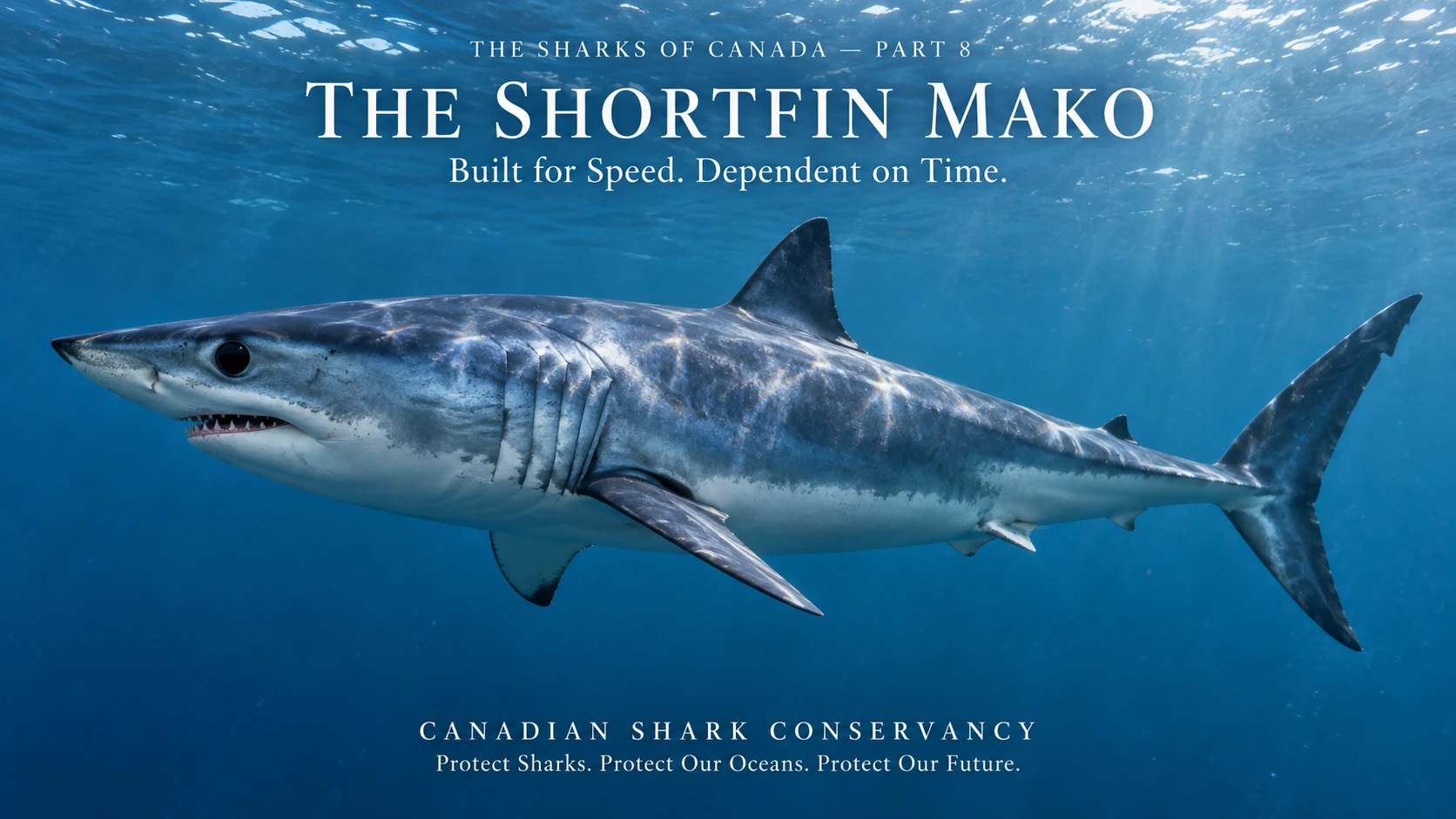
A shortfin mako moves through an imagined Atlantic scene. Its streamlined body and powerful tail support an active life, while its reproductive biology sets a much slower pace.
Imagine an offshore encounter in clear Atlantic water.
The surface shifts above you. Light reaches down in uneven columns. Small fishes turn together, briefly flashing silver.
Then a different shape enters the scene.
A pointed snout. A muscular body narrowing towards a powerful tail. Blue along the back, white beneath.
The impression is immediate: movement, strength, purpose.
This is the shortfin mako.
After the blue shark’s long-finned silhouette in Part 7, the mako presents another way to inhabit the open ocean.
Its story also asks us to hold two very different ideas together.
An animal can be remarkably capable in the water and exceptionally vulnerable to sustained fishing pressure.
Meet the shortfin mako
The shortfin mako, Isurus oxyrinchus, has a streamlined, spindle-shaped body, a sharply pointed snout and a crescent-shaped tail. Its narrow teeth differ from the broad triangular teeth commonly associated with white sharks. Some lower teeth remain visible even when its mouth is closed.
Its pectoral fins are shorter than those of the closely related longfin mako. The underside of the shortfin mako’s snout and the area around its mouth are typically white. Florida Museum species profile
These features deserve attention before any discussion of speed.
The mako is more than a record or a dramatic encounter. Its anatomy tells a story worth learning in its own right.
A seasonal Canadian presence
Canada’s 2019 COSEWIC assessment describes the shortfin mako as a highly migratory summer and autumn visitor to Atlantic Canadian waters. Records include the continental shelf off Nova Scotia, Georges and Browns banks, the Grand Banks and the Gulf of St. Lawrence.
Canadian waters represent the northern portion of a much wider North Atlantic distribution. Temperature strongly influences habitat use, with makos often associated with warmer offshore waters. COSEWIC’s 2019 assessment
Seasonal presence still makes a place part of an animal’s life.
A shark does not need to remain beside our coast throughout the year for its time here to matter. Feeding opportunities, encounters with fisheries and survival during a seasonal visit all contribute to what happens next.
An anatomy of motion
The mako’s narrow tail base and crescent-shaped tail are central to its swimming design. Its diet includes active oceanic fishes and squid. Florida Museum’s biology account
Like the salmon shark and porbeagle featured earlier in this series, the shortfin mako has endothermic adaptations that allow it to retain metabolic heat. Canada’s assessment identifies this physiology as supporting activity in cooler water. COSEWIC physiology account
There would be no visible glow during an encounter.
The physiology is beneath the skin. What we would see is its outcome: an animal moving through the water, responding to the world around it.
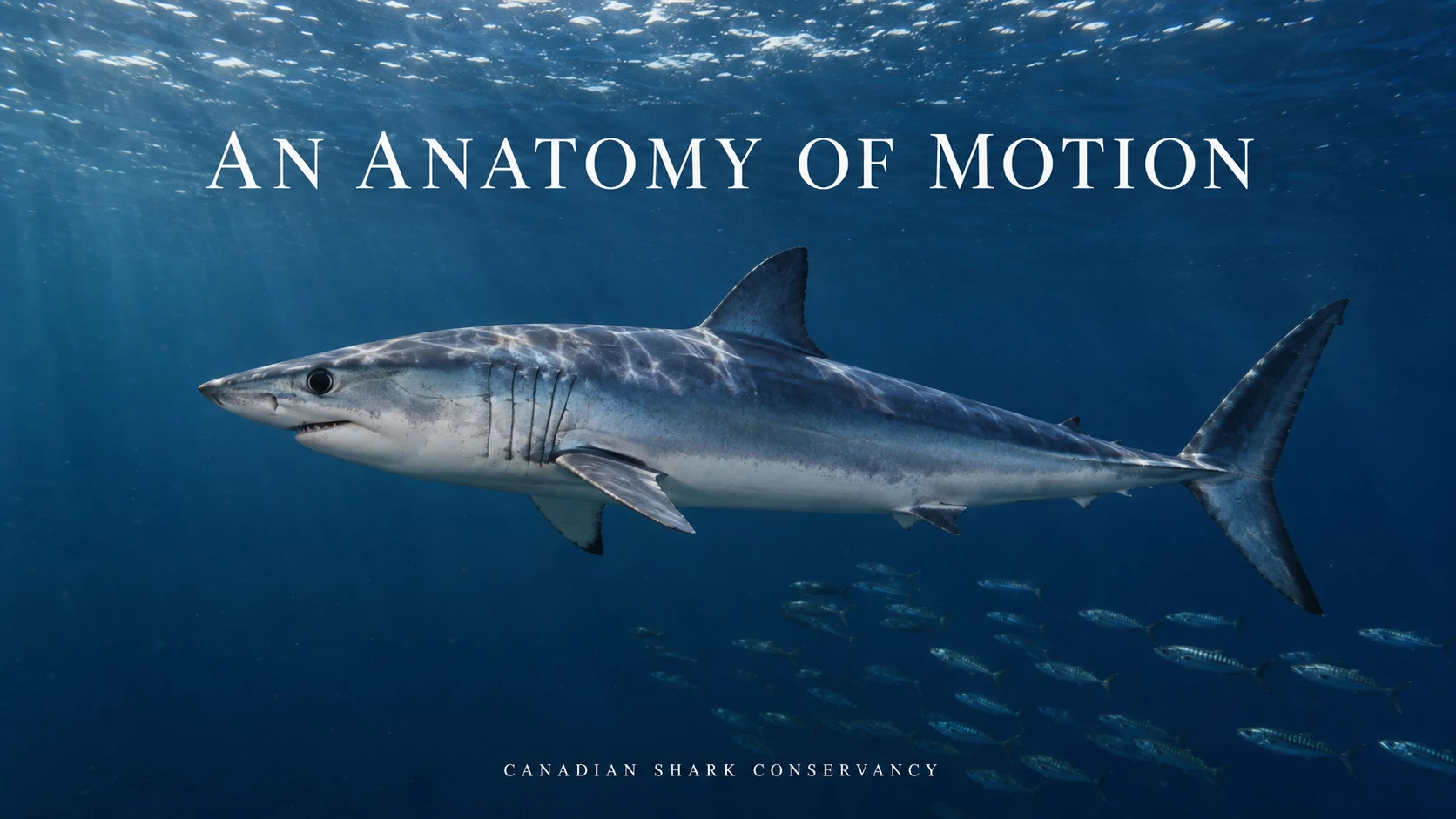
The shortfin mako’s streamlined body, relatively short pectoral fins and crescent-shaped tail contribute to its distinctive form. The accompanying fishes provide ecological context, rather than depicting a documented hunt.
Canadian Shark ConservancyView full-size visual ↗The slower clock beneath the surface
Reproduction follows a different timescale.
NOAA’s Atlantic species account places maturity at approximately eight years for males and nineteen years for females, with a reproductive cycle of roughly three years. These are biological estimates, with variation among individuals. Females give birth to live young. NOAA Fisheries
Think about a female approaching maturity.
Years of feeding, travelling and surviving may pass before she produces her first litter. Her future contribution then depends on surviving through additional reproductive cycles.
Swimming ability cannot shorten all of those years.
This is why a population can lose animals much faster than it replaces them—and why protection must consider the lives ahead of the sharks that remain.
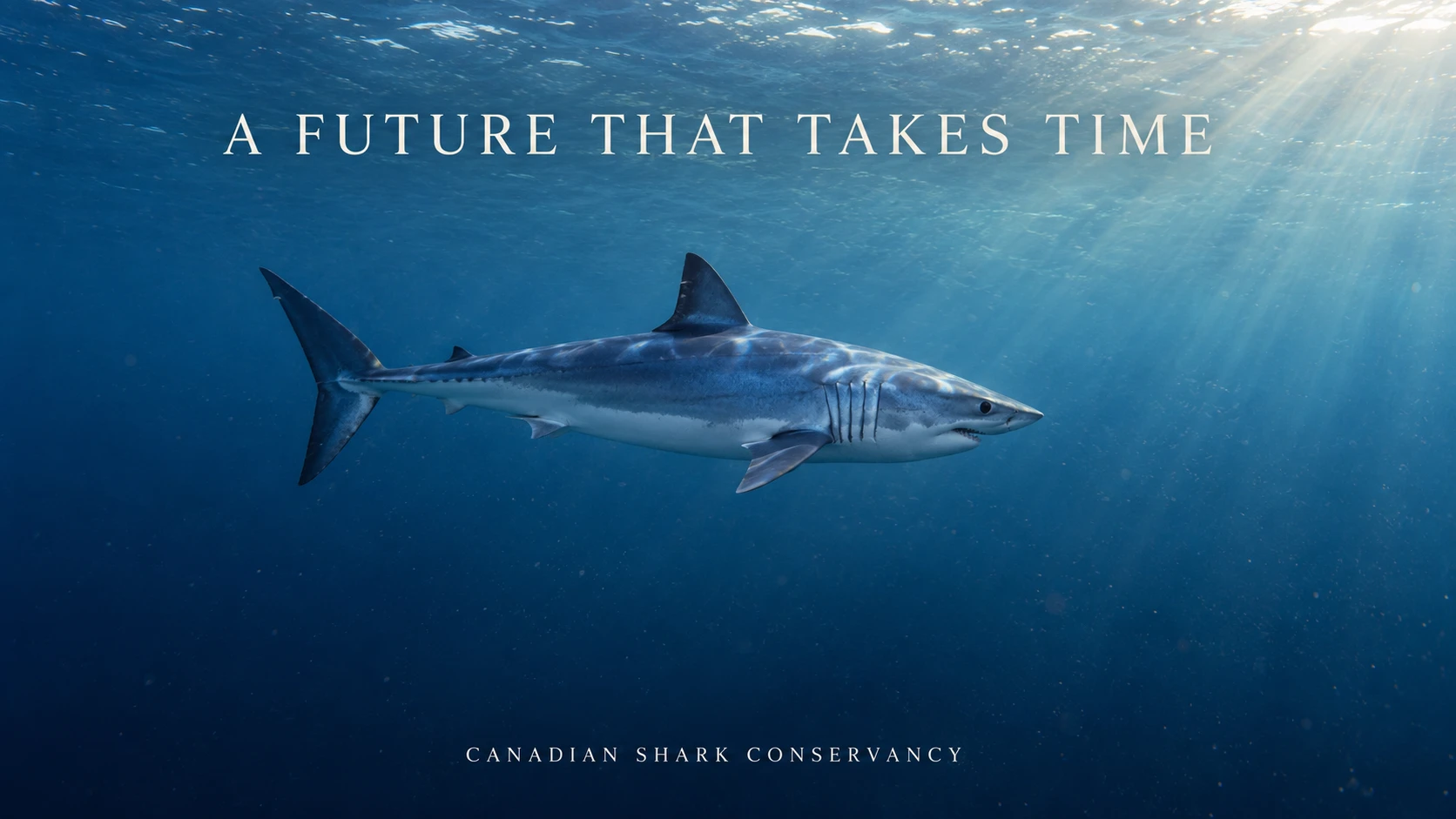
A solitary mako crosses an imagined offshore scene. Late maturity and years between litters help explain why conservation must protect future reproductive opportunities.
Canadian Shark ConservancyView full-size visual ↗What Canada’s assessment tells us
COSEWIC assessed the Atlantic population of shortfin mako as Endangered in 2019. The federal government’s consultation material explains that slow growth, late maturity and low reproductive rates increase vulnerability to fishing pressure.
That scientific assessment and legal listing under the Species at Risk Act are separate steps. An assessment communicates extinction risk; legal listing follows a government decision. Government of Canada consultation document
Keeping those distinctions clear helps readers understand both the evidence and the decisions that follow it.
It also prevents the word “protected” from becoming a substitute for asking what is happening to animals at sea.
Why the dates matter
International assessments add another layer.
ICCAT’s 2025 summary states that its attempted North Atlantic assessment that year did not produce reliable results. Consequently, the stock-status information it presented continued to rely on the 2017 assessment, with updated projections developed in 2019. Those earlier findings indicated an overfished stock and excessive fishing pressure. ICCAT shortfin mako executive summary
This is a dated account of the evidence, not a claim that researchers measured the same conditions again in 2025.
The distinction matters because uncertainty can be misunderstood in opposite ways. It can be hidden behind excessive confidence, or treated as a reason to disregard an established conservation concern.
A more useful response is to state what the evidence shows, identify what needs updating and continue reducing avoidable harm.
A shared ocean requires shared action
DFO’s recovery-potential assessment identifies fishing mortality across the North Atlantic as central to the mako’s prospects. Its analysis also makes clear that Canadian measures operate within a much larger international picture. DFO recovery-potential assessment
That is the challenge of conserving a traveller.
A shark may survive one encounter and face another elsewhere. Progress in one fishery can be weakened by losses in another. A population’s recovery depends on what happens across those encounters over many years.
For Canada, useful work includes reliable bycatch records, research on survival after capture and sustained participation in international conservation.
For readers, the task begins with asking better questions.
Are fewer sharks dying? Are catches being recorded accurately? Are enough animals surviving to reproduce?
Those questions bring conservation back to its purpose.
Making room for time
Return to the imagined mako.
For a moment, the entire animal is visible. Its pointed snout, the dark eye, the tail moving through blue water.
Then it turns and disappears.
The encounter may have lasted seconds. The life ahead of that shark could extend across decades.
That is the future we should picture when we talk about protection: feeding, travelling, growing and eventually contributing to another generation.
The shortfin mako’s speed can capture our attention.
Its need for time should hold it.
Three oceans. Extraordinary lives. A shared responsibility.
Canadian Shark Conservancy
Protect Sharks. Protect Our Oceans. Protect Our Future.
All accompanying images are AI-generated educational illustrations, not documentary photographs. Graphic credit: Canadian Shark Conservancy.