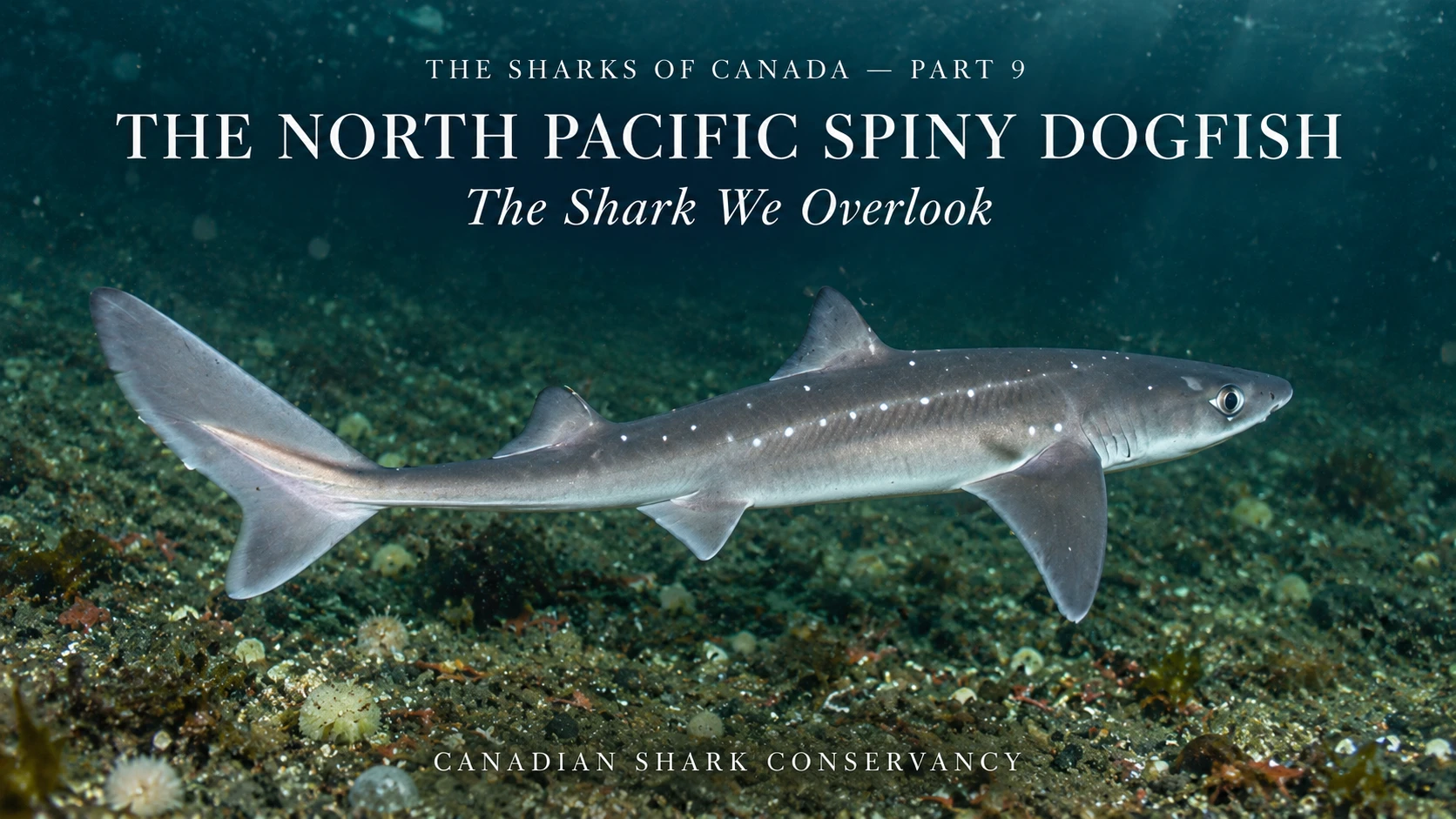
A North Pacific spiny dogfish glides above the seabed in an imagined British Columbia scene. Its small size gives little indication of the decades its life may span.
Imagine hovering above a gravel seabed off British Columbia.
The water is green. Fragments of shell catch the light. Beyond the reach of your view, the bottom disappears into a soft haze.
Then a shark passes.
There is no immense shadow, no dramatic change in the scene. A slender grey body moves close enough for you to notice pale spots along its sides. The tail sweeps steadily. Within seconds, it is gone.
Someone might describe the encounter as “just a dogfish.”
But that small word—just—can hide an extraordinary animal.
After the blue shark’s ocean journeys and the shortfin mako’s powerful silhouette, our series turns toward a shark that asks us to look more closely.
A familiar name, two different species
The North Pacific spiny dogfish is Squalus suckleyi. Its Atlantic relative is Squalus acanthias.
For many years, the Pacific shark was treated as the same species as the Atlantic one. A taxonomic reassessment in 2010 recognised the distinction, supported by differences in anatomy and genetics. Older publications may therefore use Squalus acanthias when discussing Pacific animals. Fisheries and Oceans Canada, Pacific spiny dogfish research
That change matters whenever we tell their stories. A lifespan estimate or population finding from one ocean should not automatically become a claim about the other.
This article follows the North Pacific species—the dogfish of Canada’s west coast.
Learning to recognise the smaller shark
DFO describes a grey-to-brown back, pale underside, two dorsal fins with a spine in front of each, and no anal fin. Its Pacific profile lists a maximum length of about 1.6 metres—roughly five feet. Fisheries and Oceans Canada, Pacific spiny dogfish profile
Look at the whole animal. Notice the slender body, the proportions of the fins and the tail. The familiar outline of a white shark is only one of many ways a shark can look.
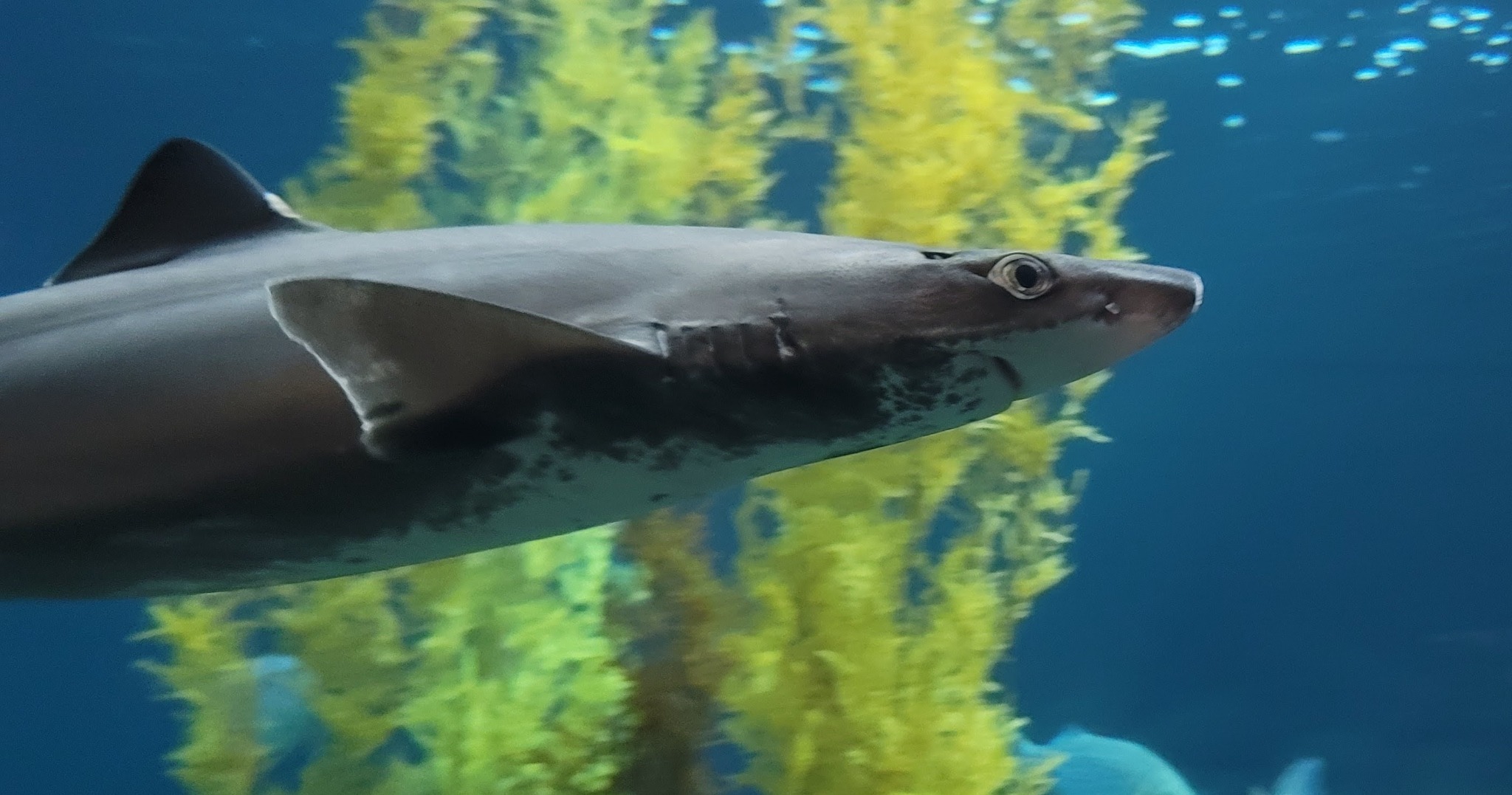
A Pacific spiny dogfish at Monterey Bay Aquarium, California. This close view offers a chance to study the species’ head and fins; it is an aquarium photograph, not a Canadian wildlife encounter.
Photograph: Macrophyseter, own work, CC BY-SA 4.0. Supplied image reproduced without further editing.
View full-size photographA small shark with a long life
Body size can be a poor guide to the pace of a life.
DFO reports that Pacific spiny dogfish can live for more than 80 years. Tagging work also revealed substantial journeys: some animals tagged off western Canada were subsequently found as far away as Japan and Mexico. Those records demonstrate what individuals can do; they do not describe a journey undertaken by every dogfish. Fisheries and Oceans Canada, Pacific spiny dogfish research
Its reproductive timetable is equally striking.
COSEWIC’s 2011 report summarised an estimated age of about 35 years at which half of females in the northeast Pacific were mature. It described gestation lasting approximately 18–24 months and an average litter of six live pups. These are research estimates, with variation among individuals and studies. COSEWIC, North Pacific Spiny Dogfish assessment and status report, 2011
Pause over those numbers.
A female may spend decades growing before reproducing. A pregnancy can extend across nearly two years. Replacing an animal lost today is a process measured on a very different clock from the one that governs a fishing season or an annual budget.
Small does not mean quickly replaced.
A place in the food web
North Pacific spiny dogfish eat a variety of fishes and invertebrates. Their diet changes with size and with the feeding opportunities available. COSEWIC’s account describes juveniles feeding primarily on midwater invertebrates, with fishes becoming more important as the sharks grow. Herring feature prominently in that account. COSEWIC, North Pacific Spiny Dogfish assessment and status report, 2011
This makes the dogfish part of a larger living system: prey, predators and changing conditions all connected beneath the surface.
Eating a commercially valuable fish does not, by itself, show that a predator is responsible for that fish population’s decline. Understanding the relationship requires evidence about consumption, abundance and other sources of mortality.
The useful question is what role the shark plays—and how that role changes across places and years.
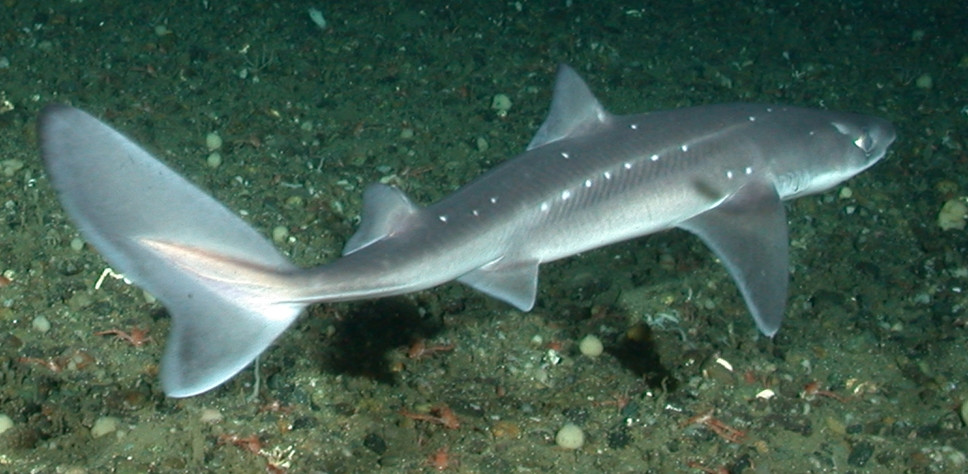
A wild spiny dogfish photographed in Olympic Coast National Marine Sanctuary off Washington State. The photograph shows part of the species’ wider northeastern Pacific setting; it was not taken in Canada.
Photograph: NOAA, public domain. Supplied image reproduced without editing.
View full-size photographWhat the recent Canadian assessment tells us
Familiarity is not a population assessment.
DFO’s 2025 science advisory report, covering population modelling for British Columbia’s outside waters in 2024, estimated that the outside stock was below its limit reference point in 2023 with greater than 95% probability, placing it in the Critical Zone. Fisheries and Oceans Canada, Science Advisory Report 2025/032
The geographic boundary matters: this assessment addressed the outside stock, not the separately assessed inside waters of Johnstone Strait and the Strait of Georgia. The category describes fisheries stock status; it is not a species-at-risk legal designation.
Researchers used reproductive output—the number of pups produced—to evaluate stock condition. This keeps attention on the population’s capacity to replace itself.
A history that reaches into the present
The same assessment traced a sharp decline in reproductive output during the 1940s vitamin A fishery, followed by a partial rebound and further decline. It also identified uncertainty about natural mortality, survey trends and deaths after discarding. Fisheries and Oceans Canada, Science Advisory Report 2025/032
A shark released from fishing gear may survive, but release alone cannot prove that outcome. Understanding those losses remains important.
The practical task is sustained monitoring, better survival evidence and decisions that account for slow reproduction.
Giving the overlooked our attention
Return to the gravel seabed.
The dogfish is already beyond your view. Nothing about its passing announced a long life, a prolonged pregnancy or the history of a fishery that began before many of us were born.
Those things became visible only when we looked beyond the encounter.
That is part of conservation: learning to care about what an animal’s appearance cannot tell us.
Canada’s shark story includes giants and travellers, fast swimmers and deep-water mysteries. It also includes a small grey shark that deserves to be recognised before familiarity becomes indifference.
The next time someone says “just a dogfish,” there is another story to tell.
Three oceans. Extraordinary lives. A shared responsibility.
Canadian Shark Conservancy
Protect Sharks. Protect Our Oceans. Protect Our Future.
Next in The Sharks of Canada: the common thresher shark—a tail like no other.
Hero: AI-generated educational illustration created for Canadian Shark Conservancy using the public-domain NOAA photograph as an anatomical reference; not a documentary photograph. Supporting photographs are credited individually above. Neither photograph depicts a Canadian location.