
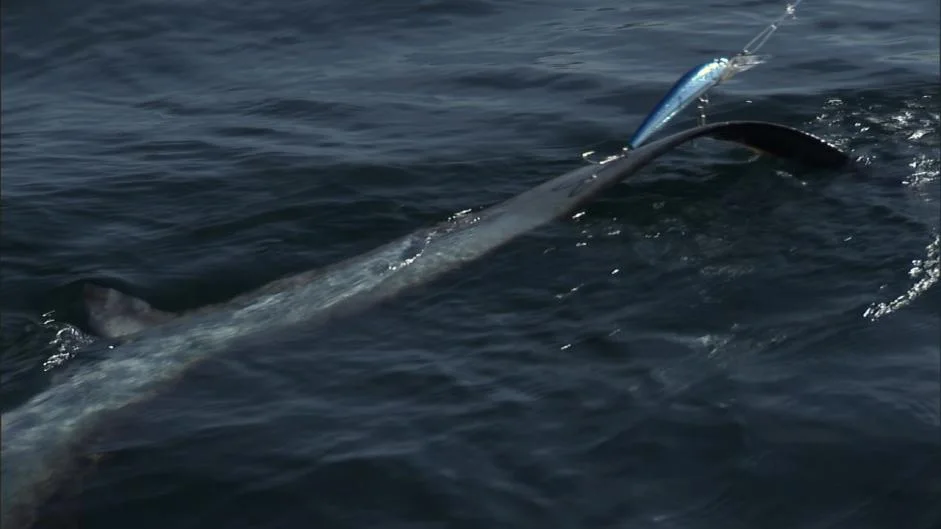
Hero: a common thresher hooked by the tail off southern California. NOAA/PIER public-domain photograph; WebP conversion only. This is a documented fishery interaction, not a Canadian sighting.
Imagine the outline of a shark moving beneath the surface. Your eye follows the body, reaches the tail—and keeps going. The common thresher’s upper tail lobe can make up roughly half its total length. It is one of the ocean’s most distinctive silhouettes. [1]
That shape belongs in Canada’s marine story. The common thresher shark, Alopias vulpinus, connects seasonal Atlantic visits and rare British Columbia records with a life extending beyond our coastlines. [1, 2]
A Canadian visitor with an ocean-wide story
DFO describes the common thresher as a summer visitor to Atlantic Canada, with records extending north to eastern Newfoundland. Its Atlantic account reports captures from July through November, most often in August and September. These records describe encounters; they do not measure how many sharks are present or establish year-round residence. [1]
On the Pacific coast, DFO identifies the species as rare in British Columbia. “Common” is its species name, not a promise that you will commonly see one here. Each well-documented encounter can help us understand Canadian shark diversity. [2]
The tail has a job
Common threshers eat schooling fishes and squid. The remarkable tail contributes to feeding as well as movement. Aalbers, Bernal and Sepulveda recorded feeding behaviour off southern California: the common threshers’ observed feeding events began with the upper tail lobe. This is direct evidence for tail-assisted hunting in this species. [3, 4]
The distinction matters. Widely shared footage from tropical dive sites often shows the pelagic thresher, Alopias pelagicus. Related animals can teach us about their family, while species-specific observations tell us which claims belong to the common thresher.
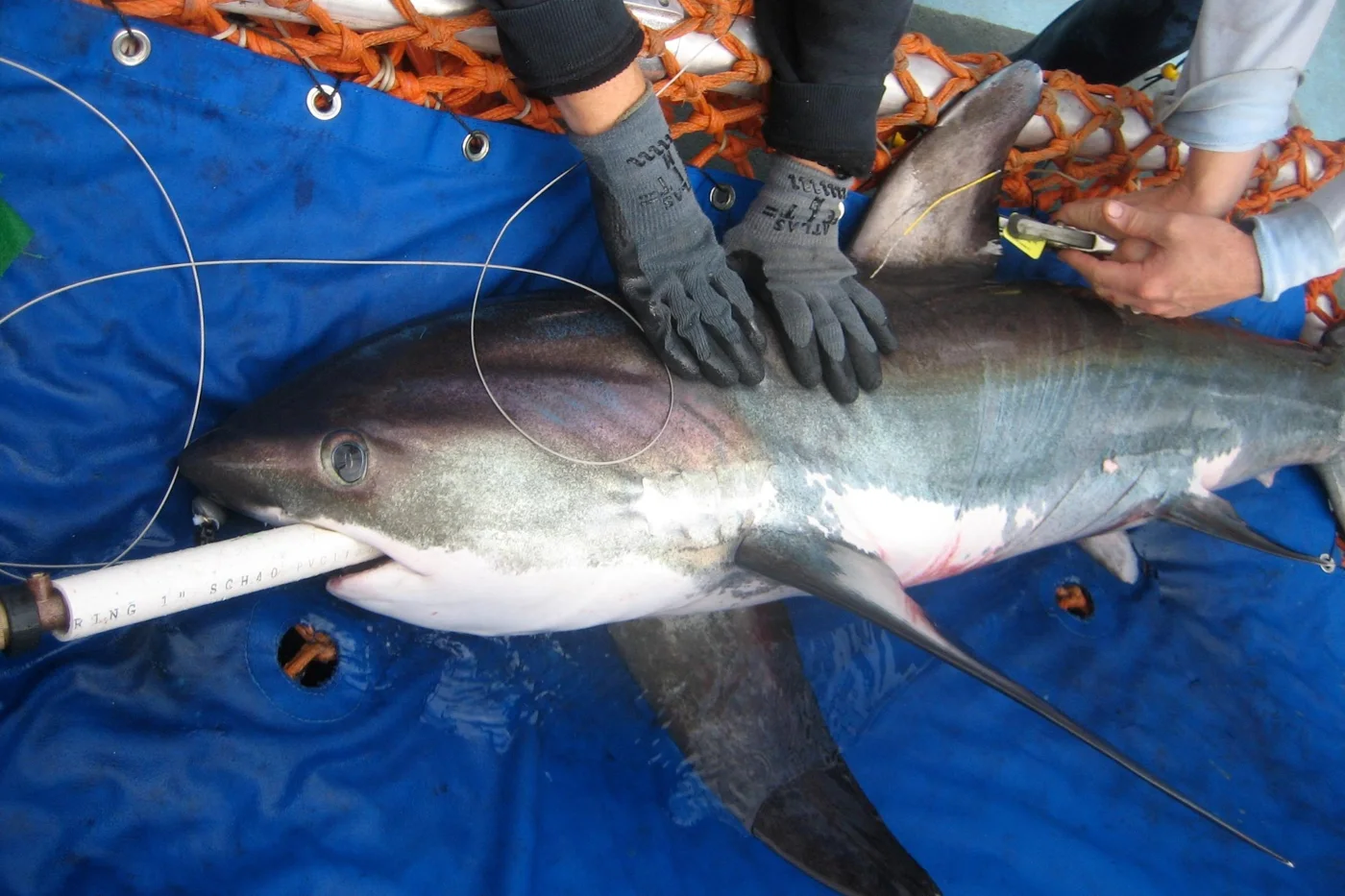
Common thresher tagged and released alive during the 2009 Channel Islands survey. A hose supplies seawater across its gills during handling. WebP conversion and proportional resize; no cropping or content changes.
View full-size photographThree threshers, three identities
The common thresher, bigeye thresher and pelagic thresher are separate species in the genus Alopias. The bigeye thresher has especially large eyes and a distinctive contour to its head. DFO provides a separate identification account for it. A long tail alone is not enough to assign every photograph to Alopias vulpinus. [5, 6]
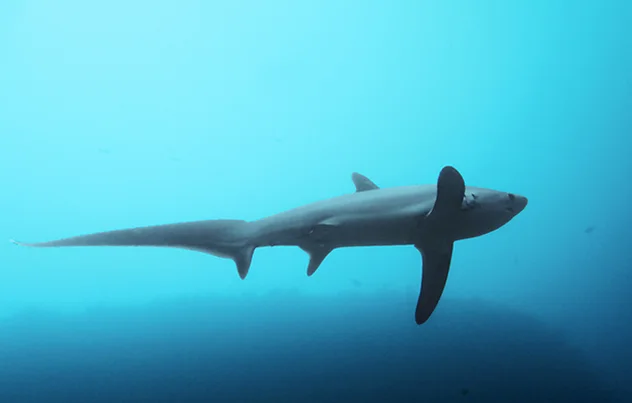
This supplied photograph is catalogued on Wikimedia Commons as Alopias pelagicus. It is shown for comparison only, was taken in the Philippines and does not document a Canadian common thresher. WebP conversion only; no cropping or content changes.
View full-size photograph
A life that takes time to replace
NOAA’s Atlantic profile describes common threshers as long-lived, slowly growing sharks with few young. Its Pacific profile describes live birth, usually two to four pups after roughly nine months of development. Reproductive estimates vary among populations, so regional numbers need to stay connected to their evidence. [3, 7]
That life history gives conservation a time dimension. Removing a shark is immediate. Replacing its contribution to a population depends on surviving animals, successful reproduction and the conditions their offspring encounter.
Read the conservation labels carefully
The Convention on Migratory Species reports the common thresher’s IUCN global category as Vulnerable. Its account describes pressure from targeted fisheries and incidental capture, together with low productivity that can slow recovery. [8]
NOAA separately reports the U.S. Pacific stock as not overfished and not subject to overfishing under its 2018 assessment. That regional stock finding does not replace the global category, describe every population or assign a Canadian legal status. Conservation decisions depend on knowing which population and assessment a statement refers to. [3]
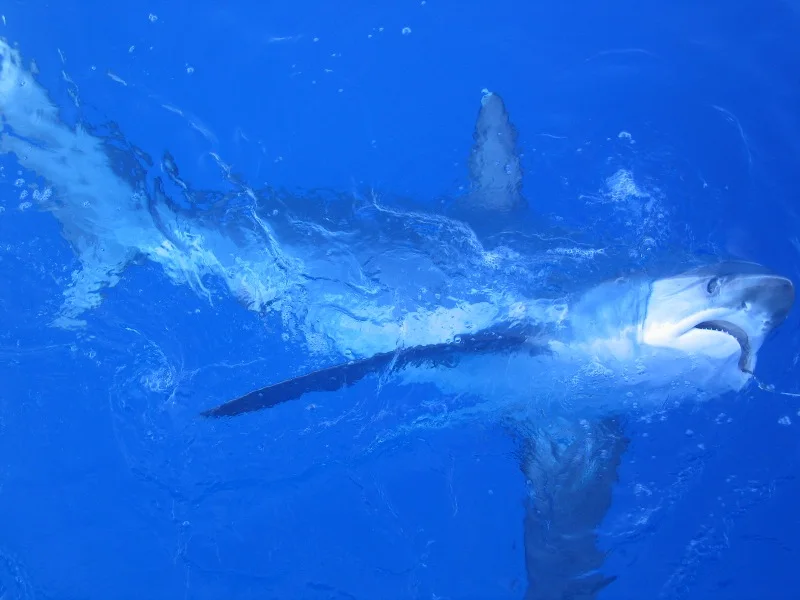
Common thresher caught on a longline; a photograph of a fishery interaction. WebP conversion and proportional resize; no cropping or content changes.
View full-size photographMake room for the whole animal
This is a wildlife profile, with no home-aquarium recommendation. Its active life and elongated tail raise substantial housing and welfare questions. The sources reviewed here do not establish a validated long-term captive-care protocol, minimum tank volume or water targets. Wild measurements should not become aquarium prescriptions.
DFO encourages reporting shark encounters in British Columbia, with its stated North Pacific spiny dogfish exception. If you encounter a shark, observe respectfully and document the date, location and photographs when safe. Follow current DFO reporting guidance rather than pursuing or handling an animal for a better picture. [2]
The tail is the feature we remember first. The larger story includes prey, movement, reproduction, fishing pressure and the evidence that helps us understand all of them. Curiosity can begin with a silhouette. Stewardship asks us to keep learning about the life attached to it.
Protect Sharks. Protect Our Oceans. Protect Our Future.
Explore the species
Common thresher in the Marine Life Library · CSC common thresher field guide
Sources and further reading
[1] DFO — thresher shark, Atlantic Canada
[2] DFO — common thresher shark, Pacific Canada
[3] NOAA Fisheries — Pacific common thresher shark
[4] Aalbers, Bernal & Sepulveda (2010) — common thresher tail-assisted feeding
[5] DFO — bigeye thresher identification
[7] NOAA Fisheries — Atlantic common thresher shark
[8] CMS Sharks — Alopias vulpinus, global conservation context