They don’t live in Canada. They return to Canada.
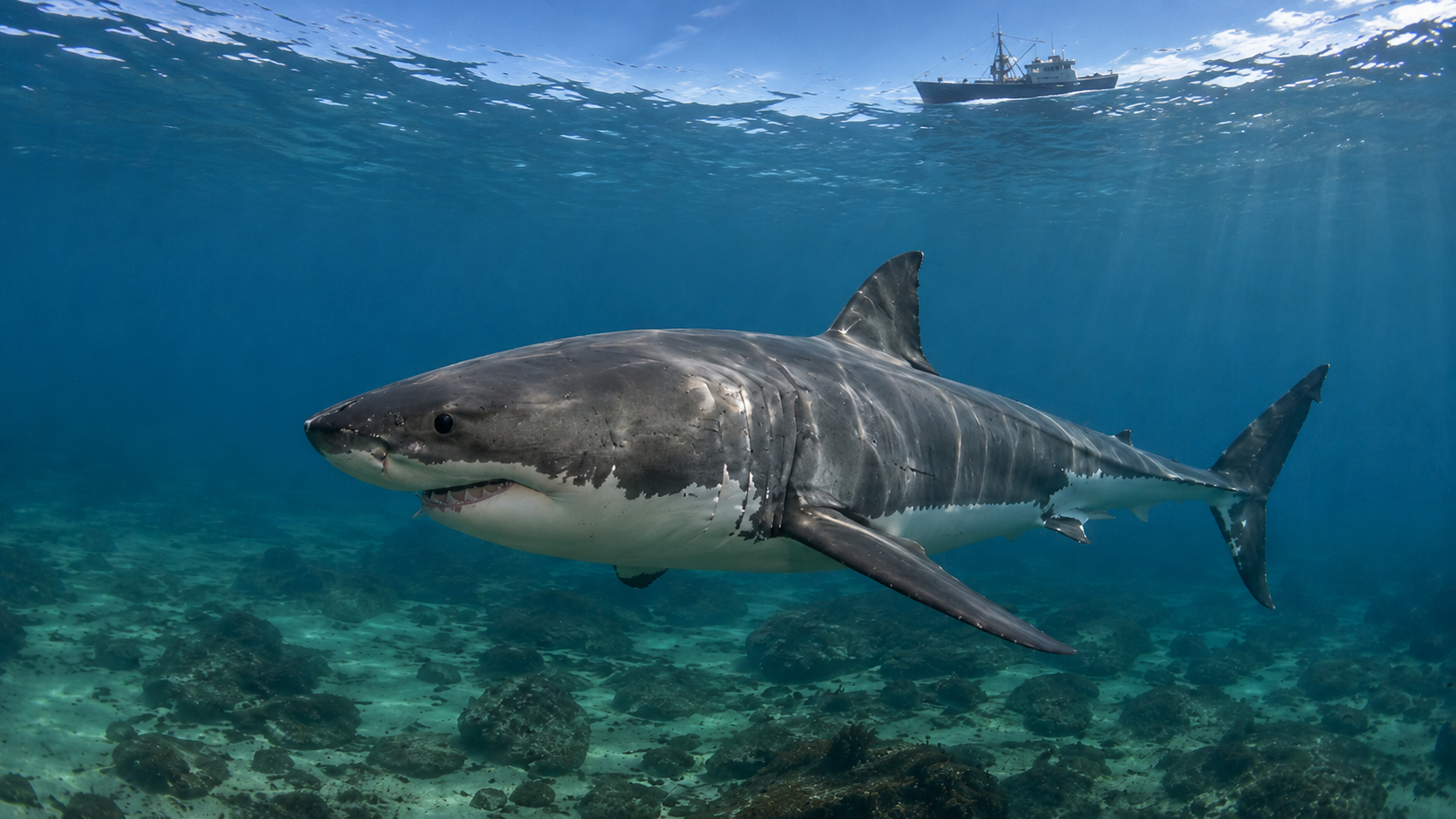
A white shark moves across the continental shelf off Atlantic Canada.
It is not looking for a fishing boat.
It is not looking for a net.
It is following the same thing fishermen are:
productive water.
Fish concentrate there.
Prey gathers there.
Oceanographic conditions make the area worth using.
For the shark, it may be feeding habitat.
For people, it may be a fishing ground.
And sometimes those two maps overlap.
That is where one of the most important threats to Canada’s white sharks begins.
Not with someone deliberately hunting a protected animal.
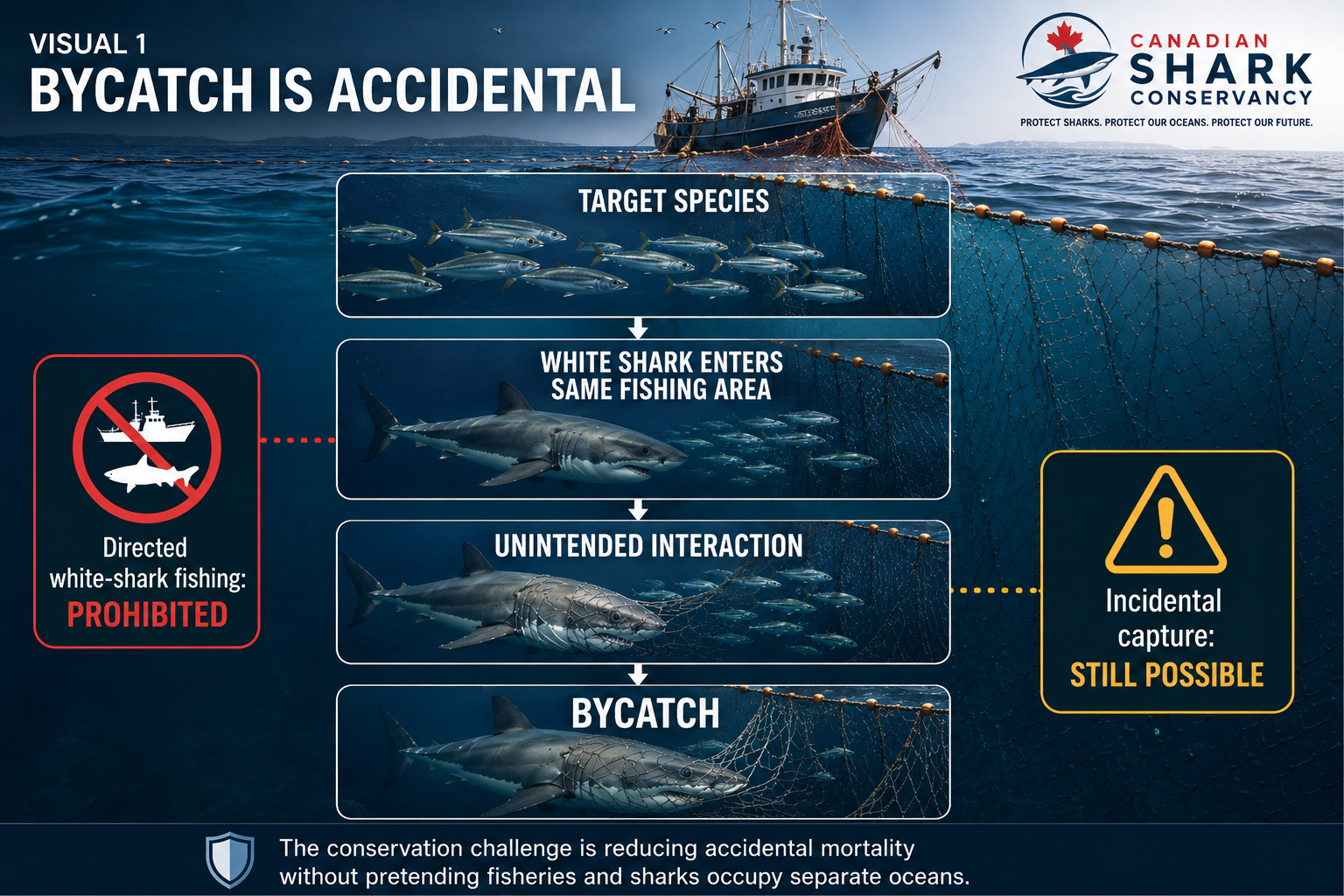
But with a shark becoming caught in fishing gear intended for something else.
Scientists call it bycatch.
And for an animal that grows slowly, may take decades to reproduce, and produces relatively few offspring, even rare accidental mortality can matter. Canada’s current recovery strategy identifies incidental commercial capture as the principal human-caused mortality threat documented in Atlantic Canadian waters.
Why Nets Can Be Especially Dangerous
Here our Shark Science interlude becomes relevant again.
White sharks are obligate ram ventilators.
They rely heavily on forward swimming to move water across their gills.
Restrict that movement, and the animal can lose its ability to ventilate effectively.
Canada's recovery strategy therefore identifies entangling gear as particularly concerning because it can restrict swimming and reduce water flow across the gills.
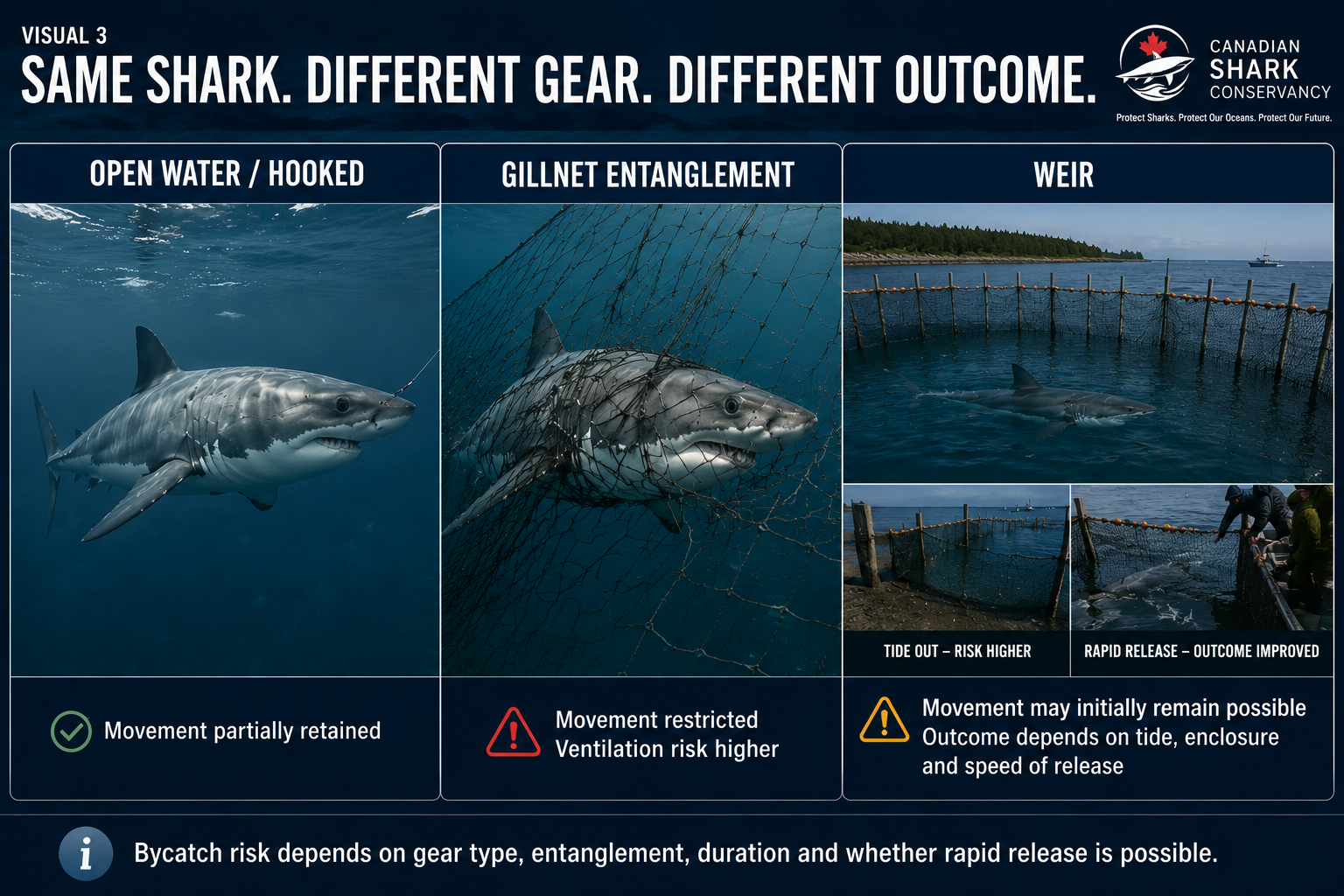
A shark caught on a hook may still be able to move.
A shark trapped loosely in a large enclosure may remain capable of swimming.
But a shark immobilized in netting faces a very different physiological problem.
This is why gear type matters.
Bycatch is not one uniform event.
Which Canadian Fisheries Have Actually Caught White Sharks?
Historical Canadian records provide clues.
Canada’s updated recovery strategy identifies 31 white-shark bycatch records resulting in likely mortality between 1873 and 2023.
About 60% of authenticated incidents between 1920 and 2023 involved cod or hake gillnets and herring weirs.
DFO’s 2025 scope-of-harm assessment similarly found that 17 of 31 likely fishery mortalities were associated with coastal gillnets or weirs.
That does not mean these fisheries routinely catch white sharks.
Quite the opposite.
Recorded Canadian interactions are rare.
But when historical evidence repeatedly points toward certain gear types, those patterns deserve attention.
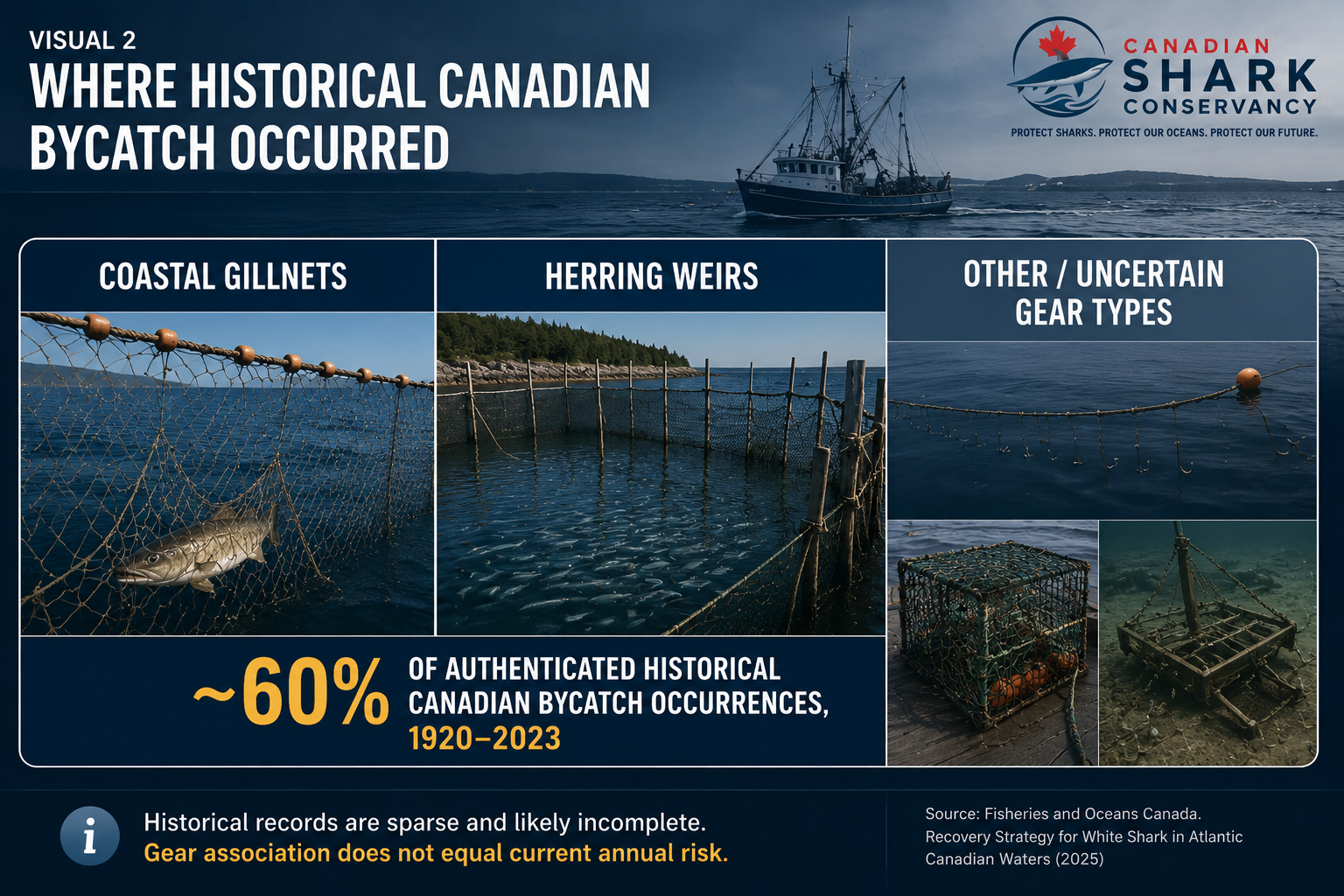
Source: Fisheries and Oceans Canada recovery strategy.
Gillnets Create a Particular Problem
A gillnet is designed to entangle fish.
For a large shark, that same feature can be dangerous.
The animal may twist.
The net can wrap around:
the head,
gills,
fins,
or body.
Movement becomes increasingly restricted.
And because white sharks depend on movement for effective ventilation, prolonged entanglement can become lethal.
DFO states that mortality rates for white sharks caught in Atlantic Canadian gillnets have not been quantified, but they are expected to be high because the gear can restrict movement and impair breathing.
There is another complication.
A shark does not need to die immediately in the net for the interaction to matter.
Stress.
Exhaustion.
Injury.
Post-release mortality.
All can be difficult to measure.
A shark released alive is not necessarily a shark that survives.
That is why conservation science increasingly distinguishes:
released alive
from
survived the interaction.
The Herring Weir Is a Different Kind of Trap
Traditional herring weirs operate very differently.
They are large fixed structures that guide schooling fish into enclosed areas.
A white shark entering a weir may still have room to swim.
That could potentially reduce immediate respiratory risk compared with tight entanglement.
But not every weir remains fully submerged.
DFO notes that some brush weirs go dry as the tide recedes, making timely live release of a large white shark difficult or impossible.
Two white-shark mortalities were recorded in Bay of Fundy weirs in 2010 and 2011.
Again, the lesson is not:
weirs are killing large numbers of sharks.
The lesson is:
gear configuration determines what options exist once an accidental encounter occurs.
How Common Is Canadian White-Shark Bycatch Today?
This is where the science becomes frustrating.
The available evidence suggests it is rare.
But determining exactly how rare is difficult.
Canada’s recovery strategy describes commercial bycatch mortality in Atlantic Canada as low concern based on currently available records.
Yet the same document emphasizes that:
- reporting is incomplete;
- observer coverage varies among fisheries;
- species identification can be difficult;
- and true fishery interactions may therefore be underestimated.
Only four white-shark records appear in Atlantic Canada’s at-sea observer databases, and DFO considers all four identifications uncertain because the reported sharks were unusually small and lacked photographic confirmation.
That tells us less about shark biology than it does about how difficult rare-event monitoring can be.
Rare Animals Create a Statistical Problem
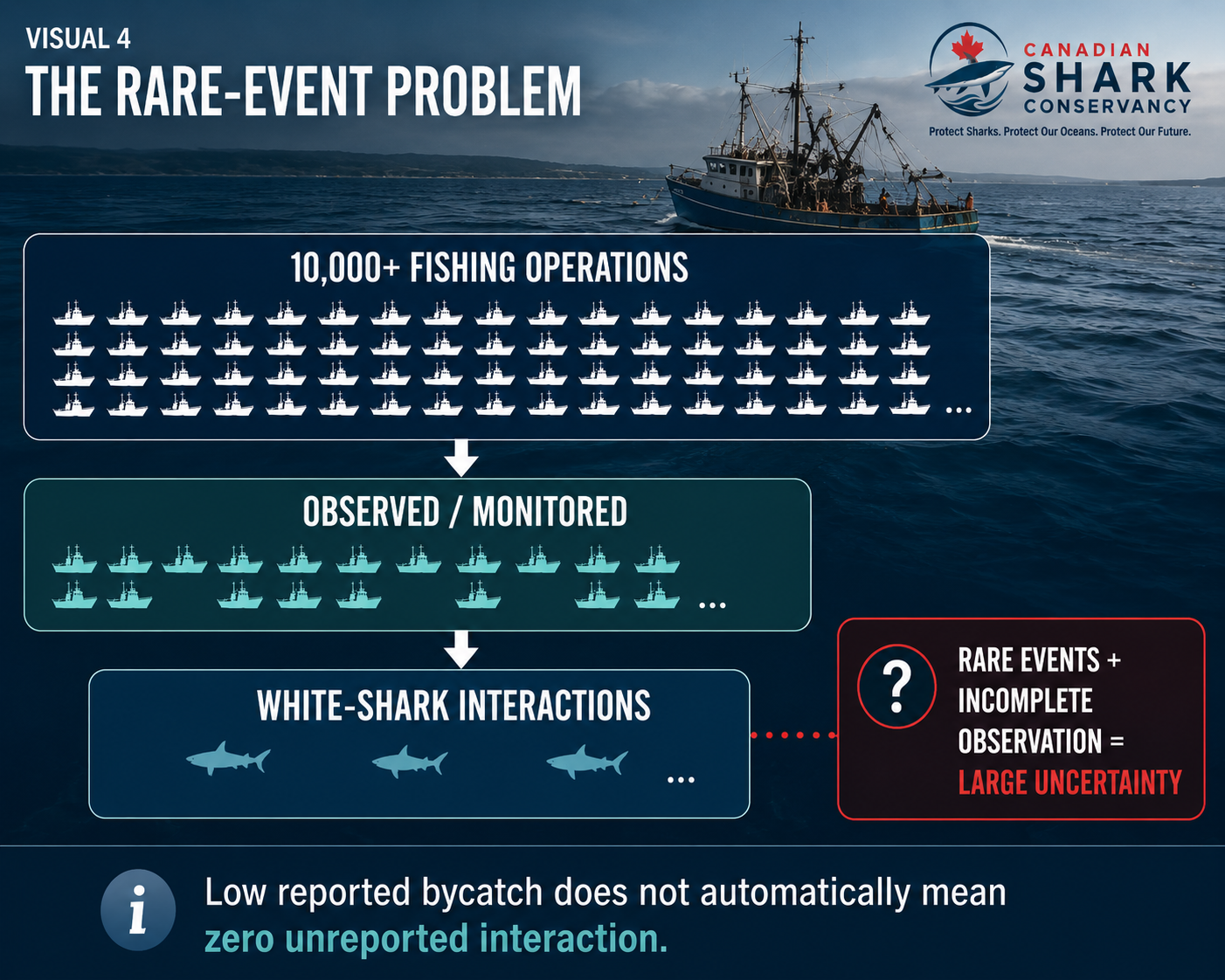
Suppose a fishing fleet makes thousands of trips.
White-shark encounters occur only occasionally.
Observer coverage is present on only a fraction of those trips.
Even if observers report perfectly, many interactions may happen when nobody independent is aboard.
Now add:
possible species misidentification,
incomplete reporting,
historical records,
and live releases that may never enter centralized datasets.
A rare interaction can be extremely difficult to estimate precisely.
This means two statements can both be true:
Recorded Canadian white-shark mortality is rare.
and
We do not know the true interaction rate with high precision.
Those are not contradictory.
They are an honest description of incomplete observation.
Reporting Has Improved
The historical record is not static.
White sharks were listed as Endangered under Canada’s Species at Risk Act in 2011.
Since then, DFO has increased education and reporting efforts.
Mandatory reporting of interactions was introduced in commercial fisheries in 2018 and recreational fisheries in 2019, helping increase the number of documented records.
This creates another challenge when comparing decades.
More recent years can appear to contain more sharks simply because:
people know what to report,
technology makes photographs easier,
and regulations require documentation.
Part 9 taught us that more observations do not automatically mean more animals.
The same lesson applies to bycatch.
More reports can sometimes mean:
better reporting.
Identification Is Harder Than It Sounds
Imagine a large shark appearing unexpectedly in commercial gear.
Bad weather.
Moving deck.
Limited time.
Crew safety concerns.
The priority is releasing the animal—not conducting a taxonomy lesson.
Several large sharks occur in Atlantic Canada.
Porbeagles.
Makos.
Basking sharks.
White sharks.
Under poor conditions, a brief encounter can be misidentified.
That is why photographs and video are so valuable.
A single clear image can turn:
possible white shark
into:
confirmed white shark.
Modern smartphones may therefore become unexpectedly valuable scientific tools.
Not because fishermen should delay release for photography.
But because documentation obtained safely can substantially improve the quality of Canada's occurrence database.
The Fisherman Is Often the First Responder
This is perhaps the most important human dimension.
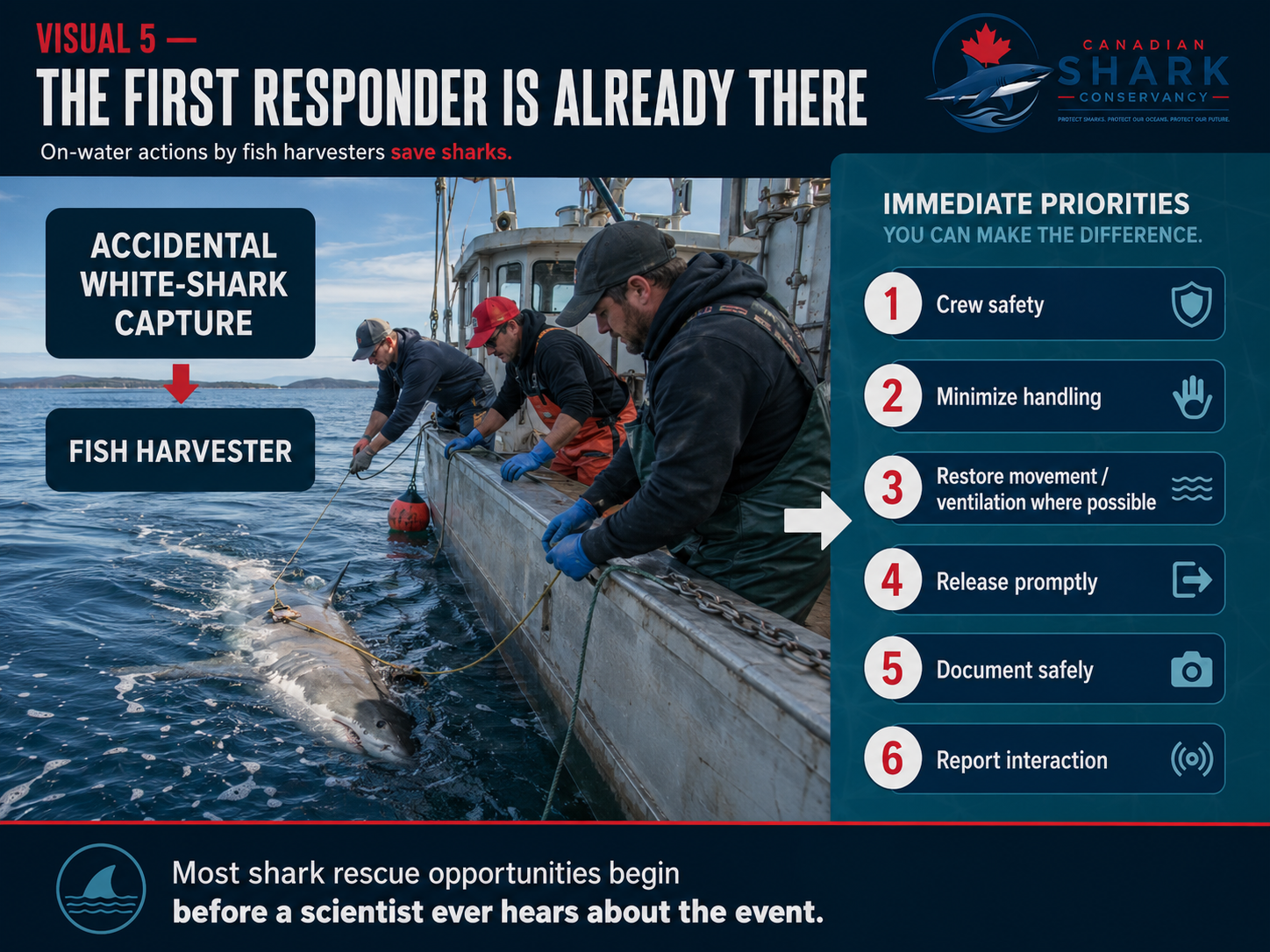
When a white shark becomes entangled offshore, the first conservation professional on scene is usually not:
a DFO scientist,
a veterinarian,
or a shark researcher.
It is the fisherman whose gear caught it.
That person may have only minutes to make decisions.
Is the shark alive?
Can the gear be cut?
Where can it be released safely?
Is approaching the animal dangerous?
Can the crew free it without increasing injury?
What information needs to be reported?
The quality of that response can affect whether the shark survives.
This makes fish harvesters conservation partners whether anyone planned it that way or not.
Live Release Matters
Canada prohibits retention of bycaught white sharks.
That makes successful release the immediate operational objective when an animal is encountered alive.
But releasing a three- or four-metre shark is not trivial.
A large white shark can injure crew.
A struggling animal can damage equipment.
Heavy fishing gear can remain wrapped around the body.
The safest response may sometimes involve sacrificing gear.
That creates an important conservation reality.
The fisherman may personally bear:
lost time,
damaged equipment,
lost catch,
and safety risk
while attempting to save an animal he never intended to catch.
If society wants better outcomes for protected species, management must recognize those costs.
Cooperation works better than blame.
Could Better Gear Reduce Interactions?
Potentially.
Bycatch mitigation across fisheries generally falls into several categories:
Avoidance
Reduce fishing effort where protected animals are currently concentrated.
Gear modification
Change gear configuration to reduce capture or improve escape.
Detection
Use real-time information to warn fishermen that protected animals are present.
Release methods
Improve procedures for safely freeing captured animals.
Monitoring
Measure whether interventions actually work.
For Canadian white sharks, the challenge is rarity.
A mitigation measure designed specifically around a very uncommon event can be difficult to test statistically.
That means the most promising approaches may be those that benefit multiple vulnerable marine species simultaneously.
For example, modifications reducing entanglement risk could potentially help:
sharks,
marine mammals,
sea turtles,
and other large animals.
Real-Time Shark Tracking May Eventually Help Fishermen Too
Imagine a future Canadian fishery.
A network of acoustic receivers detects several tagged white sharks entering a particular region.
Researchers combine:
water temperature,
recent detections,
prey conditions,
and historical movement.
A temporary advisory tells fishermen:
Elevated white-shark presence likely in this area for the next several days.
Nobody closes the ocean.
Nobody declares an emergency.
But crews enter the region aware.
Certain operations adapt.
Observers pay particular attention.
Reporting improves.
That is one possible future application of the telemetry systems we explored in Part 6.
Tracking does not need to exist only for scientists watching sharks.
It could eventually support coexistence between sharks and fisheries.
Climate Could Change the Bycatch Map
Part 9 now connects directly to Part 10.
If warming waters make Canadian habitat more suitable—
and white sharks arrive earlier,
remain longer,
or travel farther north—
then fisheries that historically encountered them rarely could begin overlapping them more frequently.
Canada’s recovery strategy explicitly notes that northward distribution change could alter the frequency of incidental fishery captures in Canadian waters.
That means the historical bycatch map may not be the future bycatch map.
A fishery with no recorded white-shark interactions today may encounter them tomorrow if the animals' seasonal range changes.
This is why conservation cannot rely only on historical records.
Monitoring has to move with the sharks.
The Biggest Mortality Risk May Not Be Canadian
There is another important perspective.
The white sharks entering Canadian waters belong to the wider Northwest Atlantic population.
They spend much of their lives elsewhere.
Canada’s recovery strategy identifies commercial bycatch in the southern United States, especially pelagic longline interactions, as probably the most important fisheries-related mortality source for the Northwest Atlantic population overall.
That means a shark successfully protected in Nova Scotia may later encounter much greater fishing risk thousands of kilometres south.
Once again, the border disappears.
Canadian conservation cannot succeed alone.
One Shark Can Encounter Many Fisheries
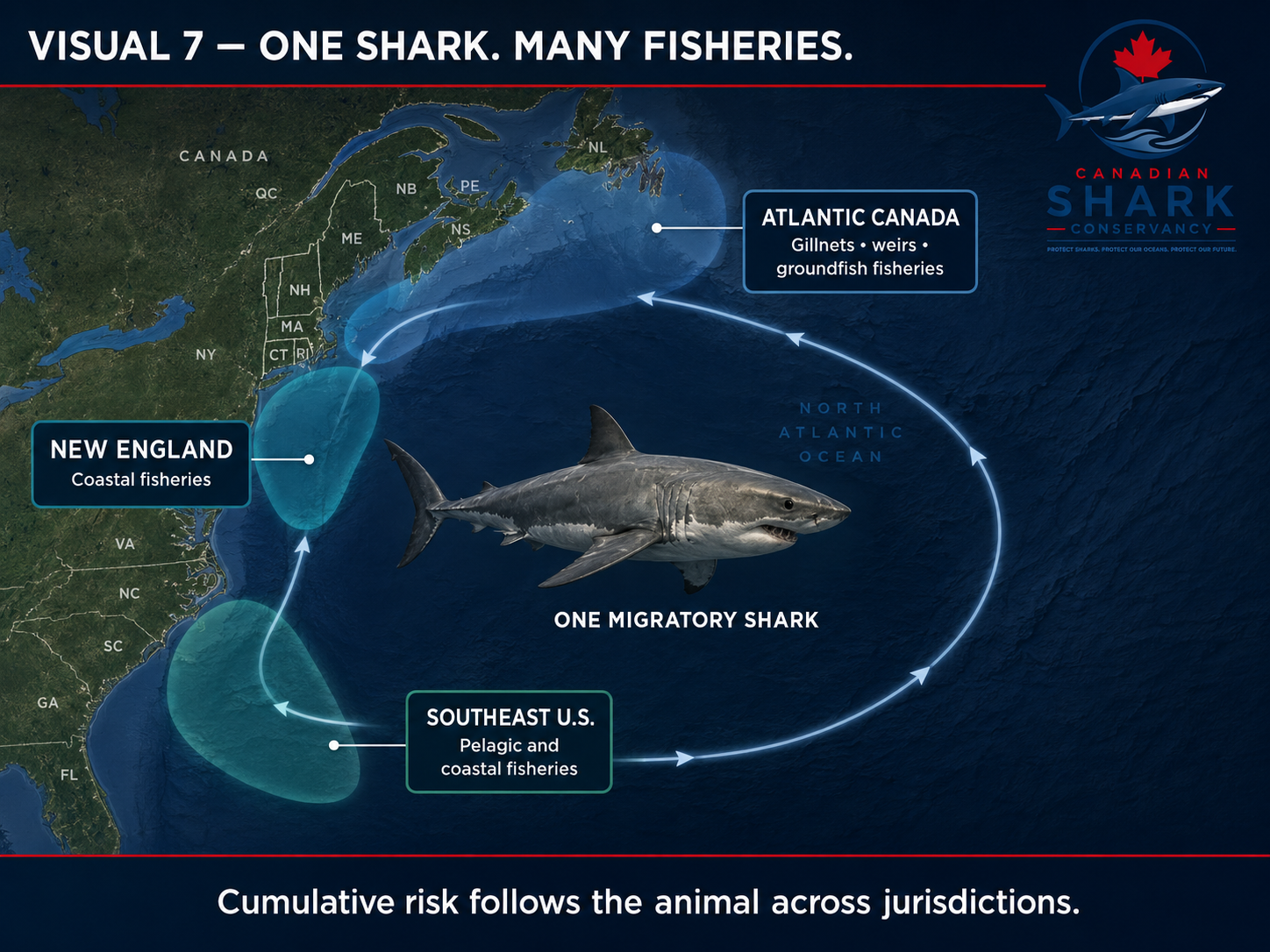
Imagine one juvenile white shark.
Summer:
Nova Scotia.
Autumn:
New England.
Winter:
southeastern United States.
Spring:
moving north again.
Along that journey it may cross:
Canadian gillnet fisheries,
herring weirs,
American hook-and-line fisheries,
pelagic longline areas,
recreational fisheries,
and many other types of marine activity.
The animal does not need to encounter every fishery.
It needs to survive the cumulative risk across all of them.
That is why international cooperation matters.
A migratory population is only as protected as the combined system of jurisdictions through which it moves.
The Numbers Are Small—but the Biology Is Slow
Thirty-one likely Canadian bycatch mortalities across roughly 150 years may sound insignificant.
And compared with many fisheries threats globally, Canadian mortality appears low.
But white-shark biology changes the meaning of a small number.
Part 8 showed us why.
Females may take decades to mature.
Pregnancy may last more than a year.
Litters are small.
Reproductive cycles are slow.
The loss of one mature female cannot be replaced next season.
Population recovery happens over generations.
This means conservation has to care about mortality even when absolute numbers are comparatively small.
Not panic.
Not exaggeration.
But caution.
Bycatch Is Also a Fishermen’s Problem
A large shark caught in commercial gear can:
damage nets,
destroy catch,
cost fishing time,
create safety hazards,
and force crews to make difficult decisions.
That means framing fishermen simply as a threat misses half of the issue.
The same interaction can harm:
the shark
and
the fisherman.
The most durable solutions are therefore those where conservation and fishing interests align.
Fewer entanglements mean:
fewer sharks injured,
less damaged gear,
less lost fishing time,
fewer dangerous release situations,
and better data when encounters do occur.
That is a far stronger foundation for collaboration than assigning blame.
What Canada Actually Needs
Canada’s recovery strategy identifies several priorities directly relevant to this problem:
improved monitoring,
better estimates of bycatch,
continued fisher reporting,
more reliable species identification,
and development of mitigation measures where needed.
I would add one broader principle:
Every interaction should teach us something.
Where did it occur?
What gear was involved?
What was the shark's approximate size?
Sex if known?
Alive or dead?
How long might it have been entangled?
Was release successful?
Was gear removed?
Was the animal tagged?
Could the encounter be linked with environmental conditions?
One accidental encounter is unfortunate.
An undocumented accidental encounter teaches us nothing.
From Incident to Evidence
Imagine a fisherman encounters a white shark.
The shark is released.
The event is reported.
Researchers compare the location with acoustic detections.
The shark had been tagged.
They know its identity.
Later, it pings farther south.
Now we know the animal survived at least long enough to continue moving.
Another similar encounter occurs.
Then another.
Patterns emerge.
Certain gear.
Certain temperature.
Certain month.
Certain location.
Now management has something actionable.
This is how bycatch science becomes conservation.
Not from one dramatic shark tangled in a net.
From many carefully documented ordinary events assembled into evidence.
Sharing the Water
White sharks are not leaving Atlantic Canada.
Neither are fisheries.
Both use productive marine ecosystems because those ecosystems contain food.
That overlap is not a failure of conservation.
It is the reality conservation must manage.
The question cannot be:
How do we keep sharks out of fishing grounds?
Nor can it simply be:
How do we keep fishermen away from sharks?
The better question is:
How do we reduce harmful interactions when both depend on the same ocean?
That requires:
science,
technology,
fishers,
regulators,
researchers,
and conservation organizations
working from the same evidence.
When Sharks and Fisheries Meet
Most fishermen will never catch a white shark.
Most Canadian white sharks will never become entangled in fishing gear.
The available evidence suggests fatal encounters here remain rare.
But rare does not mean irrelevant.
Especially for an Endangered animal whose population grows slowly.
Each accidental capture sits at the intersection of two realities.
A shark trying to survive its migration.
A fisherman trying to make a living.
Neither belongs outside the ecosystem.
Conservation succeeds when both can continue.
They don’t live in Canada.
They return to Canada.
And protecting that return means learning how to share the productive waters that draw both sharks and people to the same places.
NEXT — PART 11
Sharing the Water
What coexistence with a recovering apex predator could look like in Atlantic Canada
More sharks.
More tracking.
More sightings.
More public attention.
Eventually, white-shark conservation moves beyond scientists and fishermen.
It reaches:
beaches,
boaters,
divers,
coastal communities,
tourism,
and public safety.
How dangerous are white sharks in Atlantic Canada, really?
Should Canadians change how they use the ocean?
What lessons can we learn from Cape Cod, California, Australia and South Africa without importing their fear?
And how do you communicate genuine risk without turning a recovering native predator into a monster?
Part 11 asks what it means to live beside a shark that is coming back.
Research & Further Reading
Fisheries and Oceans Canada — Recovery Strategy for White Shark in Atlantic Canadian Waters. This is the principal Canadian source for current bycatch assessment. It identifies commercial incidental capture as the main documented source of human-induced mortality in Atlantic Canada while concluding that recorded mortality is rare and current risk appears low.READ SOURCE ↗DFO Science Response — Scope of Allowable Harm in White Shark in Atlantic Canada. The recent assessment reviewed historical encounters and identified coastal gillnets and weirs as the fishing gears most frequently represented among likely Canadian mortalities.
COSEWIC — White Shark, Atlantic population. Canada's status assessment emphasizes uncertainty caused by incomplete observer coverage, species misidentification and underreporting, while noting the particular vulnerability of juvenile sharks to entangling coastal gear.READ SOURCE ↗