
They don’t live in Canada. They return to Canada.
A white shark can pass within sight of a Canadian beach without knowing that it is near a beach.
It does not recognize swimming areas, municipal boundaries, tourism zones, or property lines.
It follows temperature, depth, prey, and opportunity.
People experience the same moment differently.
A dorsal fin near shore can become a photograph, a warning, a news report—or a reason to leave the water.
Neither perspective can simply be ignored.
The shark is using habitat.
People are trying to understand risk.
As white sharks return more frequently to parts of their historic North Atlantic range, Atlantic Canada will need to make room for both realities.
The goal cannot be to pretend that white sharks present no risk.
It also cannot be to treat every sighting as an emergency.
The challenge is to develop a relationship with these animals based on evidence, preparation and respect.
That is what coexistence looks like.

Risk Must Be Taken Seriously—and Kept in Perspective
White sharks are large, powerful predators.
Any close encounter deserves caution.
Responsible risk communication, however, requires more than repeating that sharks can be dangerous.
It requires asking:
Where are sharks being observed?
When are they present?
What are they doing?
How many people are using the same water?
Are sharks traveling through the area, or repeatedly feeding near shore?
Are seals, schooling fish, fishing activity, or animal carcasses present?
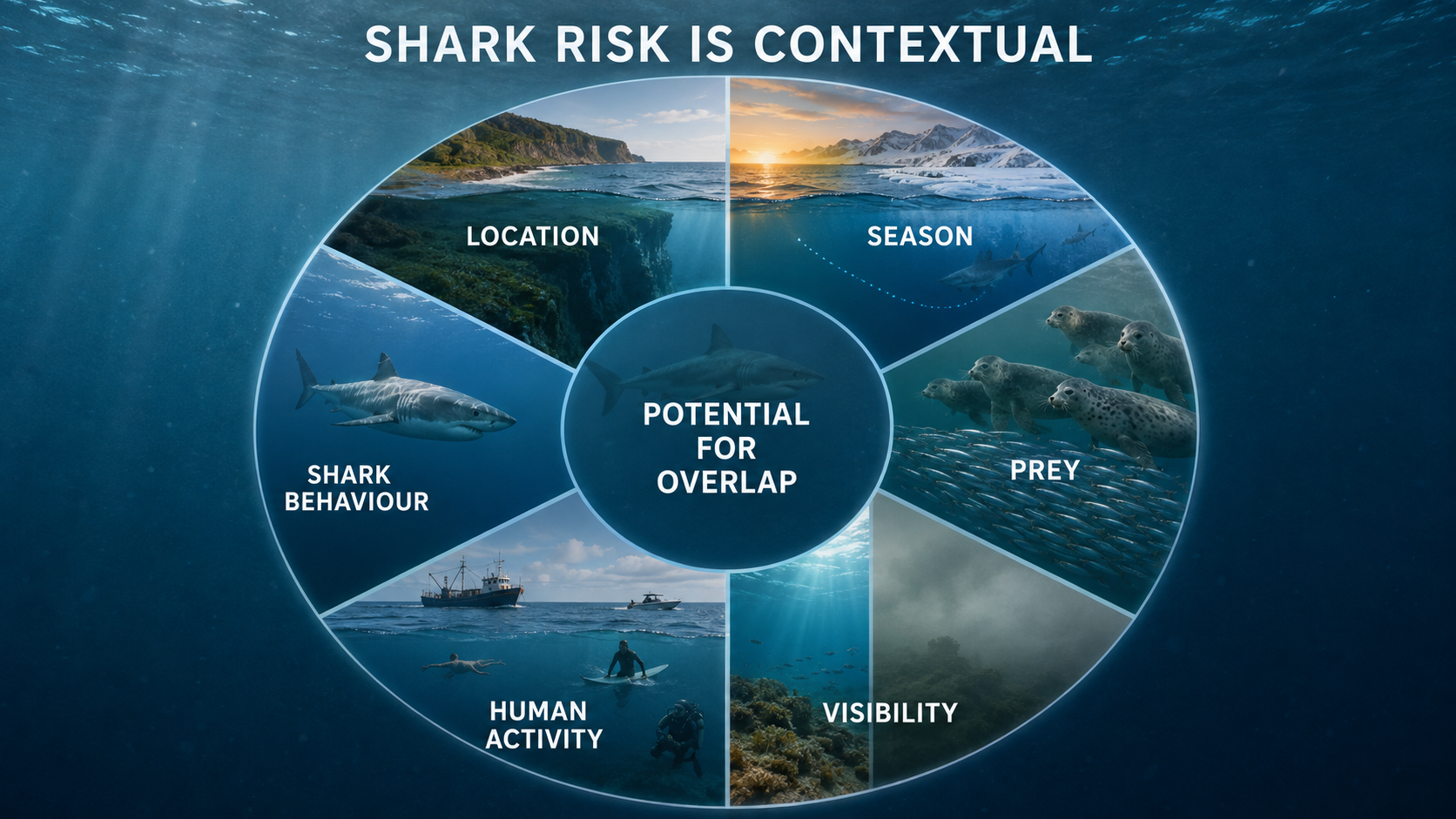
Risk is not constant across an entire coastline.
It changes with location, season, water visibility, prey activity, human activity, and environmental conditions.
A shark swimming far offshore does not create the same situation as one repeatedly hunting near a popular beach.
A single sighting is not the same as an established aggregation.
A tagged shark detected by a receiver does not mean that it is approaching people.
And the absence of a detection does not prove that no shark is present.
Shark bites remain rare events.
That does not make them inconsequential.
Every serious encounter affects a person, a family, and a coastal community.
The challenge is to acknowledge the potential severity of an incident without treating an unlikely event as inevitable.
Rare does not mean impossible.
Possible does not mean probable.
Both ideas belong in the same conversation.
Canada Is Not Cape Cod
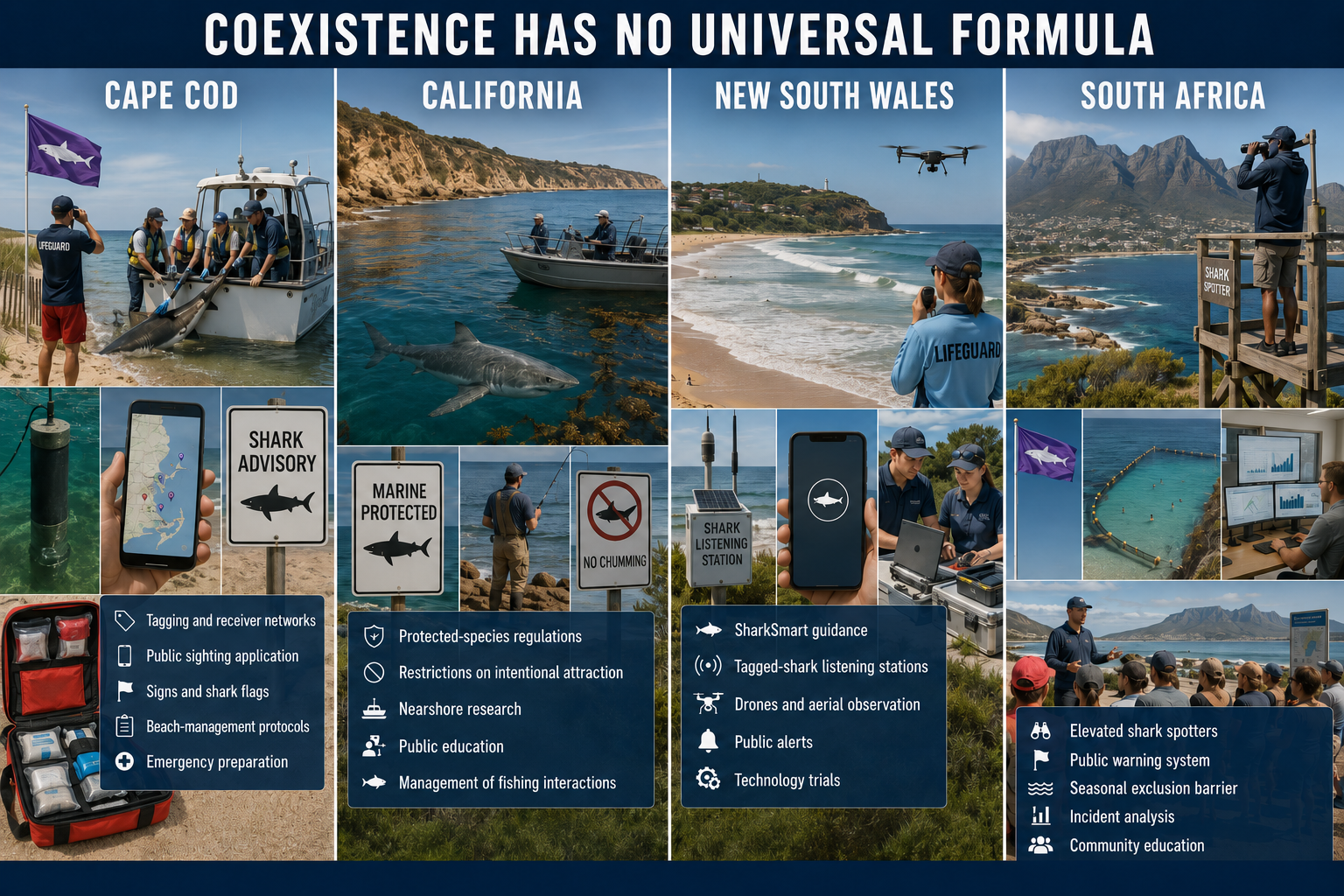
Cape Cod offers an important lesson in white shark coexistence.
It should not become a template copied without context.
The waters off Cape Cod contain seasonal concentrations of grey seals.
Those seals attract white sharks into shallow coastal areas where people also swim and surf.
This recurring overlap has created a genuine public-safety challenge.
Atlantic Canada also has seals, beaches, surfers, divers, fishers, and seasonal white sharks.
But the distribution of those animals, the shape of the coastline, the intensity of recreational activity and the availability of monitoring data are not identical.
A shark detected off Nova Scotia does not automatically indicate that Nova Scotia is becoming another Cape Cod.
That conclusion would require evidence collected over time.
The real lesson from Cape Cod is not that every Canadian beach needs an alarm.
It is that coastal communities should begin planning before a serious incident forces them to improvise.
What Cape Cod Has Learned
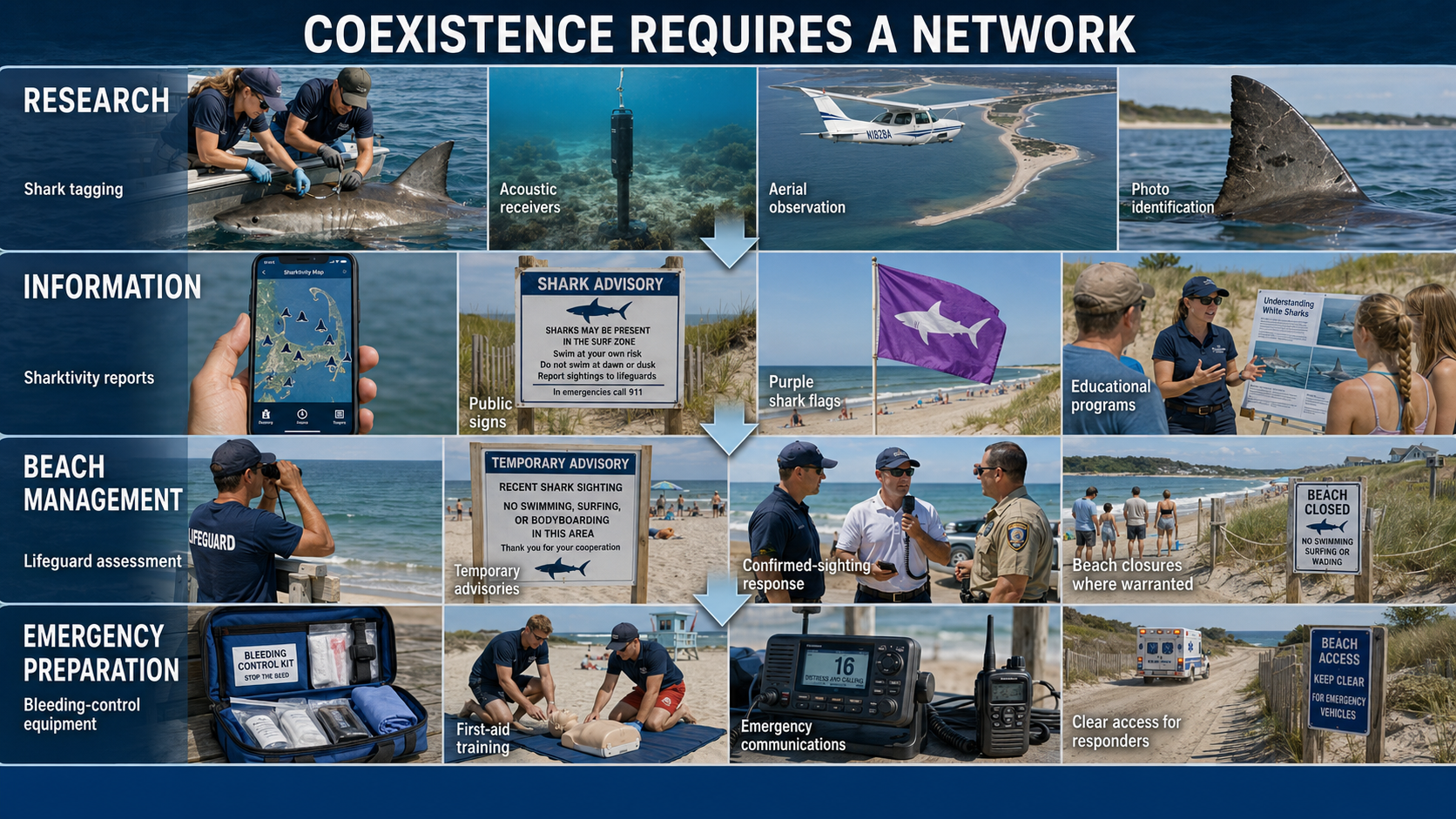
Cape Cod’s response combines research, communication, beach management, and emergency preparation.
The Atlantic White Shark Conservancy and Massachusetts Division of Marine Fisheries contribute research and public education.
Local municipalities and the Cape Cod National Seashore remain responsible for managing individual beaches.
Purple shark flags remind visitors that white sharks may be present.
Signs and brochures provide practical information.
Authorities can temporarily close beaches when they confirm a nearby sighting.
The Sharktivity app shares sightings and some tagged-shark detections.
However, its information must be interpreted correctly.
Not every white shark carries a tag.
Not every tagged shark passes a receiver.
Some sightings require verification.
Some information is delayed.
A tracking system can improve awareness.
It cannot guarantee that a beach is free of sharks.
Cape Cod communities have also expanded bleeding-control training and emergency preparedness because severe blood loss is the immediate medical danger associated with a major shark bite.
None of these measures makes entering the ocean risk-free.
Together, they create a better-informed and better-prepared coastline.
California: Manage the Interaction, Not Just the Animal
California has shared its coastline with white sharks for generations.
Its experience demonstrates the importance of managing human behaviour around protected wildlife.
California prohibits intentionally attracting white sharks with bait, chum, lures, or decoys.
When anglers know that a white shark is present near shore, state guidance directs them to stop using shark attractants or move elsewhere.
This addresses a preventable source of conflict.
A shark drawn toward bait near swimmers, surfers or divers is no longer simply moving through natural habitat.
Human activity has altered the encounter.
Atlantic Canada should take the same principle seriously.
Fishing, chumming and wildlife-viewing practices near recreational areas must be considered part of public-safety planning.
Coexistence is not only about how people react when a shark appears.
It also means avoiding actions that unnecessarily bring sharks and people together.
Australia: Give People Useful Choices
Australian shark-safety programs provide practical guidance without asking people to abandon the ocean.
New South Wales recommends that ocean users:
- Stay reasonably close to shore
- Swim, dive or surf with other people
- Avoid areas with active fishing
- Avoid schooling baitfish and visible feeding activity
- Exercise additional caution in murky water
- Avoid swimming at dawn, dusk and night
- Follow lifeguard instructions
- Report shark sightings
This guidance does not imply that following a checklist will prevent every encounter.
It reduces avoidable uncertainty and gives people useful choices.
Australia has also tested aerial observation, drones, acoustic detection, public alerts and other shark-management technologies.
The important lesson is not that Canada should purchase every available device.
It is that technologies should be evaluated for their effectiveness, environmental consequences and suitability for local conditions.
A tool should solve a demonstrated problem—not merely make people feel protected.
South Africa: Watching the Water
South Africa’s Shark Spotters program provides another model.
Trained observers watch selected coastal areas from elevated positions.
Public warnings, incident reporting, research, and a seasonal exclusion barrier at Fish Hoek have reduced conflict while allowing people and sharks to continue using the same coastal environment.
This is different from a conventional shark net intended to catch or kill animals.
A properly deployed exclusion barrier separates sharks from a defined swimming area.
The approach cannot be used everywhere.
Effective spotting depends on elevation, water clarity, weather, glare and the shape of the coastline.
Barriers depend on depth, waves, currents, maintenance and local wildlife.
But the principle travels well:
Safety improves when observation, communication and response are connected.
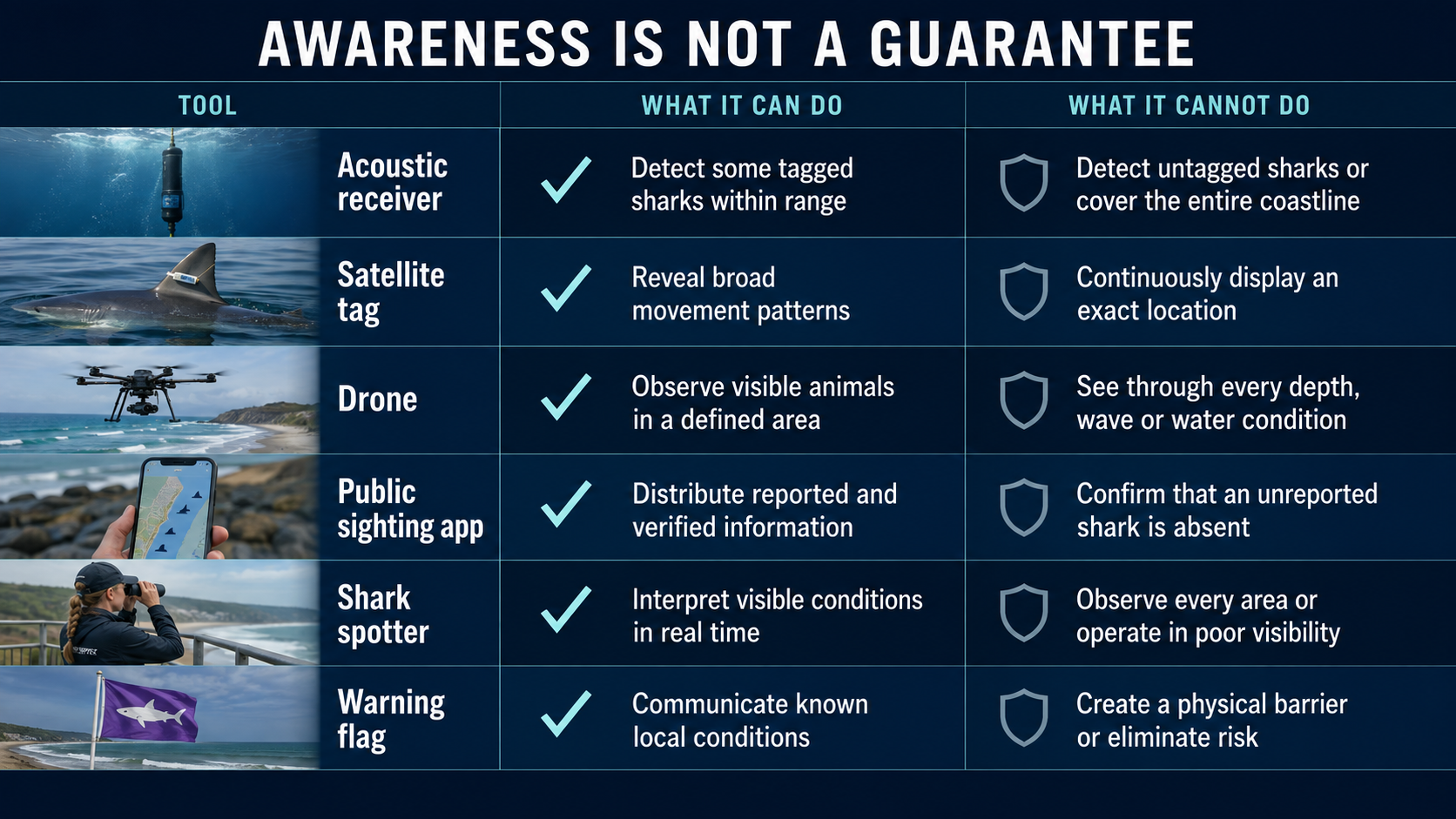
Technology Can Inform Us—But It Cannot See Everything
It is tempting to believe that enough technology can remove uncertainty from the ocean.
Acoustic receivers can detect a tagged shark when it passes within range.
Satellite tags can transmit positions when their reporting conditions are met.
Drones can observe sections of the coast when visibility and weather allow.
Applications can distribute confirmed reports.
Cameras and artificial intelligence may eventually help identify patterns more quickly.
Every one of these tools has limitations.
A receiver cannot detect an untagged shark.
A tag may stop transmitting.
A drone sees only the area beneath its flight path.
Dark water, glare, waves, and depth can conceal an animal.
A public report can be mistaken.
A location transmitted earlier does not show where a shark is now.
Technology should therefore be treated as one layer of awareness—not as proof of safety.
This distinction must be communicated clearly.
Otherwise, an alert system can create the very thing it was meant to reduce:
False confidence.
What a Canadian Coexistence System Could Look Like
Atlantic Canada does not need to wait for a serious incident before developing a framework.
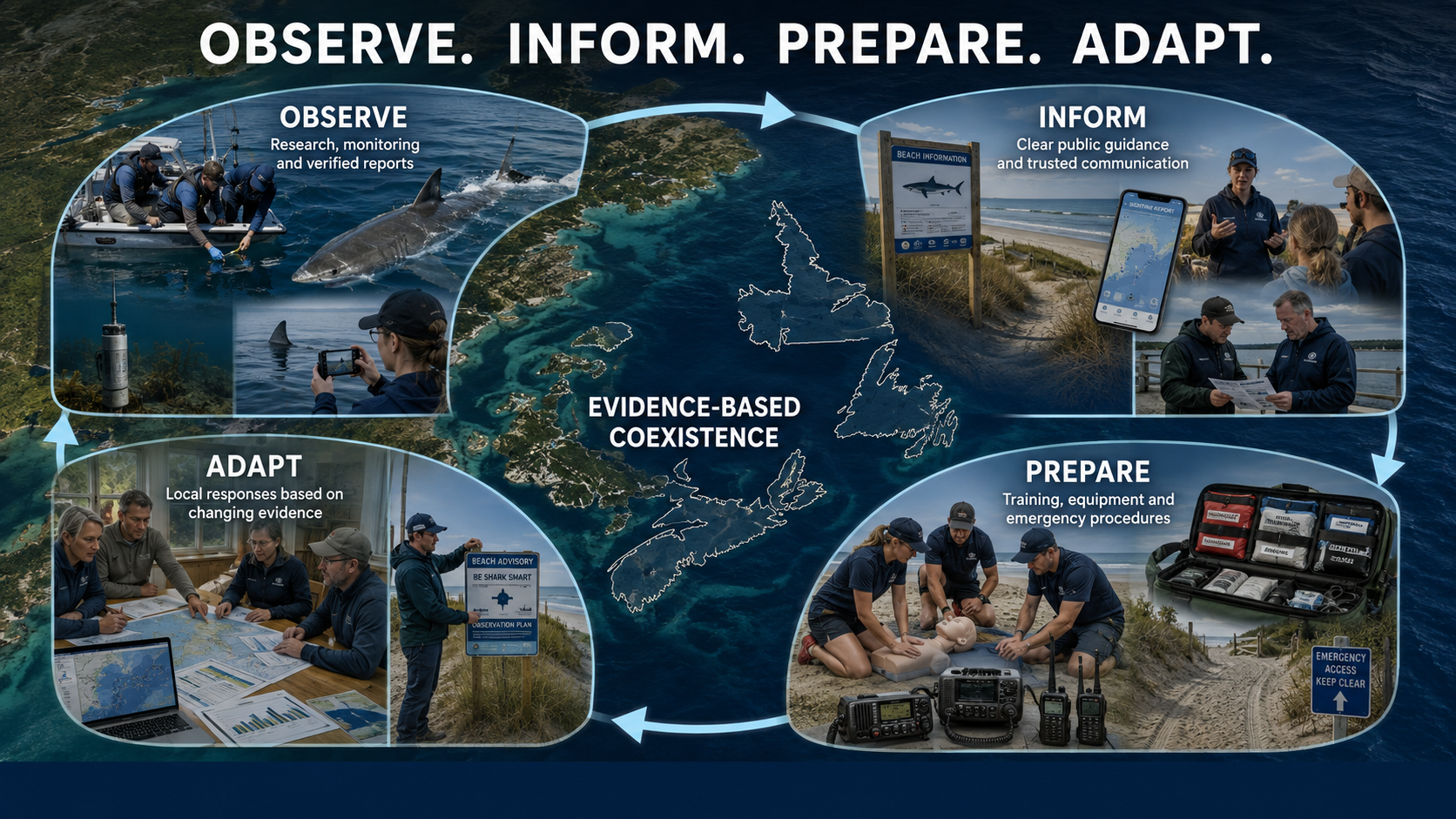
A practical Canadian approach could be built around four connected actions.
1. Observe
Researchers need reliable information about where white sharks travel, how long they remain, and what brings them closer to shore.
That means supporting:
- Acoustic receiver networks
- Satellite and camera tagging
- Aerial surveys where appropriate
- Verified public sighting reports
- Collaboration with fishers and vessel operators
- Monitoring near seal colonies and prey concentrations
- Consistent recording of environmental conditions
Anecdotes can identify questions.
Long-term evidence is needed to answer them.
2. Inform
Communities need a trusted source of current information.
That could include:
- Standardized signs
- Clear definitions for advisories and closures
- Seasonal public-education campaigns
- Verified reporting procedures
- Training for lifeguards and harbour authorities
- Guidance for tourism operators
- Clear explanations of detection-system limitations
Communication should state what is known, what remains uncertain and what people can do next.
3. Prepare
Coastal communities already prepare for rip currents, severe weather, boating emergencies and cold-water incidents.
Coastal communities can incorporate shark-related emergencies into those existing systems.
Useful measures could include:
- First-aid and bleeding-control equipment
- Staff training at heavily used beaches
- Reliable emergency communications
- Clear access points for paramedics
- Incident-response protocols
- Practice exercises involving local authorities
Preparation does not predict disaster.
It reduces confusion if something goes wrong.
4. Adapt
Not every community will require the same response.
A remote diving location, an urban beach, a seal colony and a fishing harbour have different patterns of use.
Management should therefore remain proportional to evidence.
Education may be sufficient in one place.
A temporary advisory may be appropriate somewhere else.
If monitoring reveals recurring close overlap between white sharks and people, additional measures can be considered.
The response should grow with the evidence.
Practical Guidance for Ocean Users
Most people entering Atlantic Canadian waters will never encounter a white shark.
Even so, a few habits can reduce avoidable risk.
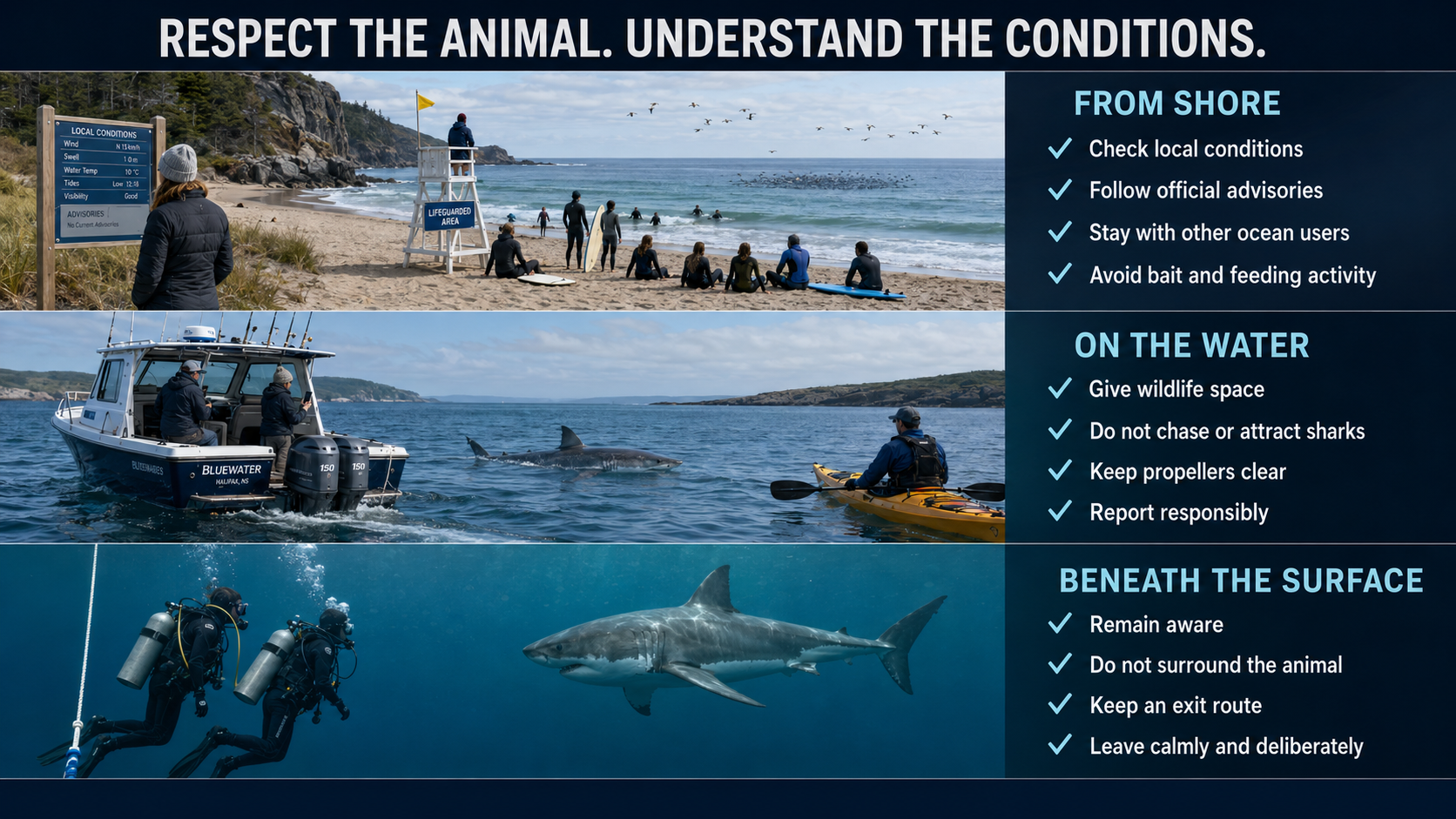
Swimmers and Surfers
- Follow local advisories, lifeguard instructions and beach closures.
- Stay reasonably close to shore.
- Enter the water with other people when possible.
- Avoid swimming near active fishing, bait, chum or discarded catch.
- Leave the water if fish are schooling intensely or marine animals are actively feeding.
- Use additional caution in murky water and during low-light periods.
- Do not enter the water with an actively bleeding wound.
- If you see a large shark, leave the water calmly and alert the appropriate local authority.
Divers and Paddlers
- Review local conditions before entering the water.
- Avoid approaching, following, or surrounding a shark.
- Do not block its direction of travel.
- Keep the animal in sight when possible while creating distance.
- End the encounter deliberately instead of pursuing a photograph.
- Record the time, location, estimated size, and observed behaviour.
- Report useful observations through a recognized research or public-safety channel.
Boaters and Wildlife Viewers
- Never feed or intentionally attract a white shark without appropriate authorization and safeguards.
- Do not crowd, chase, or repeatedly cut across its path.
- Keep propellers away from the animal.
- Avoid directing a shark toward swimmers or smaller vessels.
- Give researchers room to work.
- Share useful observations without publicly broadcasting sensitive real-time locations when doing so could encourage harassment or crowding.
The guiding rule is simple:
Give the shark space, and do not manufacture an encounter.
The Role of Responsible Tourism
White sharks can create fear.
They can also spark curiosity, create research opportunities, and support conservation.
Responsible wildlife tourism may help coastal communities benefit economically from protecting large marine predators.
But the word responsible matters.
Tourism should not place sharks, passengers, crews or other ocean users at unnecessary risk.
Operators should follow clear standards covering:
- Vessel approach
- Animal welfare
- Passenger safety
- Use of attractants
- Photography and filming
- Data sharing
- Emergency procedures
- Minimum distances and encounter duration
When thoughtfully managed, tourism can help transform a shark from an anonymous threat into a living animal with a migration, history, and ecological role.
When poorly managed, it can reward crowding, sensationalism and increasingly intrusive encounters.
The difference lies in the rules.
Words Are Part of Public Safety
The first report of a white shark often reaches the public through a headline or social-media post.
That first description can shape everything that follows.
Words such as “invasion,” “infestation,” “man-eater” and “terror” imply intent and abnormality.
They create a story before the evidence is known.
More accurate language is available:
- A shark was observed.
- The sighting was confirmed or remains unconfirmed.
- The animal was traveling, circling, feeding, or displaying undetermined behavior.
- The beach was temporarily closed as a precaution.
- No approach toward people was observed.
- The shark’s motivation could not be determined.
Accuracy does not make a report boring.
It makes it useful.
Scientists and conservation organizations must also resist the temptation to overcorrect.
Saying sharks are harmless is not honest.
Claiming an encounter was “just curiosity” without evidence assigns an unconfirmed motive.
People deserve clear information—not fear, but not false certainty either.
Coexistence Is a System
Coexistence is sometimes presented as an attitude.
Respect sharks.
Stay calm.
Accept that the ocean is wild.
Those ideas matter, but they are not enough.
Real coexistence is a system.
It connects research to public information.
It connects sightings to trained decision-makers.
It connects beach management to emergency preparation.
It connects conservation rules to the realities faced by fishers, tourism operators, swimmers, divers, and coastal residents.
Most importantly, it changes as the evidence changes.
If white sharks become more common near a particular Canadian community, the response should not begin with panic.
It should begin with questions.
Why are they there?
When do they arrive?
What are they doing?
How long do they remain?
How closely does their habitat overlap with human activity?
Which actions could reduce risk without unnecessarily harming wildlife?
Those are public-safety questions.
They are also conservation questions.
The Same Horizon
Imagine a family standing on a beach in Nova Scotia.
Offshore, a white shark moves through cold blue water.
The family cannot see it.
The shark does not know they are there.
For a few moments, they share the same horizon.
That image is not a warning that people no longer belong in the ocean.
It reminds us we were never alone in it.
White sharks are returning to a coastline increasingly capable of detecting them.
Atlantic Canada now has an opportunity to decide what happens next.
We can allow each sighting to become another cycle of fear and reaction.
Or we can build the knowledge, communication, and preparation required to share the water.
Coexistence does not mean eliminating risk.
It means understanding risk well enough to live with wildlife without demanding that wildlife disappear.
They don’t live in Canada. They return to Canada.
And when they return, we should be ready.
Not frightened.
Not careless.
Informed.
NEXT — PART 12
THE FUTURE OF THE RETURN
What a changing Atlantic Ocean could mean for the white sharks that migrate into Canadian waters
The waters white sharks return to are changing.
Ocean temperatures are shifting.
Prey distributions are moving.
Monitoring technology is improving.
Public attention is growing.
Could white sharks begin arriving earlier?
Could some remain later into the year?
Will more sharks use Canadian habitat—or will changing conditions redirect them elsewhere?
And how can Canada protect an animal whose future depends on decisions made across an entire ocean?
In Part 12 of White Sharks in Canada, we examine the future of this seasonal migration and what climate, conservation and international cooperation may mean for the sharks that continue to return.