
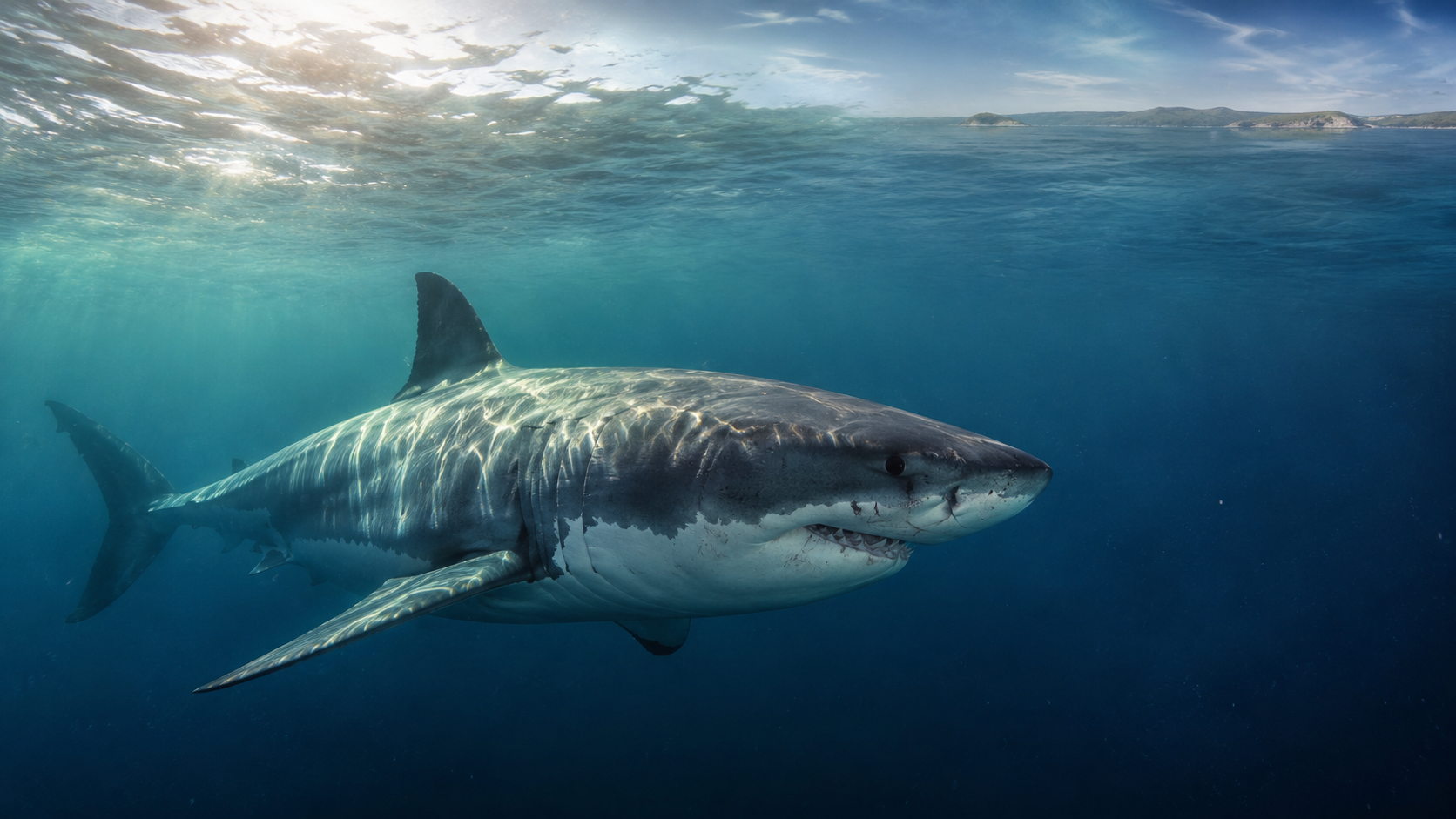
They don’t live in Canada. They return to Canada.
A white shark swimming north does not know when it crosses the Canadian border.
It does not know where Nova Scotia begins.
It does not know that Newfoundland lies farther north.
It does not know the difference between American and Canadian fisheries jurisdiction.
What it knows is the ocean.
Temperature.
Current.
Depth.
Prey.
Season.
The physical and biological signals that make one body of water worth entering and another worth leaving.
And those signals are changing.
Atlantic Canada is not experiencing the same ocean that its white sharks encountered a century ago.
Surface waters have warmed over the long term.
Bottom temperatures across Atlantic Canada's continental shelves have warmed unusually.
Warm Gulf Stream waters have increasingly influenced portions of the Scotian Shelf and Gulf of St. Lawrence.
Future climate projections also anticipate substantial additional change in the Northwest Atlantic.
For an animal whose annual migration is closely connected to season and temperature, that raises an obvious question:
What happens when the thermal map moves?
Could white sharks arrive in Canada earlier?
Stay later?
Travel farther north?
Could areas currently near the edge of their range become regular seasonal habitat?
And if we see more sharks in Canadian waters, how much of that change is actually climate?
The answer is more complicated than it first appears.
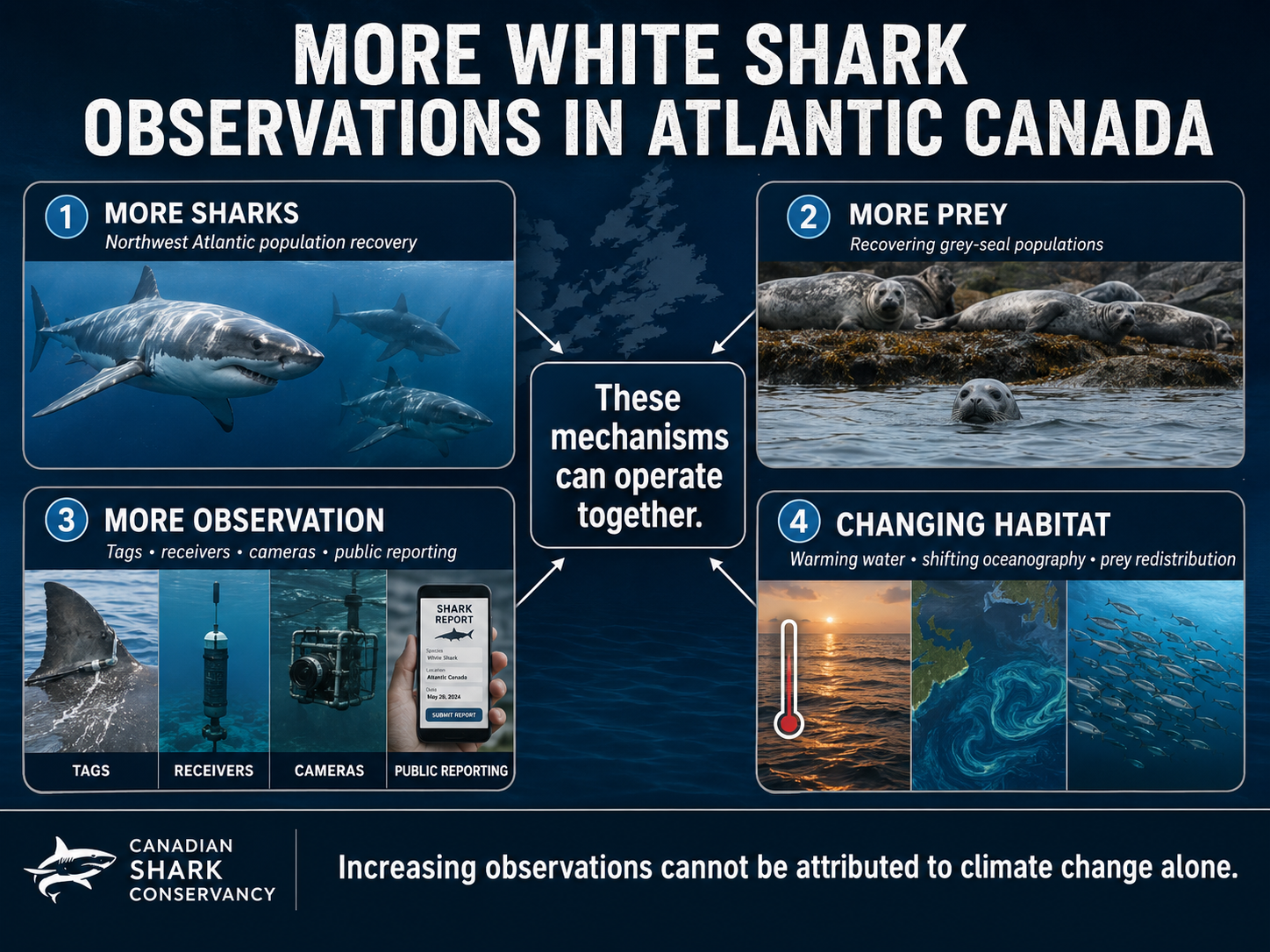
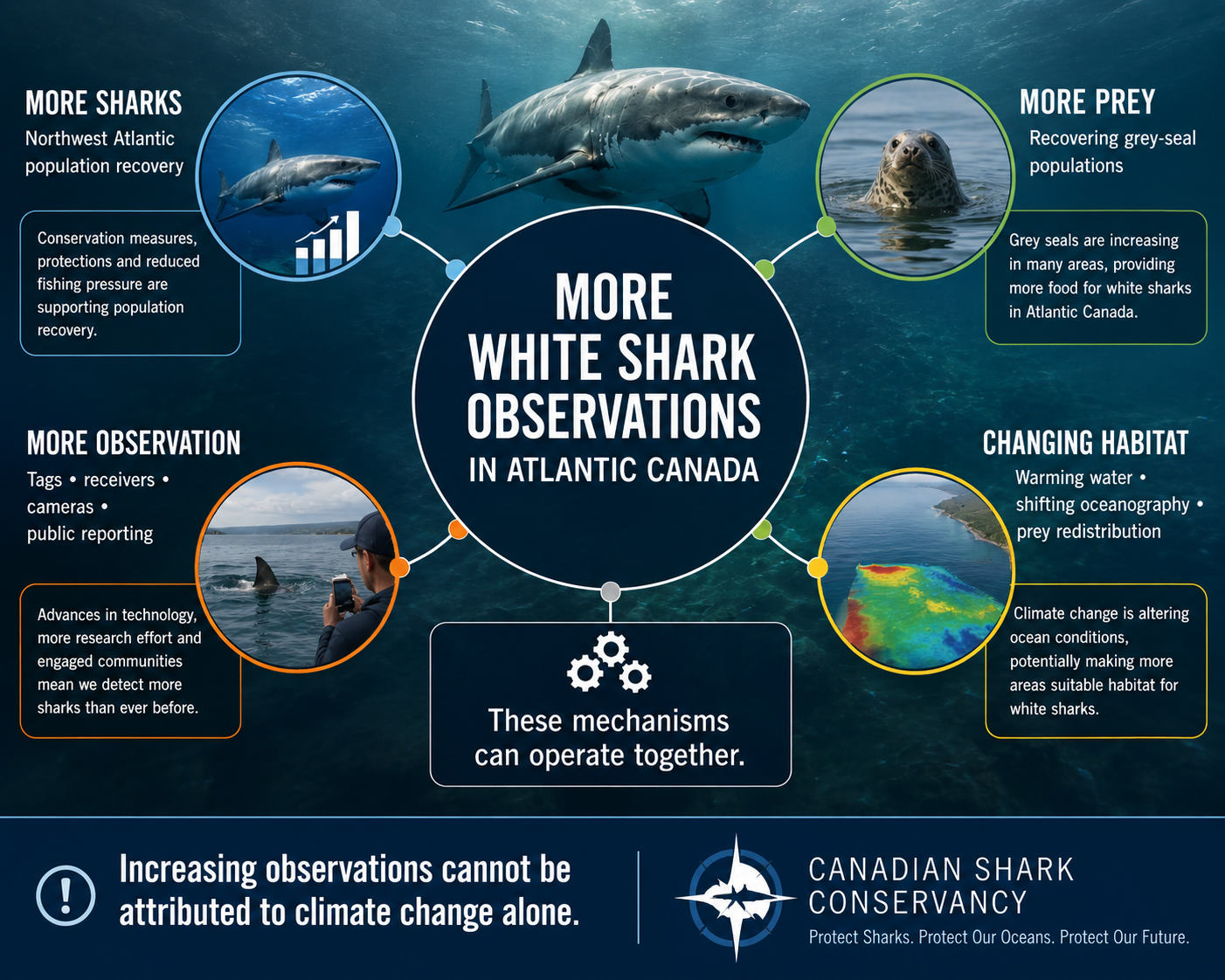
MORE WHITE SHARK OBSERVATIONS IN ATLANTIC CANADA
Four surrounding possibilities:
MORE SHARKS Northwest Atlantic population recovery
MORE PREY Recovering grey-seal populations
MORE OBSERVATION Tags • receivers • cameras • public reporting
CHANGING HABITAT Warming water • shifting oceanography • prey redistribution
Centre callout:
These mechanisms can operate together.
Footer:
Increasing observations cannot be attributed to climate change alone.
But the Atlantic Really Is Warming
Removing climate exaggeration does not mean removing climate from the story.
The ocean itself is changing.
Fisheries and Oceans Canada's assessment of Atlantic ecosystems reports long-term warming of sea-surface waters and unusually high bottom temperatures across Atlantic Canada's continental shelves during much of 2016–2021.
The same assessment notes increasing Gulf Stream influence on the Scotian Shelf and in deep channels of the northern Gulf of St. Lawrence.
DFO also identifies the Scotian Shelf and nearshore Newfoundland and Labrador among Canadian marine regions expected to experience particularly rapid future change.
Climate modelling of the Northwest Atlantic has projected changes in annual average sea-surface temperature approaching 2°C in some Maritime shelf and Labrador Sea areas by mid-century, though the exact magnitude and regional pattern depend on circulation and emissions scenarios.
Two degrees can sound insignificant when compared with daily weather.
In an ocean ecosystem, it can reorganize geography.
Because marine species do not experience temperature as a weather forecast.
They experience it as habitat.
A Shark Lives Inside a Thermal Landscape
White sharks tolerate an extraordinary range of temperatures.
Northwest Atlantic records include water from approximately 1.6°C to more than 30°C.
But broad tolerance does not mean temperature is irrelevant.
White sharks show seasonal habitat preferences, and temperature is one of the environmental variables influencing where they occur and how they move.
Think back to our Shark Science interlude.
White sharks possess regional endothermy.
They can maintain important tissues warmer than the surrounding sea.
That gives them greater access to cold environments than many predatory fishes.
But they still inhabit an ocean whose temperature affects:
prey,
metabolism,
migration,
productivity,
water masses,
and the energetic cost of occupying a particular region.
Regional endothermy gives the shark options.
It does not make it independent of climate.
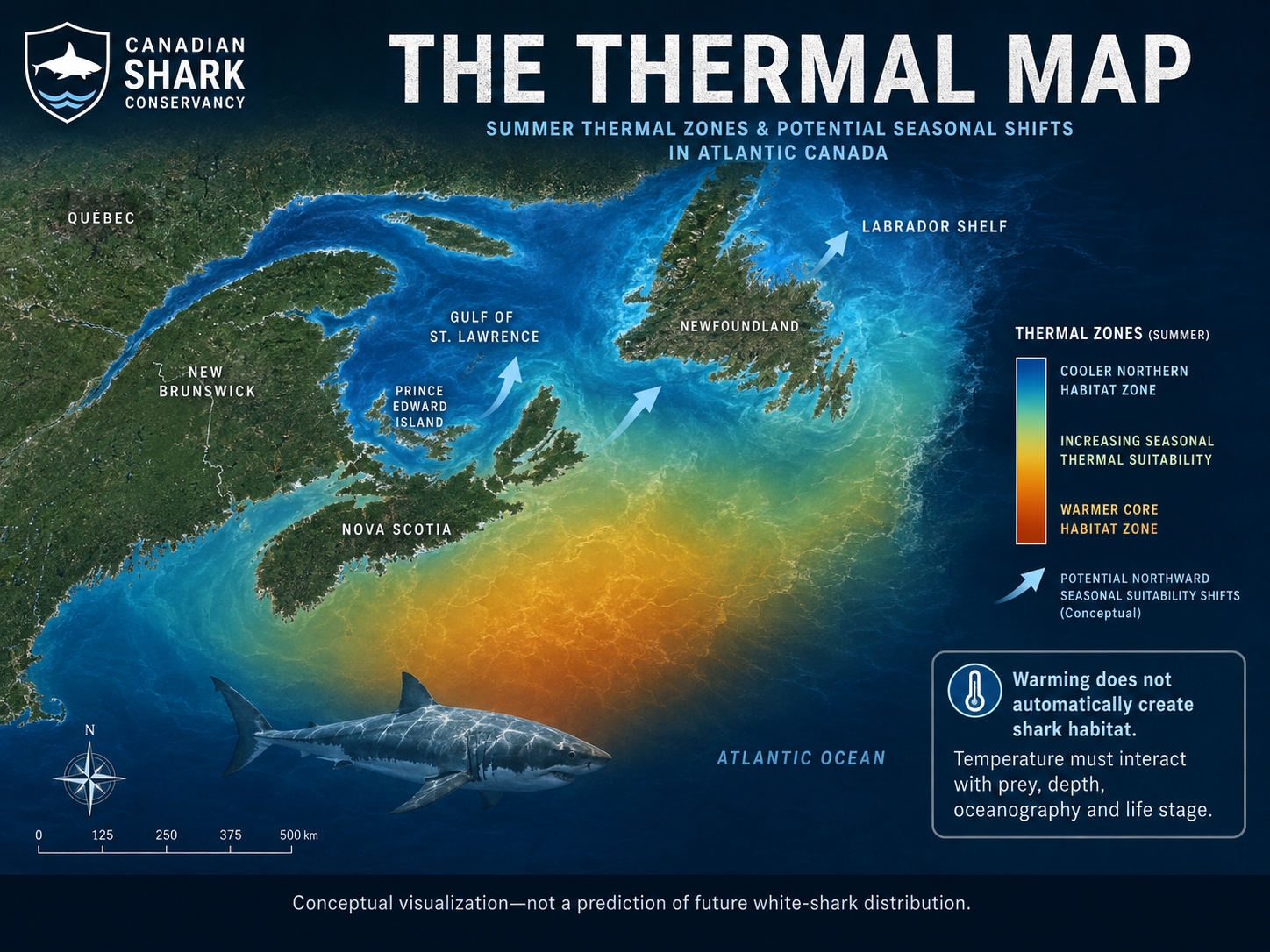
The Edge of a Range Is Where Change May Appear First
Atlantic Canada occupies something ecologically important.
It is the northern portion of the Northwest Atlantic white shark's regular range.
The species occurs from waters off Brazil northward through the eastern United States and into Canada, with occasional movements still farther toward subarctic waters.
Canada therefore sits near a biological boundary.
Range edges are interesting places under climate change.
If conditions become more suitable beyond an existing boundary, dispersing animals can begin using those areas more frequently.
For white sharks, that does not require evolution.
They already can travel enormous distances.
The question is simply whether going farther north becomes worthwhile.
Canada's final recovery strategy explicitly recognizes this possibility.
It states that although global climate change could degrade white-shark habitat elsewhere, warming may also increase habitat suitability in Atlantic Canadian waters and potentially increase seasonal abundance here.
Importantly, DFO also says the overall climate effect remains poorly understood.
That is the correct scientific framing:
NORTHWARD EXPANSION
Possible.
GREATER CANADIAN SEASONAL USE
Possible.
ALREADY PROVEN TO BE CAUSED BY CLIMATE CHANGE
No.
Earlier In. Later Out?
Consider the current migration.
Most Canadian records historically cluster from roughly June through September, with August producing the greatest number of records in DFO's compilation through 2023.
That seasonal pattern presumably exists because a combination of conditions becomes favourable.
Water temperature.
Prey.
Ocean productivity.
Migration timing elsewhere in the range.
Now imagine those conditions beginning earlier in spring.
Or persisting longer into autumn.
The geographical range might remain similar while the calendar changes.
A shark that once entered Canadian waters in July might eventually arrive in June.
One that departed in October might remain into November.
That concept is called a change in phenology—the timing of recurring biological events.
We do not yet have enough long-term standardized Canadian white-shark data to declare that such a shift has occurred.
But it is exactly the kind of signal researchers should be looking for.
Newfoundland May Become an Especially Important Question
White sharks already reach Newfoundland.
That should be clear.
They are not hypothetical future visitors.
Canada's status assessment documents white sharks throughout the Newfoundland Shelf and notes occasional movements beyond the continental shelf toward waters near Greenland.
But Newfoundland sits farther toward the current northern edge.
That makes changes there particularly interesting.
A small environmental shift within central Nova Scotia habitat may change shark behaviour without dramatically changing distribution.
The same thermal change near Newfoundland could transform an area from:
occasionally usable
to
regularly attractive during summer.
That is one reason range-edge monitoring matters.
Scientists should not simply count the total number of Canadian detections.
They should ask whether the geographical distribution of those detections is moving.
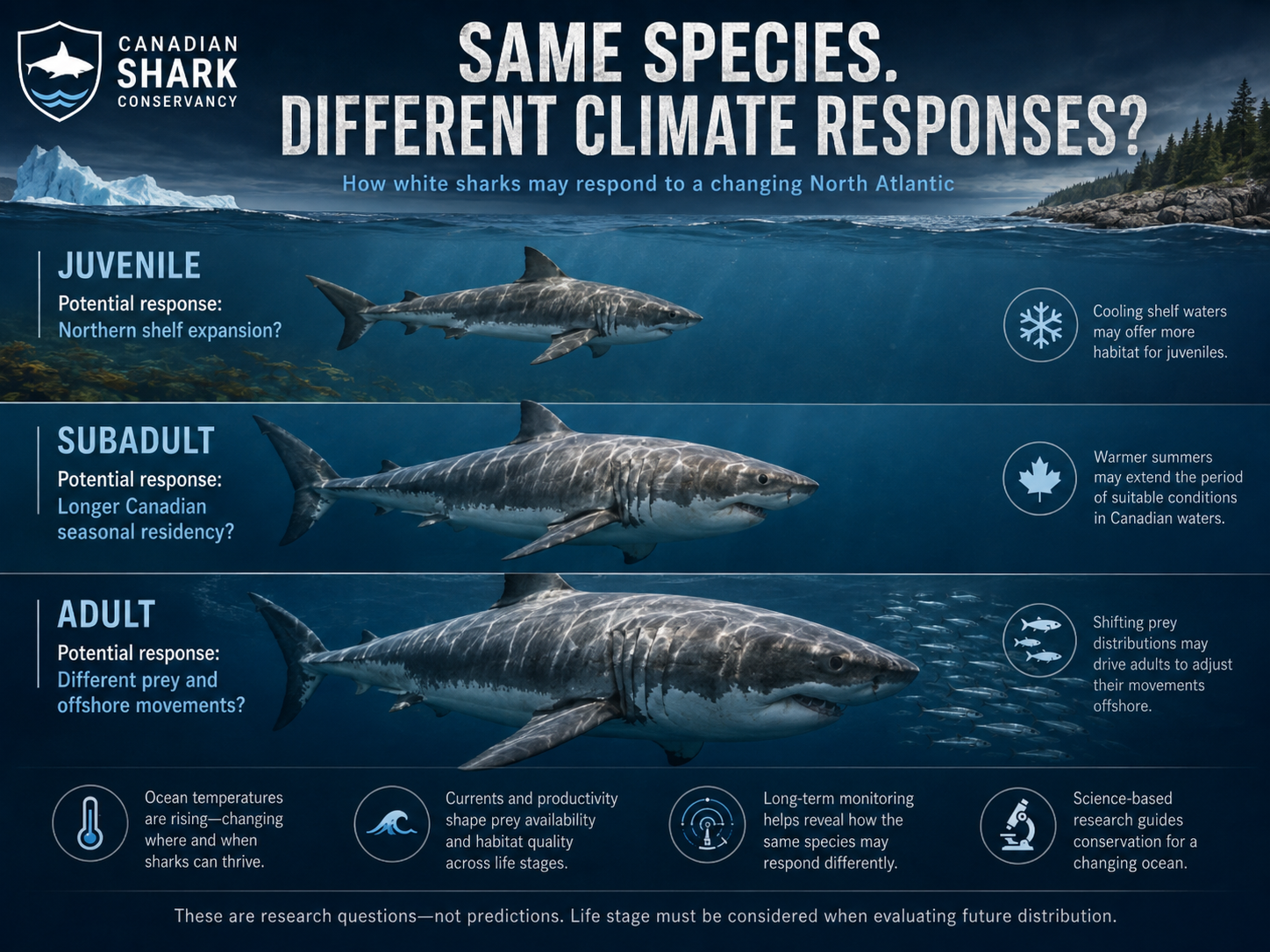
Will Juveniles Lead the Way?
Part 7 gave us another intriguing clue.
Juveniles and subadults were more likely than adults to move into Canadian waters in the major DFO telemetry analysis.
Juveniles were estimated to be 4.7 times more likely than adults to move north.
Subadults were 3.4 times more likely.
If climate makes additional northern shelf habitat seasonally accessible, which life stage will begin exploiting it first?
Younger animals are an obvious group to watch.
But that remains a hypothesis.
There are several possible outcomes.
Young sharks could expand northward because productive shelf habitat becomes accessible.
Adults could respond differently because their energetic requirements and prey differ.
Large females might continue following offshore reproductive or foraging strategies largely independent of coastal warming.
Different sharks could therefore respond to the same changing ocean in different ways.
Climate change may not simply shift the white shark range.
It may reshape several different white-shark ranges simultaneously.
But a Shark Does Not Follow Temperature Alone
This may be the biggest mistake in simplistic climate maps.
You cannot take a sea-surface temperature map, shade everything between two numbers, and declare:
white shark habitat.
Temperature matters.
But so does food.
Consider what we discovered in Part 4.
Atlantic Canada contains:
grey seals,
porpoises,
large fishes,
rays,
productive banks,
continental-shelf ecosystems,
and oceanographic fronts.
White-shark habitat is partly determined by prey availability, and Canada's COSEWIC assessment specifically identifies the recovery of Atlantic grey seals as potentially improving prey availability for white sharks in Canadian waters.
Climate change can also alter those prey distributions.
And that means a shark can respond to climate without directly following temperature.
Suppose mackerel shift north.
Or seals change their seasonal foraging range.
Or a productive ocean front moves.
The shark may follow the food.
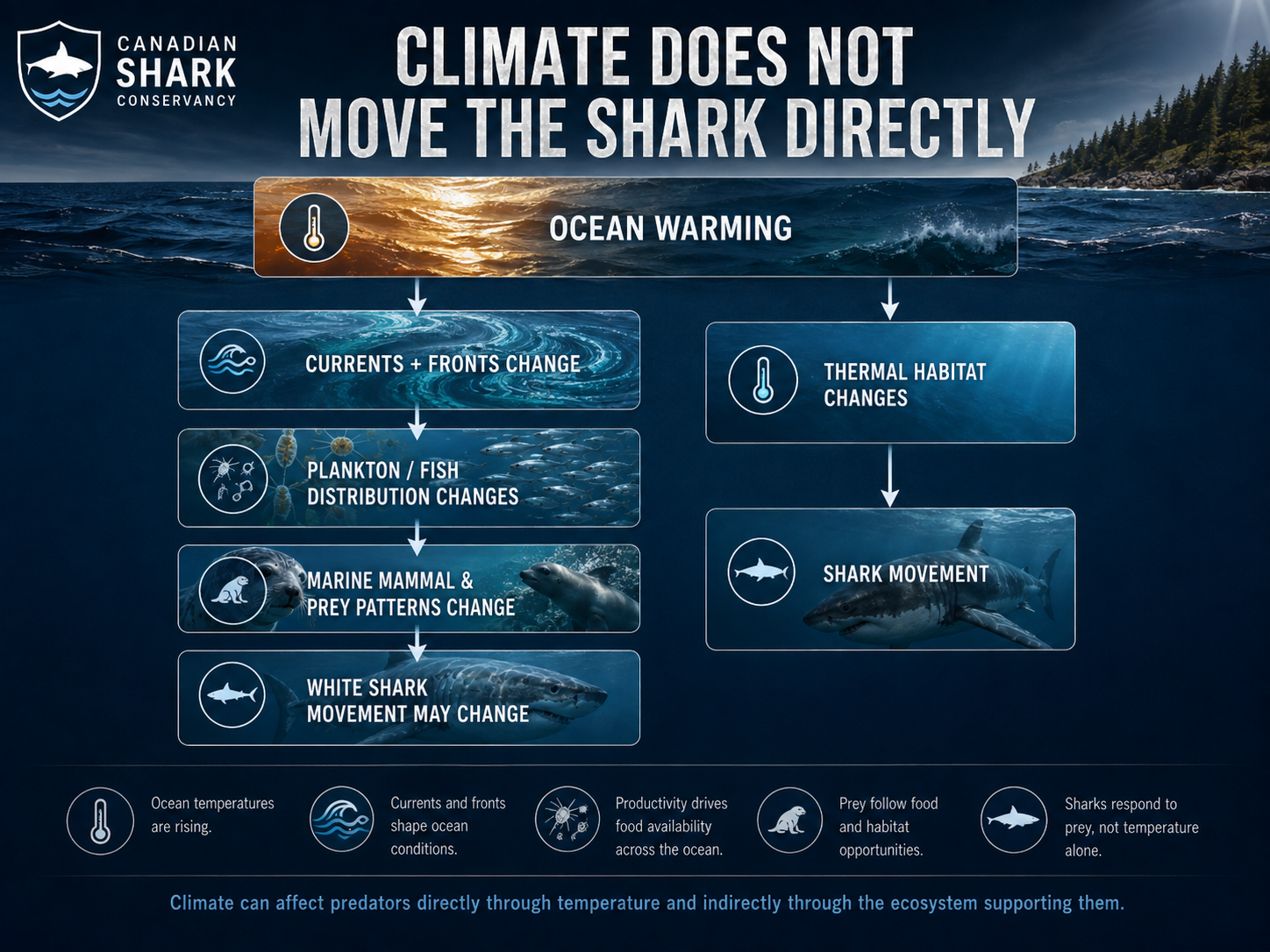
From the shark's perspective, the causal chain could be:
climate changes oceanography
↓
oceanography changes prey
↓
prey changes distribution
↓
shark changes movement
The shark is responding to climate—
but indirectly.
The Food Web May Move Before the Predator
Marine ecosystems reorganize from the bottom up as well as the top down.
Temperature influences:
plankton blooms,
fish recruitment,
migration timing,
species interactions,
and which organisms can occupy particular regions.
DFO warns that continued ocean warming could shift species distributions and alter ecosystem productivity across Atlantic Canada.
That raises a fascinating possibility.
The future map of Canada's white sharks may be determined not by the sharks' thermal limits—
but by where the food web beneath them relocates.
A white shark capable of tolerating cold Newfoundland water still has little reason to remain if profitable prey is elsewhere.
Conversely, a modestly warmer region with increasingly abundant prey could become very attractive.
There Is Another Variable: More Sharks
Suppose white shark observations increase in Nova Scotia during the next decade.
Climate change would be one possible explanation.
But there is another very encouraging possibility:
The population itself may be recovering.
White sharks suffered major historical declines in the Northwest Atlantic.
Protection measures introduced in the United States beginning in the 1990s reduced targeted mortality, and the best available evidence suggests the wider population has since stabilized or increased.
The exact size of that recovery remains uncertain.
But consider the mathematics.
If the proportion of the population travelling to Canada stayed completely unchanged while the total population doubled—
Canada would see more sharks.
No northward range shift required.
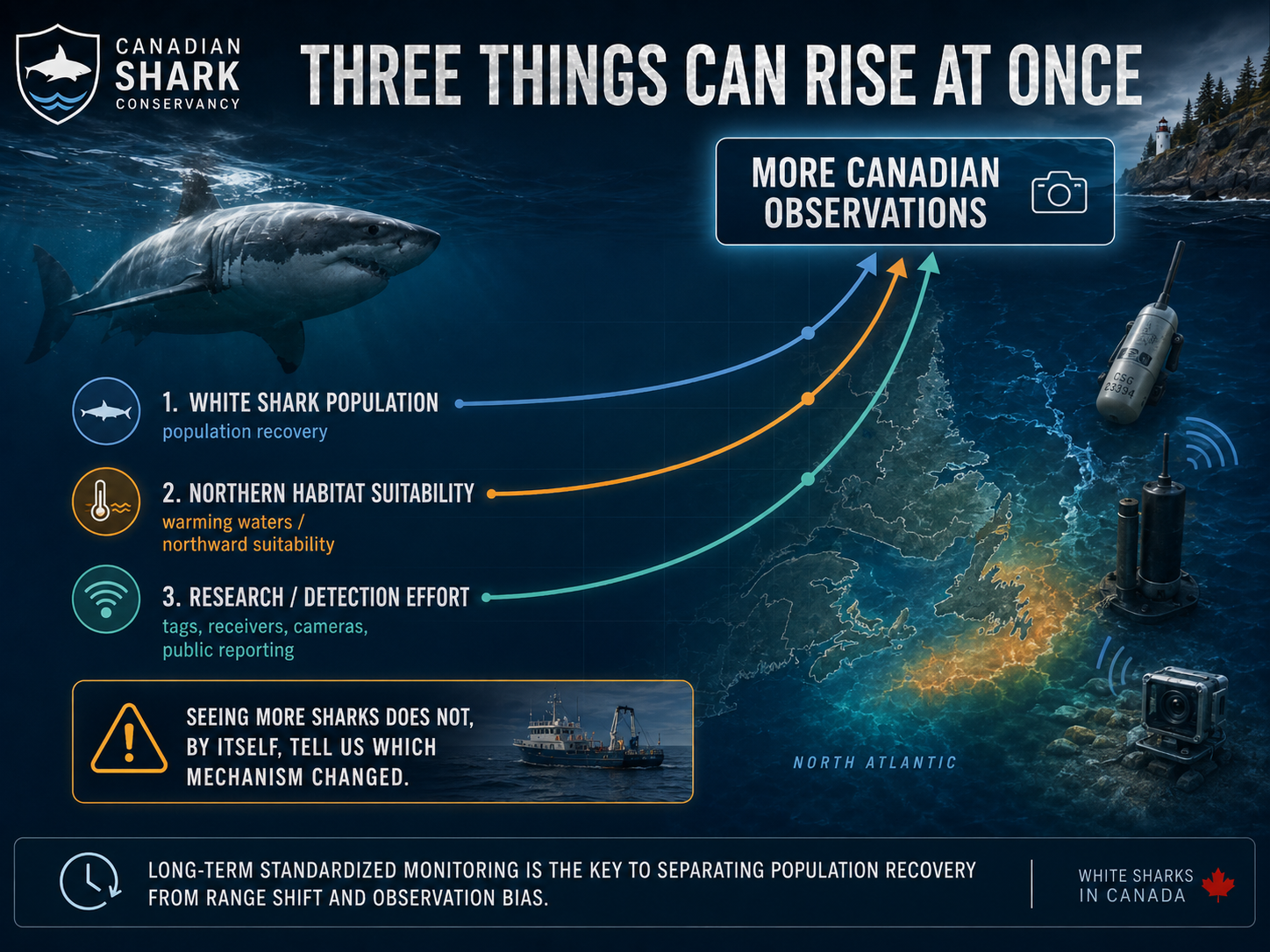
This creates one of the central scientific challenges of the entire Canadian story.
When observations increase, researchers need to separate:
population recovery
from
distribution change
from
observation effort.
And perhaps all three are happening simultaneously.
More Tags Can Look Like More Sharks
Technology creates another illusion.
Twenty years ago, a white shark could swim past Nova Scotia and disappear without being noticed.
Today it may be:
satellite tagged,
acoustically tagged,
photographed,
recorded on a phone,
reported to DFO,
detected by an Ocean Tracking Network receiver,
and discussed online within hours.
The shark's biological presence might not have changed nearly as much as our ability to detect it.
Canada's 2025 recovery strategy explicitly notes that recent increases in research and identification effort have demonstrated that white sharks use Atlantic Canadian waters more frequently than previously understood.
That means any climate analysis needs standardized observation effort.
Otherwise:
more listening can masquerade as more sharks.
Marine Heatwaves Add Another Layer
Climate change is not only a slow increase in average temperature.
The ocean also experiences episodic extremes.
Marine heatwaves are periods of unusually warm ocean conditions lasting days, weeks, or longer.
DFO warns that these events can create substantial ecological shocks on top of long-term warming.
For a mobile predator like a white shark, a marine heatwave can create an interesting response.
Leave.
Move deeper.
Shift north.
Follow displaced prey.
Or remain if prey availability compensates for temperature.
The response may differ among animals.
That means some future changes in white-shark distribution may not appear as a smooth northward march.
They could appear as abrupt seasonal anomalies.
One unusually warm year.
A surprising number of Newfoundland detections.
Then fewer the next.
Climate signals in highly mobile predators can be noisy.
Only long datasets reveal the underlying pattern.
What About the Southern End?
Whenever we talk about climate creating habitat in Canada, there is another side of the map.
If northern habitat becomes more suitable because it warms—
some southern habitat could become less suitable.
Canada's COSEWIC assessment explicitly notes this possibility: increasingly frequent warm anomalies may expand thermal habitat northward while warming could also contract distribution at the southern end of the range.
That matters because white sharks need an entire annual cycle.
Southern winter habitat.
Migration corridors.
Nursery habitat.
Northern feeding habitat.
Offshore habitat.
We should therefore not frame climate change as:
“good for Canadian white sharks because Canada becomes warmer.”
A gain in one part of the range can accompany disruption somewhere else.
The Nursery Cannot Simply Move Without Consequences
Consider the youngest white sharks.
The New York Bight provides confirmed nursery habitat.
Those young animals occupy particular temperatures, depths, and coastal environments.
If warming shifts those conditions north, do nursery areas eventually move?
Expand?
Contract?
Persist because other habitat characteristics remain favourable?
We do not know.
But the answer matters enormously.
Young-of-the-year sharks do not have the same thermal physiology, movement history, or ecological requirements as giant adults.
Climate change can therefore affect an animal at one life stage very differently from another.
The population's future depends on the entire sequence continuing to work.
What Would We Expect to See If the Range Really Is Changing?
This gives scientists something testable.
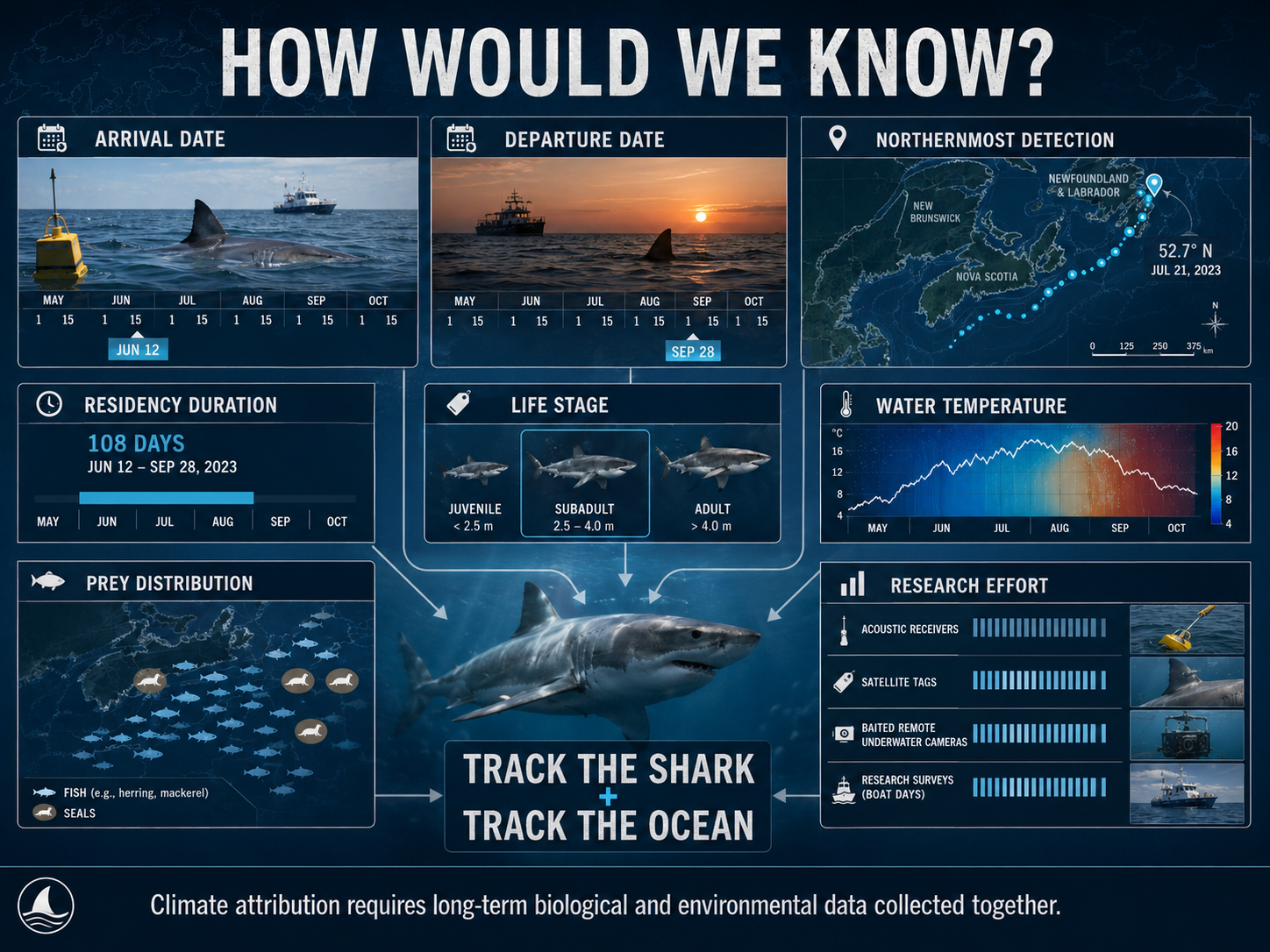
A genuine climate-related northward shift should eventually leave measurable signals.
Potential indicators include:
Earlier seasonal arrival
Sharks begin entering Canadian waters earlier.
Later seasonal departure
Residency extends deeper into autumn.
More northern detections
Use increases around Newfoundland, Labrador, or other northern areas.
Changes by life stage
Certain age classes expand first.
Changing habitat associations
Animals use different temperature ranges or shelf regions than previously.
Prey redistribution
Shark movement increasingly overlaps shifting fish or marine-mammal populations.
Persistent patterns
The changes continue across many years rather than reflecting one unusually warm season.
None of these individually proves causation.
Together—with environmental modelling—they could build a strong case.
Canada's Recovery Strategy Already Anticipates This
The climate question is not a theoretical conservation discussion.
It is already built into Canada's white-shark recovery planning.
DFO identifies oceanographic characteristics, habitat use, seasonal distribution, migration, and life-stage differences as priority areas for future research.
The study schedule specifically calls for ecological research that can relate shark distribution to ocean conditions, along with continued tagging and monitoring over the coming years.
That becomes even more important in a changing ocean.
Critical habitat identified from yesterday's conditions may not perfectly describe tomorrow's.
For highly migratory marine animals, conservation may increasingly require protecting ecological functions and connections, not merely fixed coordinates.
Conservation Maps May Need to Move Too
Imagine Canada eventually identifies an important seasonal white-shark habitat off southwestern Nova Scotia.
Then the ocean changes.
Prey distributions shift.
Sharks spend less time there.
Another region becomes increasingly important.
How should conservation respond?
Traditional conservation often thinks spatially:
Protect this place.
Draw this boundary.
Regulate this activity within it.
Migratory predators force us to add another dimension:
time.
And climate adds another:
change.
The conservation challenge therefore becomes:
protect important places,
protect migration connections,
monitor emerging habitat,
and remain willing to change management as the animals change their use of the ocean.
That is much harder than drawing a box on a map.
But it is closer to how a shark actually lives.
More Sharks in Canada Does Not Necessarily Mean Something Is Wrong
This deserves to be said clearly.
If white sharks become more common in Canadian waters, public reaction may frame that change as alarming.
“Great whites moving north.”
“Shark invasion.”
“Canadian waters becoming dangerous.”
Those headlines misunderstand what a range shift means.
Atlantic Canada has always been white-shark habitat.
An increasing population or changing seasonal distribution would represent an ecological change, not an invasion.
White sharks are native predators within the Northwest Atlantic ecosystem.
A shark arriving in Nova Scotia is not entering foreign ecological territory.
It is using part of its natural range.
The scientific questions are:
Why?
How frequently?
For how long?
And how is that changing?
Humans Will Have to Adapt Too
A growing or longer seasonal white-shark presence does create practical questions.
More sharks can mean more overlap with:
commercial fisheries,
recreational fishing,
boating,
diving,
swimming,
aquaculture,
and coastal communities.
That does not require fear.
It requires preparation.
Better reporting.
Fisher education.
Safe release protocols.
Public understanding.
Evidence-based beach management.
Clear communication about actual risk.
Continued telemetry.
And conservation practices that recognize white sharks as part of the ecosystem rather than an unexpected emergency.
If the ocean is changing, human expectations about who lives in that ocean may have to change too.
The Shark Is Not Following a Border North
Return to the shark.
It leaves the southeastern United States.
Moves past the Carolinas.
Past Cape Cod.
Toward Nova Scotia.
Perhaps farther.
It does not know that average ocean temperature has risen.
It does not know what a climate model predicts for 2050.
It does not understand a marine heatwave.
It simply evaluates the ocean presented to it.
Does the temperature work?
Is food available?
Can its body perform efficiently?
Does experience tell it this region is worth returning to?
Then it moves.
That is how climate change becomes visible in animal behaviour.
Not as a political issue.
Not as a graph.
But as a decision repeated by thousands of living organisms responding to a world whose physical boundaries are moving around them.
The Ocean Is Changing Beneath Them
For the first eight parts of this series, we treated the white-shark migration almost like a recurring route.
South.
North.
Canada.
South again.
Return.
But the stage beneath that journey is not stationary.
Currents change.
Water warms.
Prey moves.
Marine heatwaves come and go.
Populations recover.
Habitats shift.
The next generation of white sharks may therefore inherit a Northwest Atlantic that looks ecologically different from the one their mothers learned.
Some places may become less useful.
Others more important.
Their northern season may lengthen.
Their range may extend.
Or the effect may prove subtler than any simple northward arrow.
We do not yet know.
What we do know is that the question can no longer be:
Where do Canadian white sharks go?
It must also become:
How is the ocean changing the meaning of where they go?
They don't live in Canada.
They return to Canada.
But the Canada they return to each year is not exactly the same ocean they left behind.
NEXT — PART 10
When Sharks and Fisheries Meet
The accidental encounters that remain Canada's greatest direct threat to white sharks
A white shark follows prey onto the Canadian continental shelf.
A fishing vessel is working the same productive waters.
Neither is looking for the other.
Then a net closes.
Canada prohibits directed fishing for white sharks.
But protected animals can still encounter commercial gear accidentally.
And for a species that grows slowly, matures late, and produces relatively few young, the loss of even a small number of sharks matters.
In Part 10 of White Sharks in Canada, we will examine:
bycatch,
gillnets,
weirs,
live release,
mandatory reporting,
how often Canadian interactions actually occur,
and why protecting a recovering predator requires working with the people who share its habitat.
Research & Further Reading
Fisheries and Oceans Canada — Recovery Strategy for White Shark in Atlantic Canadian Waters (2025). Canada's final recovery strategy recognizes climate change as a potential influence on Canadian habitat suitability while emphasizing substantial uncertainty. It also documents the seasonal Canadian range, research priorities and need for continued monitoring.READ SOURCE ↗Bastien et al. (2020) — Inconspicuous, recovering, or northward shift: status and management of the white shark in Atlantic Canada. This Canadian research explicitly considers competing explanations for increasing white-shark observations, including previously cryptic presence, population recovery, prey abundance and climate-related range expansion.READ SOURCE ↗Fisheries and Oceans Canada — Canada's Oceans Now: Atlantic Ecosystems. DFO documents long-term Atlantic surface warming, unusually warm bottom conditions across Atlantic shelves and changing influence of major water masses including the Gulf Stream.READ SOURCE ↗COSEWIC (2021) — White Shark, Atlantic population. Canada's status assessment describes the white shark's broad thermal range, northern Canadian distribution and the possibility that increasingly frequent warm anomalies could expand thermal habitat northward while reducing suitability farther south.READ SOURCE ↗DFO Northwest Atlantic climate modelling. High-resolution modelling projects continued warming and major changes in temperature, stratification and other ocean conditions across Canadian Atlantic ecosystems over coming decades.