
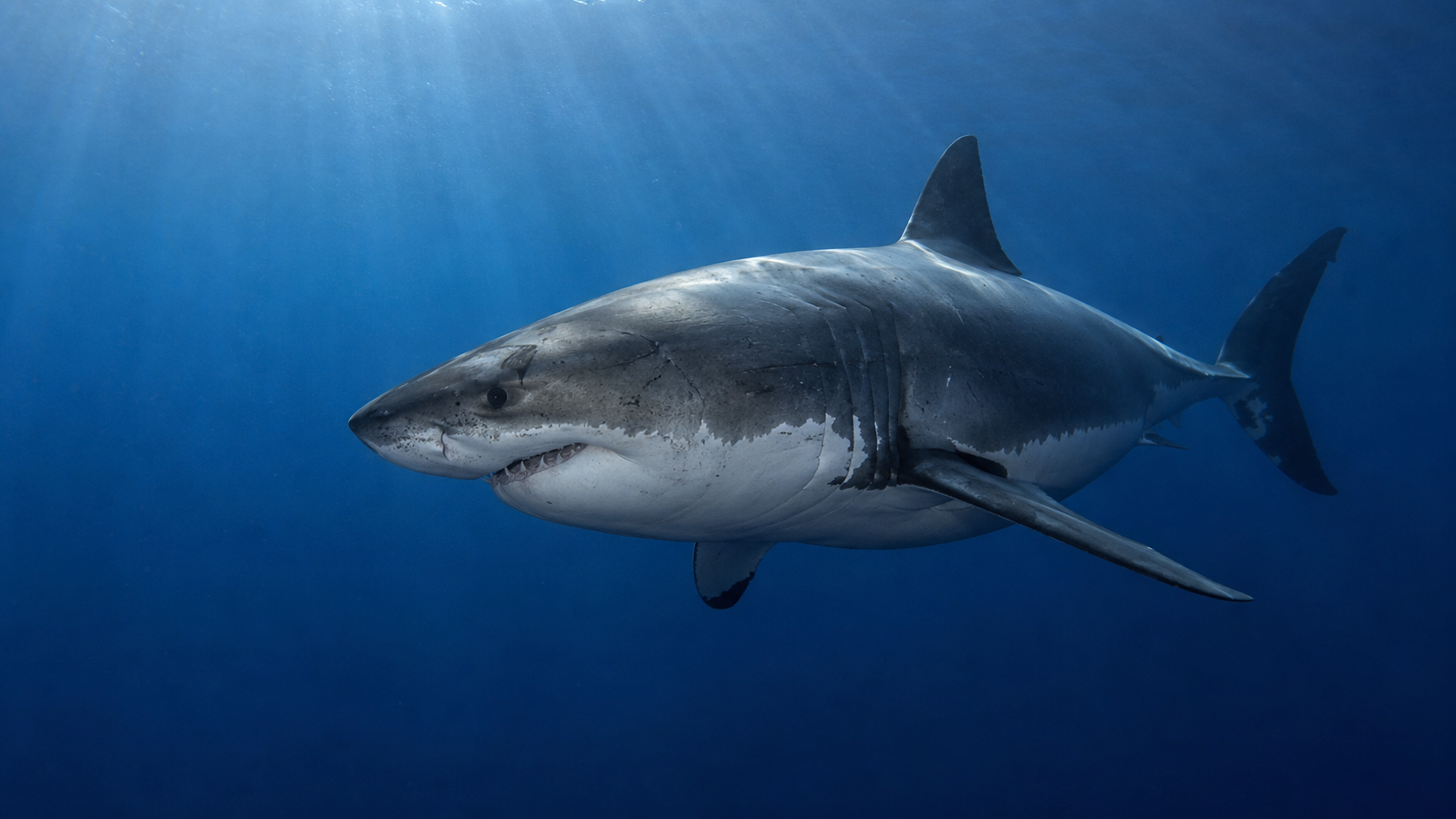
They don’t live in Canada. They return to Canada.
We know where some of the youngest white sharks spend their first summers.
Off Long Island and throughout the New York Bight, young-of-the-year sharks use shallow coastal nursery habitat before moving south as winter approaches.
As they grow, their world expands.
Some begin travelling through New England.
Some eventually continue into Nova Scotia, the Bay of Fundy, the Gulf of St. Lawrence and Newfoundland.
We have followed those movements through satellite tags.
Acoustic receivers.
Photographs.
Archival tags.
We can watch a juvenile's world becoming larger.
But reverse the story.
Where was that shark before Long Island?
Where was its mother?
Where did she mate?
Where did she spend her pregnancy?
Where did she finally give birth?
Suddenly, the tracking map becomes much emptier.
For all we have learned about white sharks in the Northwest Atlantic, reproduction remains one of the most elusive chapters of their lives.
And at the centre of that mystery are some of the hardest animals in the population to study:
large adult females.
First, You Have to Survive Long Enough to Become a Mother
White sharks do not reproduce quickly.
That fact lies behind almost every conservation problem the species faces.
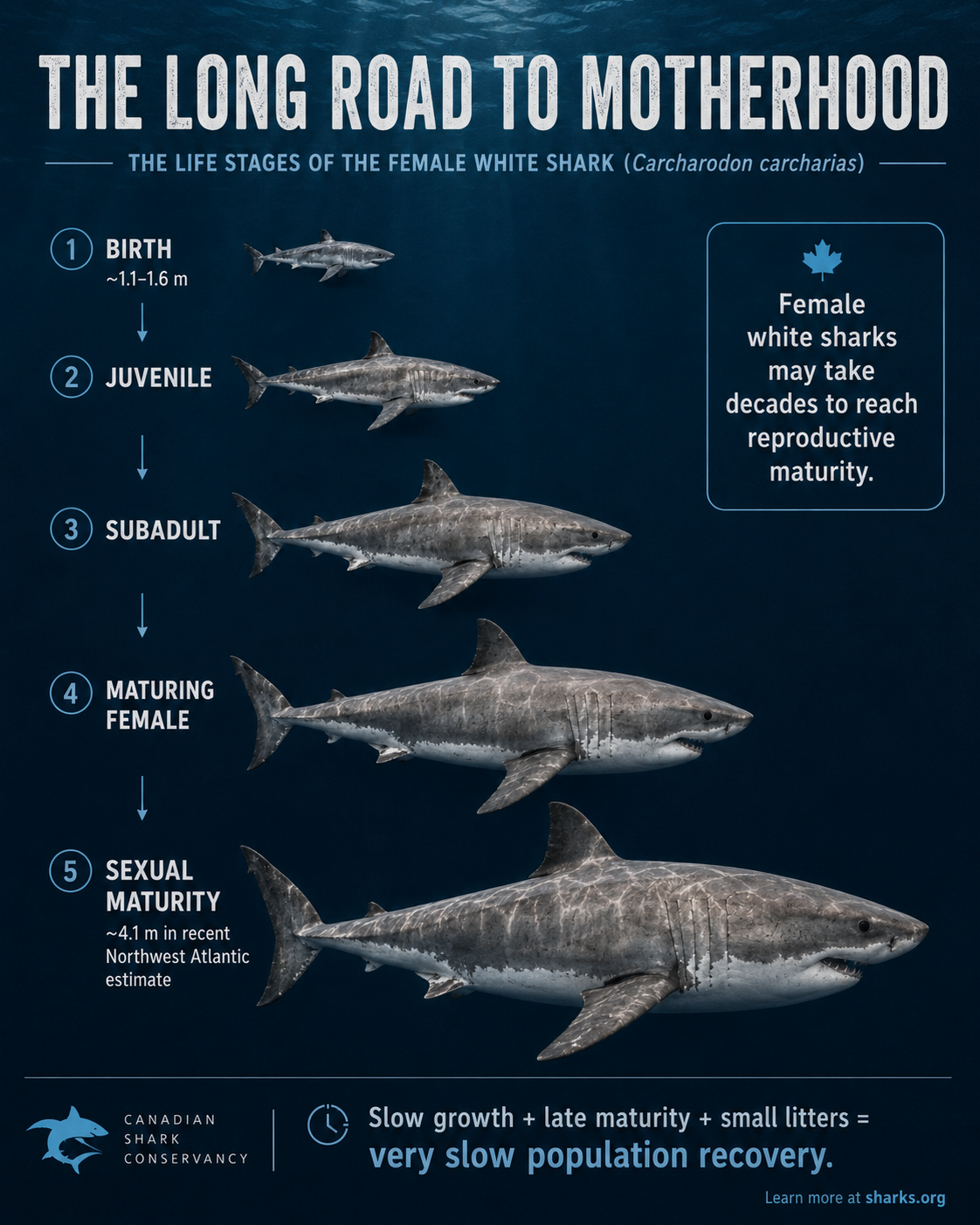
Recent research on western North Atlantic sharks estimated the length at which 50% of females are sexually mature at approximately 4.11 metres.
For males, the estimate is approximately 3.35 metres.
But length tells only part of the story.
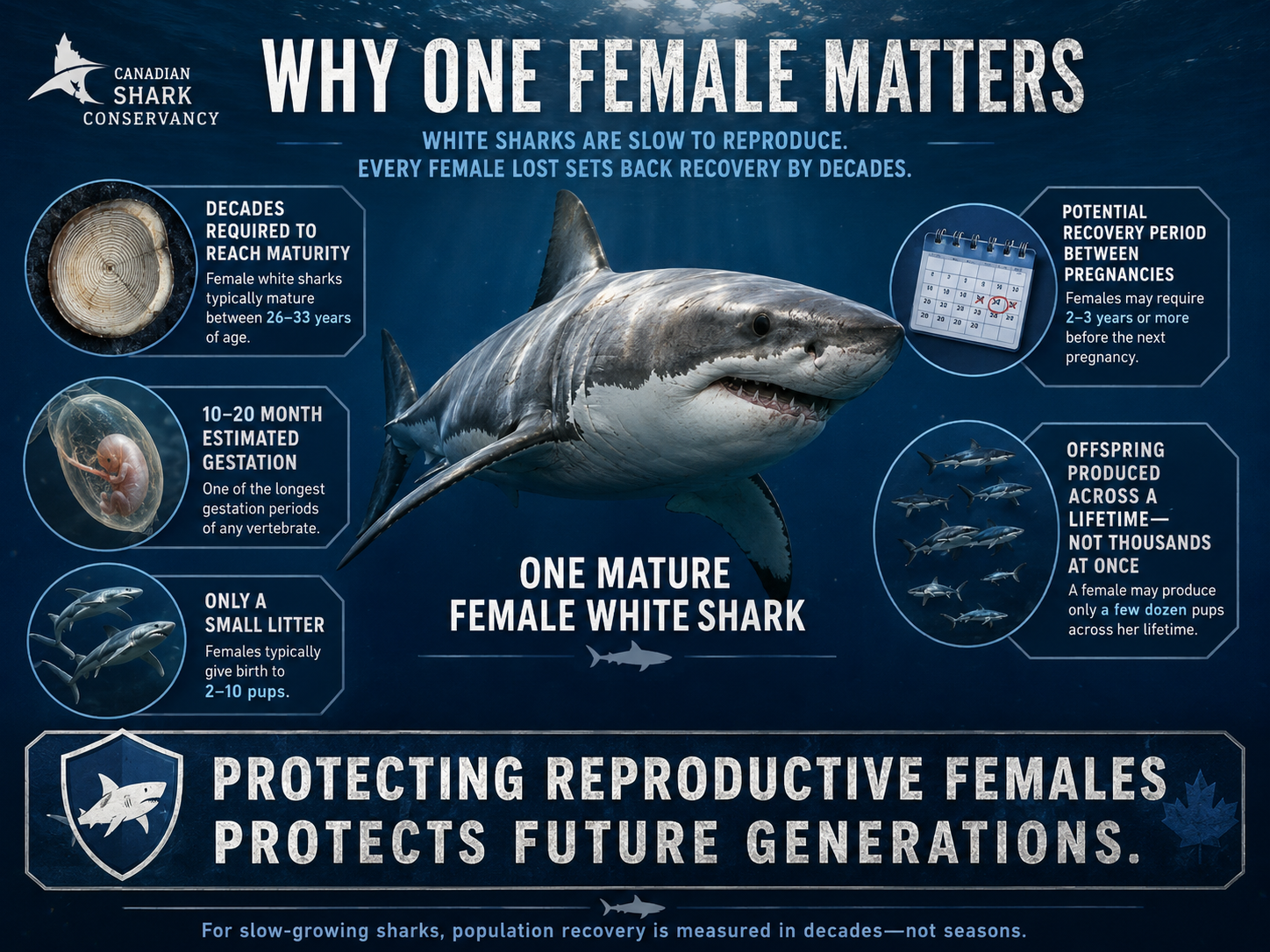
Growth studies have suggested that Northwest Atlantic females may not mature until roughly three decades into life, although age-at-maturity estimates remain less certain than length-based estimates. Canada's current recovery strategy cites approximately 33 years for females and 26 years for males based on earlier age-and-growth work.
Think about that.
A female white shark might need to survive:
fisheries interactions,
entanglement,
injury,
changing prey distributions,
pollutants,
and decades of migration
before producing her first litter.
A white shark lost at age 10 is not simply one shark removed from the population.
It may represent decades of future reproduction that never happens.
White Sharks Do Not Lay Eggs
Their relatives demonstrate almost every reproductive strategy imaginable.
Some sharks lay leathery egg cases.
Some develop a placenta-like connection.
Some give birth to live young nourished mostly by yolk.
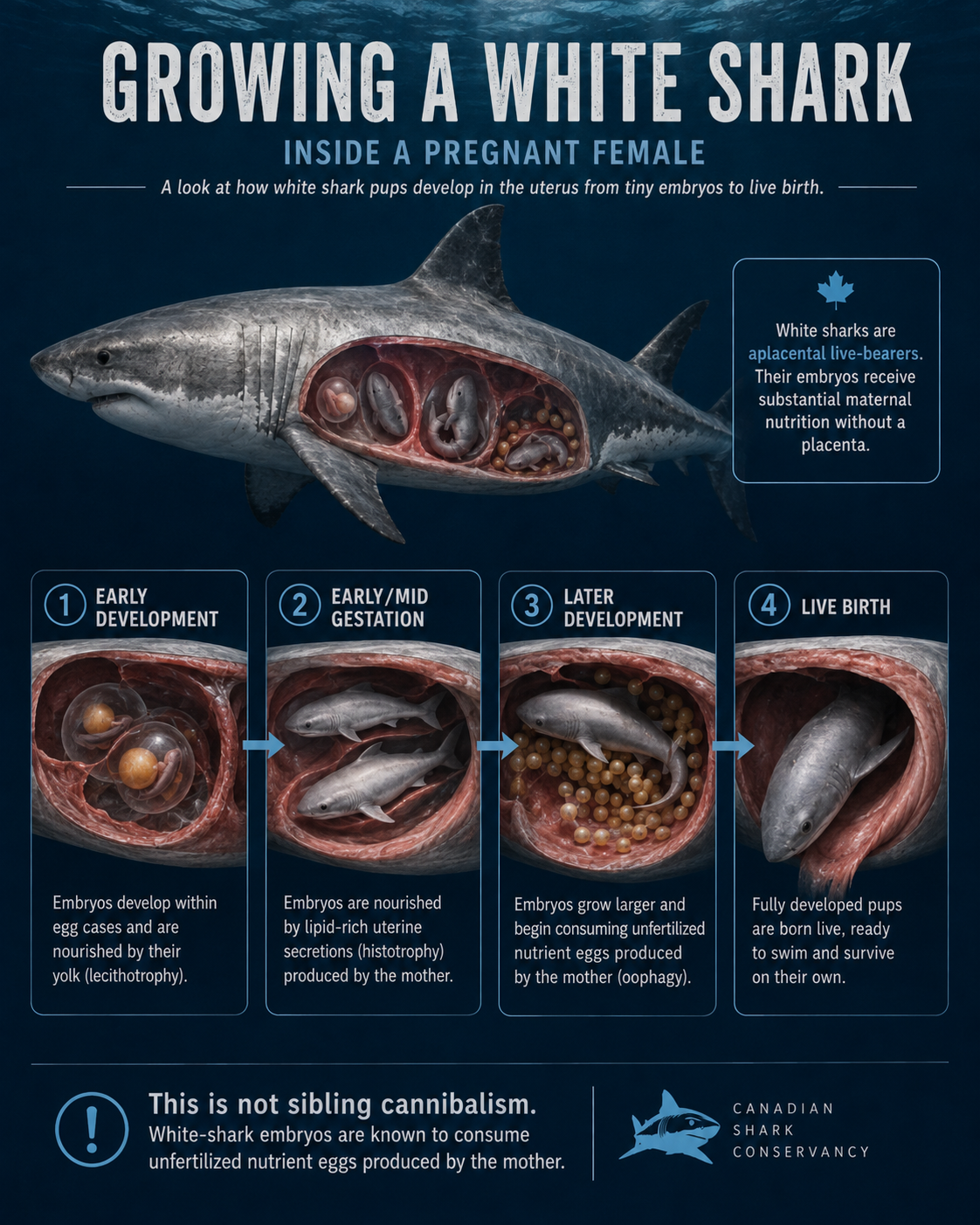
White sharks give birth to live pups, but they do not use a mammalian-style placenta.
Their reproductive system is usually described more precisely today as aplacental viviparity with maternal nourishment.
And what happens inside the uterus is extraordinary.
A developing white shark may receive nutrition through several stages:
yolk carried by the embryo,
then a lipid-rich uterine secretion sometimes called “uterine milk,”
and later unfertilized eggs produced by the mother for the embryos to consume—a process called oophagy.
Yes.
Before it is born, a white shark can feed on eggs produced specifically as nourishment inside its mother's uterus.
But even that description did not become clear until scientists encountered an extraordinarily rare animal.
The Pregnant Shark That Changed What We Knew
In February 2014, fishermen off Okinawa, Japan, accidentally caught a 4.95-metre pregnant female white shark.
Inside her were six embryos.
Three in each uterus.
They measured roughly 54 to 62 centimetres long.
Researchers also found enormous quantities of yellowish, lipid-rich uterine fluid, nutrient eggs and broken egg capsules.
More than 79 litres of uterine fluid remained in just one uterus when it was examined.
The discovery revealed something researchers had not previously understood.
Early white-shark embryos apparently receive considerable nourishment from lipid-rich secretions produced by the uterine wall.
Later, the developing sharks increasingly consume unfertilized eggs.
Further microscopic work showed that the uterine lining actively releases those lipids through a remarkable secretory process.
In other words, even one unfortunate encounter with one pregnant shark fundamentally changed our understanding of the species.
That tells us how rare direct reproductive evidence really is.
That last distinction is worth emphasizing because white sharks are frequently confused with sand tiger sharks, whose embryos can consume siblings in utero.
Pregnancy Is Long—and Still Poorly Understood
How long is a white shark pregnant?
We still do not know with precision.
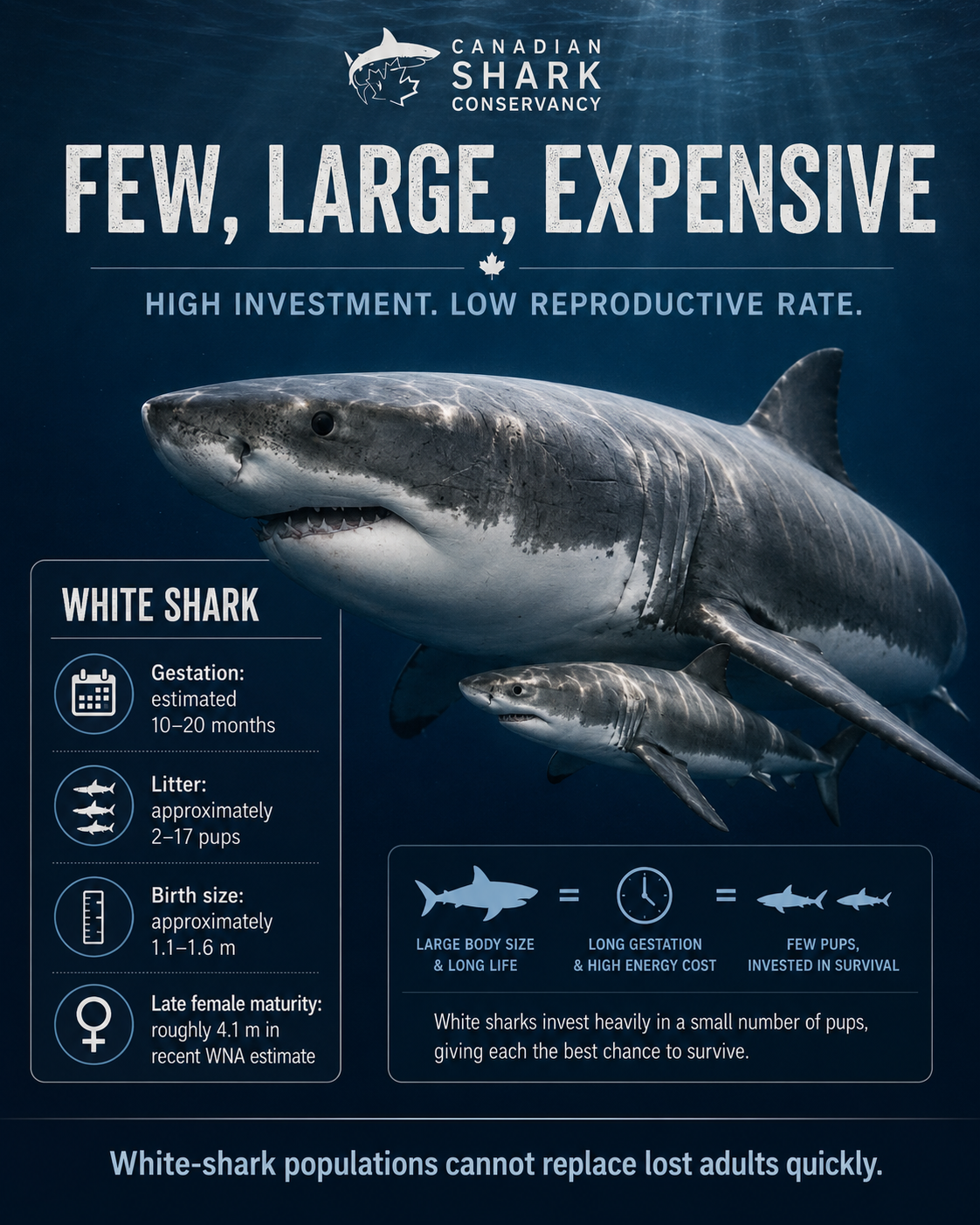
Canada's recovery strategy gives an estimated gestation period of approximately 10 to 20 months.
That enormous range is not a typo.
It reflects how rarely scientists can identify a female at conception and then follow her continuously until birth.
The full reproductive cycle is even less certain.
Some evidence from other white-shark populations suggests females may reproduce on approximately two-year cycles.
Other estimates suggest the interval may exceed three years, especially if a female requires substantial time after giving birth to rebuild energy stores.
That would make reproduction extraordinarily expensive.
Imagine spending more than a year supporting several rapidly growing predators inside your body—
giving them lipids,
producing unfertilized eggs to feed them,
carrying them until each approaches the size of a human being—
then potentially requiring another year or more simply to recover.
A large female white shark is not a high-volume reproductive machine.
She represents enormous biological investment in a small number of offspring.
How Many Pups?
Again, the answer is surprisingly uncertain.
Reported white-shark litters generally range from only a few pups to perhaps the high teens.
Canada's recovery strategy currently summarizes the known range as approximately 2 to 17 pups.
COSEWIC has historically cited an average of around seven.
And at birth, those pups are already substantial predators—roughly 1.1 to 1.6 metres long based on available records.
That makes evolutionary sense.
There is no parental nursery.
No mother guarding them.
No feeding from a parent after birth.
A newborn white shark enters the ocean equipped to survive independently.
The mother's strategy is not:
produce thousands and hope some survive.
It is closer to:
produce relatively few, but invest heavily in making each one large and capable before it enters the sea.
We Know Where the Babies Go
This is where the Northwest Atlantic story becomes especially intriguing.
Young-of-the-year white sharks have repeatedly been documented around the New York Bight, particularly the waters off Long Island.
Tracking research has confirmed that the region functions as nursery habitat.
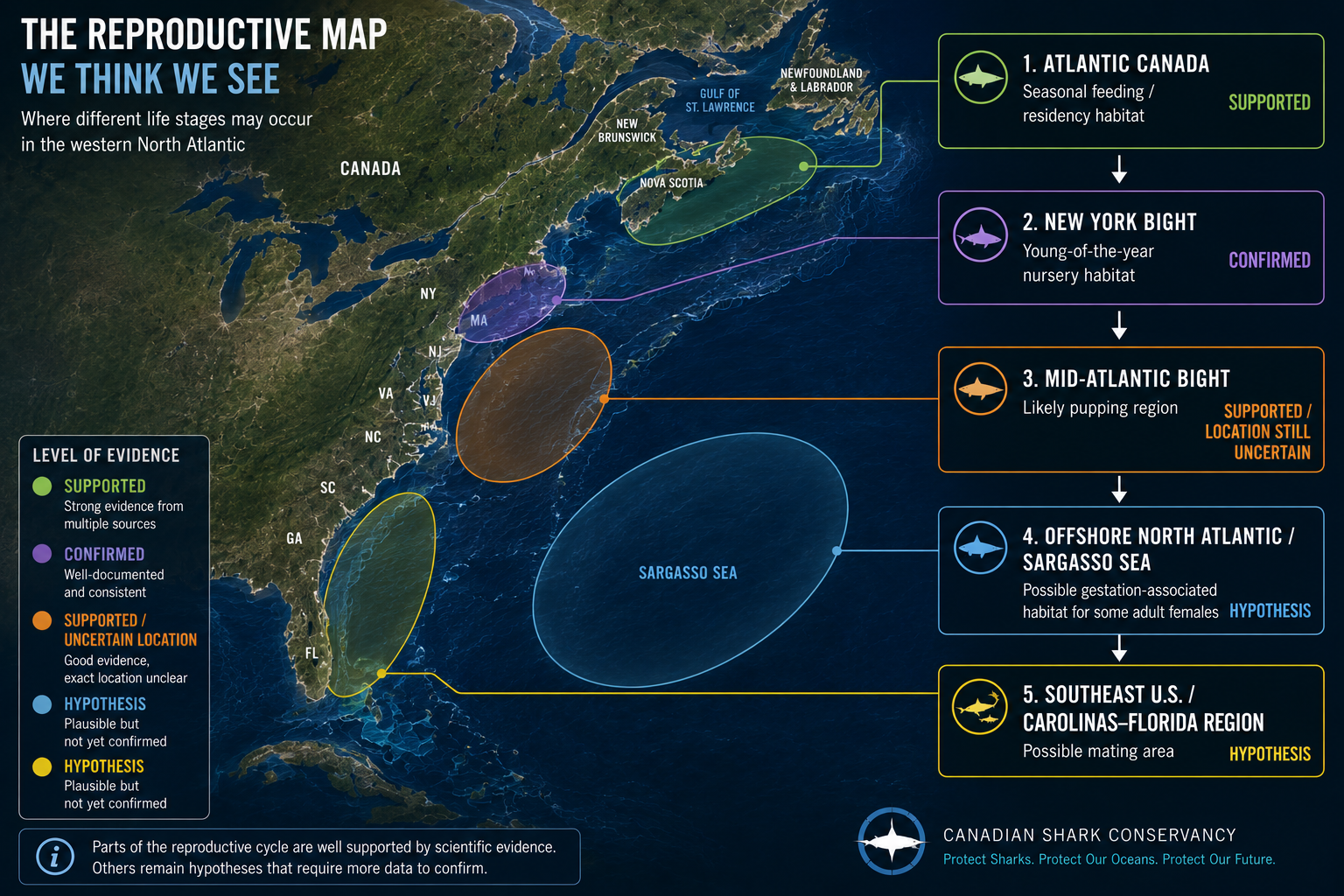
Young sharks use the area through warmer months and later move south toward the Carolinas as temperatures decline.
That gives us an important endpoint.
At some point, newborn sharks appear in this broader Mid-Atlantic region.
But a nursery is not necessarily the same thing as the precise place where birth occurs.
The exact pupping grounds of the Northwest Atlantic population remain uncertain.
COSEWIC considers the Mid-Atlantic Bight a likely parturition region, with young-of-the-year animals then using the New York Bight nursery.
That leaves a tantalizing gap.
We know where the infants gather.
We still cannot confidently point to the place where the mothers give birth.
And They Are Not Giving Birth in Canada
At least, there is currently no evidence that they are.
As we established in Part 7, no neonate or young-of-the-year white shark has yet been documented in Atlantic Canadian waters.
Canada is seasonal habitat for juveniles, subadults and adults.
It is not currently recognized as a white-shark nursery or pupping area.
So a large female travelling through Nova Scotia is almost certainly participating in a much larger reproductive geography.
If she is reproductively active, some important parts of her cycle happen elsewhere.
Canada may provide feeding opportunities.
The southeastern United States may play another role.
Open-ocean habitat another.
The Mid-Atlantic Bight another.
One pregnancy could therefore connect habitats across an enormous portion of the Northwest Atlantic.
So Where Do They Mate?
This may be the most difficult question in the entire Northwest Atlantic life cycle.
Nobody has simply watched a population of white sharks assemble and mate.
Instead, researchers search for clues.
Adult males and females occupying the same area.
Hormone levels.
Mature sperm.
Ultrasound evidence of reproductive condition.
Fresh mating wounds.
Movement patterns before and after suspected reproductive periods.
Tracking studies have proposed that mating may occur somewhere from off North Carolina toward northern Florida during late winter through early summer.
The idea is based partly on the seasonal convergence of mature males and females and on the subsequent offshore movements of some adult females.
Franks and colleagues described that southeastern region as a proposed mating area, not a confirmed one.
OCEARCH has specifically targeted the Carolinas to collect reproductive hormones, ultrasound data, semen samples and evidence of mating wounds to test that hypothesis.
Even recent summaries still describe the reproductive cycle and timing of mating as questions that remain unresolved.
That wording matters.
Mating off the Carolinas?
Plausible.
Supported by several lines of evidence.
Not yet something we should present as conclusively proven.
The Scars May Tell Part of the Story
Shark mating can be physically intense.
Male sharks use paired reproductive organs called claspers to transfer sperm.
During mating, males of many species bite females to maintain position.
Consequently, mature female sharks can carry:
bite marks,
scratches,
and scars
associated with reproductive behaviour.
Researchers therefore pay attention when a large female appears with fresh wounds during the season and in the region where reproductive activity is suspected.
Franks and colleagues noted anecdotal evidence of a large female with possible mating wounds near the shelf break off Georgia in June 2018 when developing their conceptual model of Northwest Atlantic reproduction.
One scar cannot prove an entire mating ground.
But combined with:
male reproductive condition,
female hormones,
seasonal convergence,
and subsequent offshore movement,
it becomes another piece of evidence.
This is how a reproductive puzzle is assembled when the animals refuse to perform the critical moment in front of us.
Then the Females Disappear Offshore
Here is perhaps the most intriguing clue of all.
Large adult females do something many younger sharks rarely do.
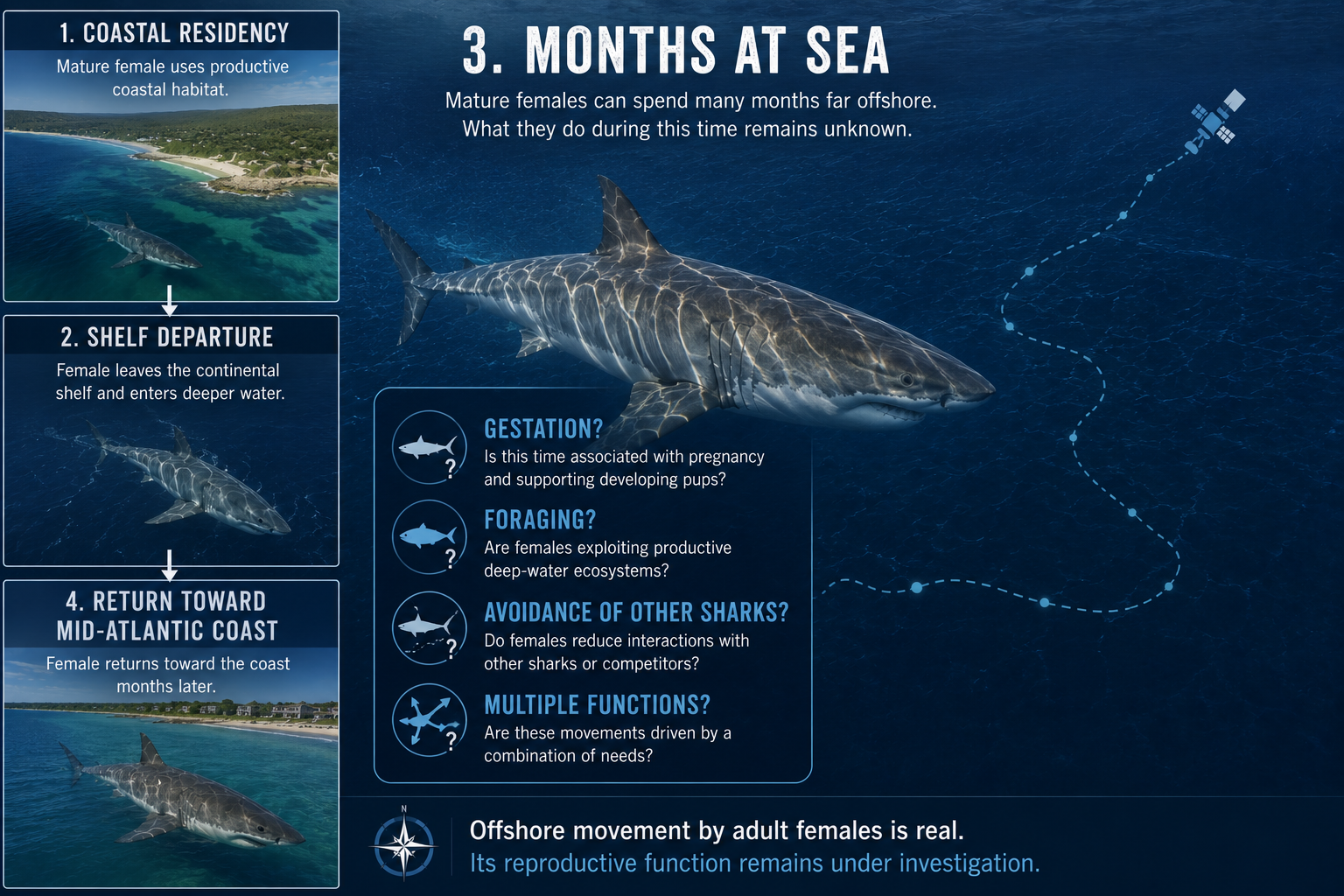
They leave the continental shelf for long periods.
The major western North Atlantic telemetry study found adult females considerably more likely than juveniles and subadults to occupy offshore water.
Some travelled extraordinarily far.
Toward the Gulf Stream.
Across the Sargasso Sea.
Even toward the Mid-Atlantic Ridge and beyond.
Three mature females tracked for multiple years made offshore excursions at different intervals:
one in consecutive years,
one after two years,
another after three.
There was no simple universal cycle.
And that is exactly why scientists are interested.
Could these movements correspond to different reproductive stages?
Possibly.
But researchers could neither confirm nor rule out a reproductive cycle from the limited number of adult females available.
This remains one of the central hypotheses of Northwest Atlantic white-shark research.
Why Would a Pregnant Shark Go Into the Open Ocean?
At first, leaving productive coastal feeding areas seems strange.
Especially for a female supporting developing pups.
But open ocean is not empty.
Satellite research on mature female white sharks in the North Atlantic has shown extensive use of Gulf Stream eddies and the Sargasso Sea.
Two tracked adult females repeatedly entered warm-core anticyclonic eddies.
One made frequent dives approaching 1,000 metres.
Researchers proposed that those warmer eddies may provide access to deep mesopelagic prey while reducing the energetic cost of descending into cold water.
That provides an important alternative—or complementary—explanation.
An offshore female may be:
gestating,
feeding,
responding to oceanographic conditions,
avoiding other sharks,
or doing several of those things simultaneously.
Tracking behaviour alone cannot tell us:
“This shark is pregnant.”
Again, the movement tells us what happened.
Determining why requires additional biological evidence.
Pregnancy Cannot Yet Be Read From a Satellite Track
This is a perfect companion to Part 6.
Tracking technology can show:
where a female goes,
how long she stays offshore,
how deeply she dives,
what temperatures she experiences,
and when she returns.
It cannot directly show:
conception,
embryonic development,
pregnancy stage,
or birth.
Those questions require biology.
Researchers therefore increasingly combine telemetry with:
blood chemistry,
reproductive hormones,
ultrasound imaging,
genetics,
and reproductive samples.
Ultrasound is particularly intriguing because it could potentially reveal ovarian activity or developing embryos without sacrificing the shark.
The challenge?
You first have to safely encounter the right large mature female at the right stage of pregnancy.
In an ocean covering millions of square kilometres.
That is why even modern white-shark reproduction retains enormous blank spaces.
Imagine Trying to Study One Pregnancy
Suppose a female white shark mates off the southeastern United States.
That event may occur completely unseen.
She then travels offshore.
Her satellite tag may produce only occasional positions.
She spends more than a year ranging across the North Atlantic.
She dives hundreds of metres.
Perhaps deeper.
Then months later she begins returning toward the coast.
Somewhere in the Mid-Atlantic region, she gives birth.
The pups leave.
Within hours—or perhaps sooner—the mother and offspring may already be separating.
By the time researchers encounter one of the pups near Long Island, the event they are trying to reconstruct is already over.
No nest.
No den.
No parent nearby.
No birth record.
Only a newborn shark.
This is why researchers often have to work backwards from the babies.
The Nursery Gives Us a Clue About the Mothers
Young-of-the-year sharks provide something mature females rarely do:
numbers.
If newborn sharks repeatedly appear in the same region during the same season, scientists can begin narrowing the possible birthing landscape.
The New York Bight nursery therefore does more than tell us where young sharks live.
It gives us information about where their mothers must have been shortly before those pups arrived.
That is a form of biological triangulation.
Newborn presence.
Female movements.
Timing.
Water temperature.
Size at birth.
Genetics.
Eventually, perhaps, those pieces will reveal the precise pupping grounds.
But there is another tool that could make the story even more powerful.
Genetics Can Rebuild a Family We Never Saw
Imagine collecting a small tissue sample from a juvenile shark in Nova Scotia.
Years later, researchers sample a large female somewhere else in the Northwest Atlantic.
Genetic analysis reveals that they are related.
Perhaps mother and offspring.
Or half-siblings.
Suddenly scientists can start connecting:
birth cohorts,
maternal lineages,
nursery areas,
migration strategies,
and adult habitat.
This is where population genetics and long-term tagging can transform isolated encounters into family histories.
The Northwest Atlantic white shark is considered one widely ranging population rather than a distinct Canadian stock, making those connections particularly important.
Someday the shark swimming past Nova Scotia may no longer be just:
Female, 4.8 metres.
She may be:
the mother of juveniles identified years earlier.
That would fundamentally change how we understand the population.
The Mother May Matter More Than Almost Any Other Shark
Conservation forces us to think differently about individuals.
If a population contains many young animals but few reproductively active females, those females have enormous demographic value.
A mature female has already survived decades.
She has successfully navigated every life stage we have explored in this series.
Nursery habitat.
Juvenile migration.
Northern residency.
Predation risk.
Human activity.
Winter habitat.
Maturation.
And eventually reproduction.
Removing that animal means losing not only one shark.
It means losing the offspring she might have produced through the remainder of a potentially very long life.
This is why the combination of:
late maturity,
long gestation,
small litters,
and extended recovery between pregnancies
makes white sharks exceptionally slow to rebound from population declines.
And Yet Some Mothers Come to Canada
This is where our story reconnects with Atlantic Canada.
Adult females are not absent from Canadian waters.
Mature females have been documented here.
Large females can use northern coastal habitat during portions of their annual range.
But compared with juveniles and subadults, adult sharks are less likely to make the Canadian journey, and some adult females undertake much more extensive offshore movements.
So when a large female white shark appears off Nova Scotia, we may be looking at an animal whose life connects an extraordinary series of environments.
Canadian feeding habitat.
U.S. overwintering habitat.
Possible mating habitat.
Open-ocean foraging or gestation habitat.
Possible pupping grounds.
Nursery habitat used by her offspring.
One female.
One reproductive cycle.
Multiple ecosystems.
Multiple jurisdictions.
Her Pup May Return Years Later
Imagine the complete story.
A mature female spends part of a summer feeding somewhere around Atlantic Canada.
She moves south.
Months later she encounters mature males somewhere in the southeastern United States.
Perhaps mating occurs there.
She moves offshore.
For more than a year, developing pups grow inside her.
She travels across open ocean.
Feeds in deep-water ecosystems.
Eventually she returns toward the Mid-Atlantic coast.
She gives birth.
One pup begins life in the New York Bight.
It survives its first winter.
Then another.
Its migration expands.
New England.
Eventually Nova Scotia.
Years after its mother used Canadian waters, her offspring arrives in them too.
We cannot yet demonstrate that complete individual story.
But every piece of it is biologically plausible within the movement and reproductive evidence scientists are assembling.
And one day, enough tags, genetics and reproductive data may allow researchers to follow exactly such a family across generations.
The Missing Mothers
The title sounds as though the mothers are absent.
They aren't.
They are out there.
What is missing is our ability to see enough of their lives.
We know white sharks reproduce slowly.
We know females mature late.
We know they give birth to relatively few, very large pups.
We know embryos are nourished in extraordinary ways.
We know young sharks use nursery habitat in the Mid-Atlantic.
We know some large females travel far offshore.
We have plausible reproductive hypotheses connecting those movements.
But we still do not know, with the precision we would like:
Exactly where mating occurs.
Exactly how long pregnancy lasts.
How frequently individual females reproduce.
Which offshore habitats are most important during pregnancy.
Exactly where most Northwest Atlantic pups are born.
How many females contribute to each generation.
Or how those mothers and their offspring reconnect across decades.
For one of the most studied sharks on Earth, that is extraordinary.
Perhaps the Hardest Shark to Find Is the Most Important One
A juvenile feeding near Long Island can be tagged.
A subadult swimming near Nova Scotia can be tracked.
A male visiting Cape Cod can be photographed.
But somewhere in the North Atlantic, a very large female may spend months travelling through offshore water carrying the next generation inside her.
She may be one of the most biologically important animals in the population.
And for much of that time, she may be almost completely invisible to us.
That is the paradox of white-shark science.
The animals we most need to understand are sometimes the animals hardest to study.
So the search continues.
Along the Carolinas.
Across the Gulf Stream.
Into the Sargasso Sea.
Through the Mid-Atlantic.
And north again toward Canada.
Because understanding where white sharks go is important.
Understanding where new white sharks come from may be even more important.
They don't live in Canada.
They return to Canada.
And somewhere beyond Canadian waters, the mothers that make those returns possible are carrying the future of the population with them.
NEXT — PART 9
The Ocean Is Changing Beneath Them
How warming waters may reshape the white shark's Canadian range
Atlantic Canada is warming.
Prey distributions are changing.
Seasonal temperatures are shifting.
And the northern edge of the white shark's range may not remain where it is today.
Could sharks arrive earlier?
Stay longer?
Travel farther north?
Will younger sharks lead that expansion?
Could Newfoundland become increasingly important?
And what happens when a protected predator responds to climate change by entering places where humans are not accustomed to seeing it?
In Part 9 of White Sharks in Canada, we examine the changing ocean beneath the migration.
Research & Further Reading
Fisheries and Oceans Canada — Recovery Strategy for White Shark in Atlantic Canadian Waters. Canada's current strategy summarizes late maturity, low reproductive capacity, estimated 10–20 month gestation, small litters, likely Mid-Atlantic pupping and major remaining reproductive knowledge gaps.READ SOURCE ↗Franks et al. (2021) — Western North Atlantic movement ecology. Long-term telemetry revealed extensive offshore movements by mature females, sometimes reaching the Mid-Atlantic Ridge, and proposed possible links between those movements and reproduction while emphasizing that the hypothesis remains unresolved.READ SOURCE ↗Sato et al. (2016) — How great white sharks nourish their embryos to a large size. Examination of an exceptionally rare pregnant white shark provided direct evidence that developing embryos receive lipid-rich uterine secretions before increasingly relying on unfertilized nutrient eggs.READ SOURCE ↗Tomita et al. (2022) — Mode of uterine milk secretion in the white shark. Microscopic examination clarified how the white-shark uterus produces lipid-rich secretions used in early embryonic nourishment.READ SOURCE ↗Gaube et al. (2018) — Mesoscale eddies influence movements of mature female white sharks. Satellite-tagged females used Gulf Stream and Sargasso Sea eddies and conducted deep dives, demonstrating that offshore habitat may provide substantial foraging opportunities in addition to any possible reproductive role.
Márquez-Farías et al. (2024) — Length at life stages of the white shark in the western North Atlantic. Analysis of 87 sharks estimated female length at 50% sexual maturity at approximately 4.11 m and male maturity at approximately 3.35 m.