

They don’t live in Canada. They return to Canada.
Imagine the western North Atlantic population of white sharks spread across thousands of kilometres of ocean.
Some are barely longer than a person.
Others are three-metre juveniles approaching adulthood.
Some are mature males.
Some are enormous adult females capable of exceeding four metres.
They all belong to the same population.
But when summer arrives, they do not all make the same decision.
Some remain farther south.
Some occupy New England waters.
Some move offshore.
And some continue north.
Into Canada.
When Fisheries and Oceans Canada researchers examined the largest white-shark tagging dataset then available for the Northwest Atlantic—272 tag deployments between 2010 and 2020—they found something striking.
Juvenile white sharks were 4.7 times more likely than adults to move north into Canadian waters.
Subadults were 3.4 times more likely.
Canada was not receiving a random sample of the population.
The sharks coming north were disproportionately young and still growing.
That changes the question.
Instead of asking only:
Why do white sharks come to Canada?
we now need to ask:
Why are certain white sharks more likely to come here than others?
First, What Is a “Young” White Shark?
It sounds like a simple question.
It isn't.
White sharks grow slowly.
Their size at maturity differs between males and females, and the exact thresholds used by researchers have changed as scientists gather better information.
Canada's current recovery strategy cites recent Northwest Atlantic estimates of sexual maturity at approximately 3.3 metres for males and 4.1 metres for females, while earlier studies placed those thresholds somewhat differently. White sharks also mature astonishingly late compared with most familiar fishes. Earlier age estimates suggested roughly 26 years for males and 33 years for females, though considerable uncertainty remains around growth and maturation.
That means a three-metre shark can be a substantial predator and still be biologically immature.
In the Canadian telemetry analysis, researchers used practical life-stage categories based on body length and sex. Animals under approximately three metres were generally classified as juveniles, while larger immature sharks fell into sex-specific subadult categories.
So when we say “young shark,” we should not picture a tiny baby.
Some of the younger sharks entering Canadian waters are already formidable animals several metres long.
They simply have much more growing—and living—ahead of them.
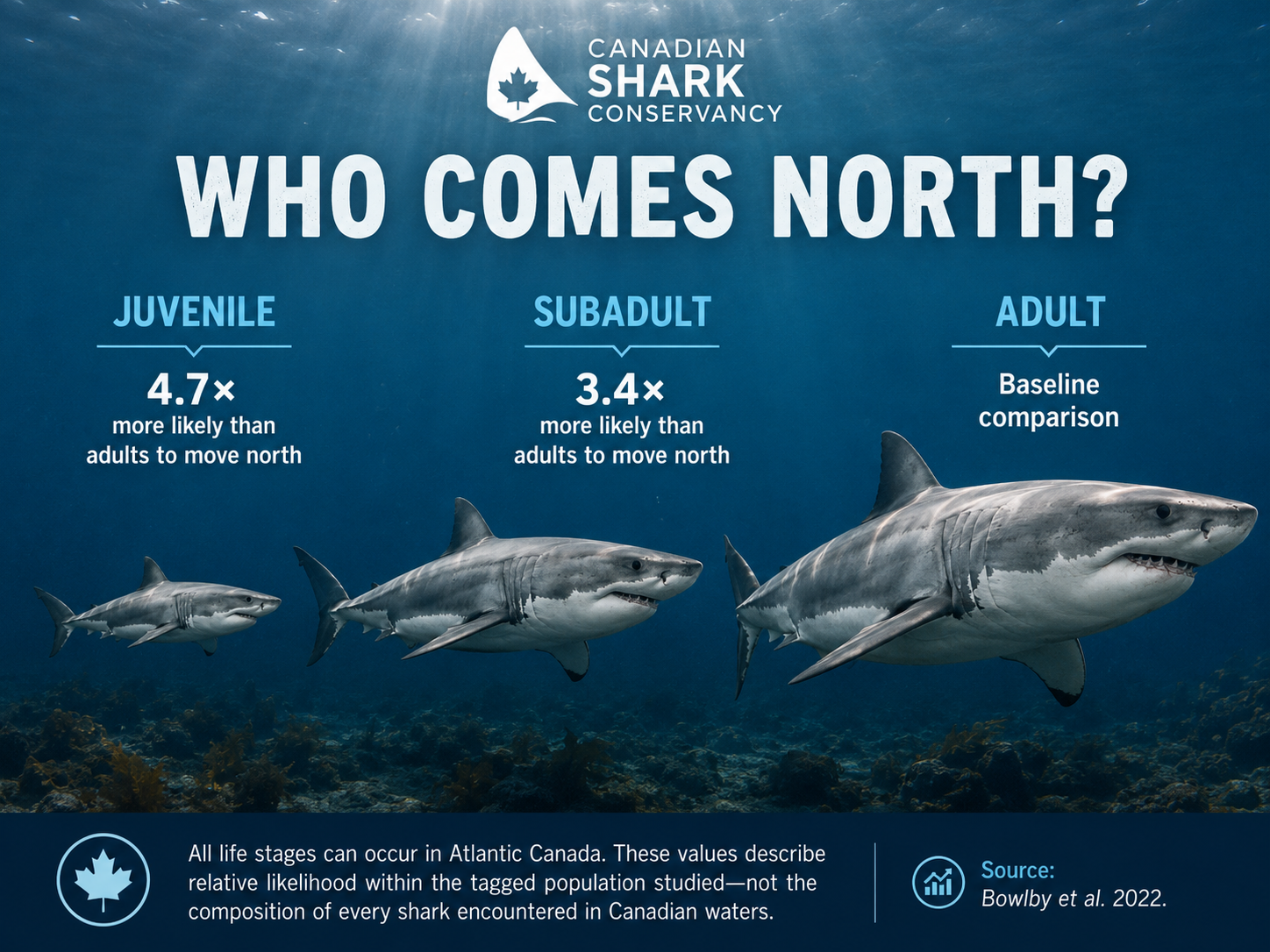
WHO COMES NORTH?
Footer:
All life stages can occur in Atlantic Canada. These values describe relative likelihood within the tagged population studied—not the composition of every shark encountered in Canadian waters.
Source: Bowlby et al. 2022.
But Canada Is Not a White Shark Nursery
This distinction is extremely important.
If younger sharks disproportionately use Canadian waters, it would be tempting to say:
“Canada must be a nursery.”
The evidence does not support that.
A shark nursery has a much more specific ecological meaning.
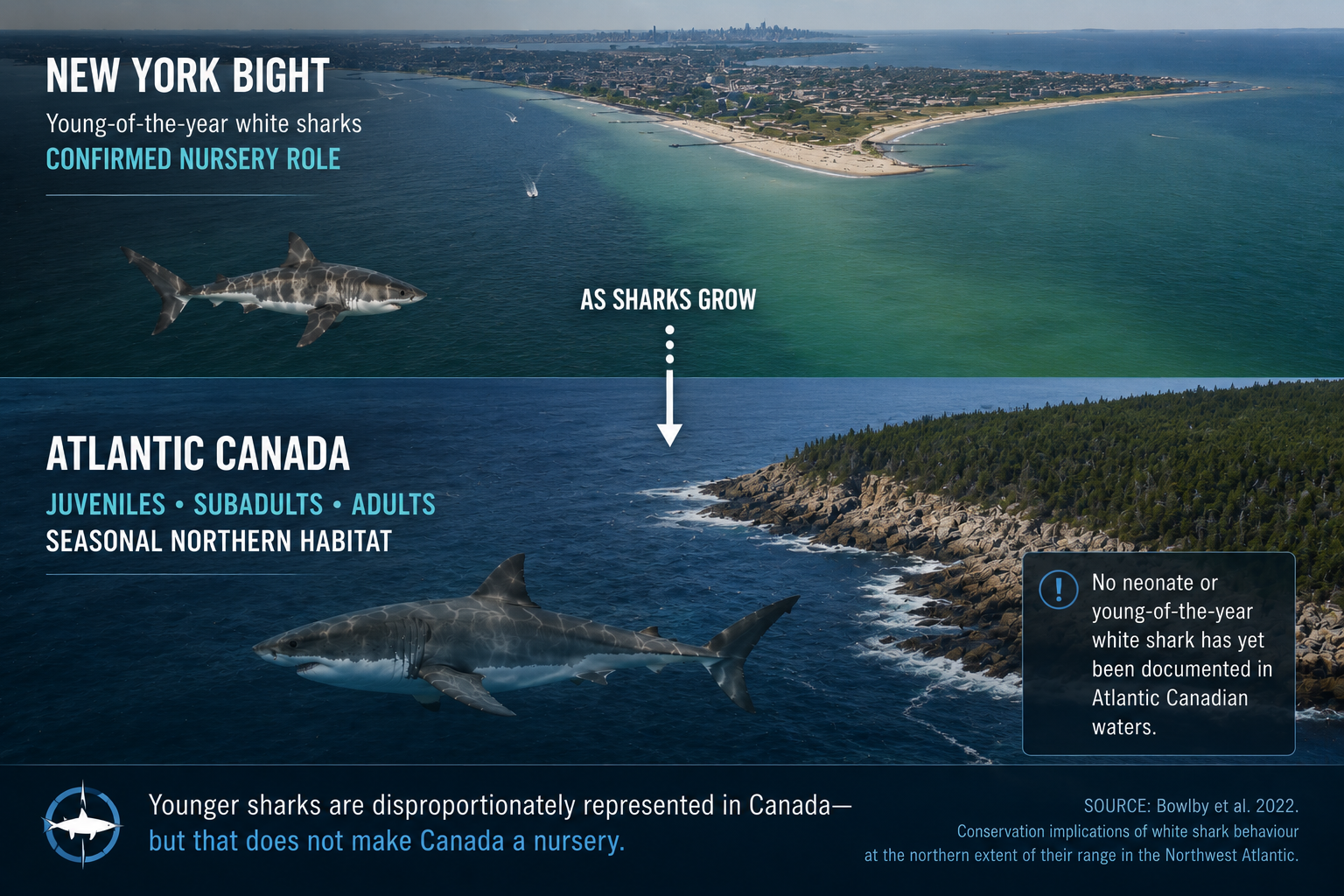
Young-of-the-year animals must occur there more frequently than elsewhere, remain or repeatedly use the area, and the habitat must be used across multiple years.
For the Northwest Atlantic white shark population, researchers have demonstrated exactly that pattern around the New York Bight and waters off Long Island.
Young-of-the-year white sharks roughly 1.4 to 1.7 metres long have been tracked spending summer and early autumn there before migrating south toward the Carolinas for winter. Subsequent work has further characterized the Long Island region as confirmed nursery habitat.
Canada is different.
The federal recovery strategy specifically notes that neonates and young-of-the-year white sharks have not been documented in Canadian waters.
So the story is not:
White sharks are born in Canada and grow up here.
It is:
As some sharks grow beyond their earliest nursery stage, Canada becomes increasingly available as part of their seasonal range.
That may ultimately prove to be just as ecologically interesting.
Growing Up Changes the Map
A white shark does not simply become a larger version of the animal it was born as.
Its ecology changes as it grows.
Its prey changes.
Its swimming capabilities change.
Its energetic requirements change.
Its vulnerability to predators changes.
And eventually, reproduction enters the equation.
Young white sharks feed heavily on fishes, rays, smaller sharks and other comparatively small prey.
As they grow, their ability to exploit larger prey increases.
Marine mammals become increasingly important for larger white sharks, though white sharks remain opportunistic predators throughout life. Canada's recovery documents describe a broad diet that includes fishes, sharks and rays, seals, cetaceans, marine turtles, seabirds and some invertebrates.
That creates what ecologists call an ontogenetic shift:
the animal's ecology changes as the animal itself develops.
And when diet changes, geography can change with it.
The places that provide a one-and-a-half-metre shark with everything it needs may not be the same places that best serve a three-metre shark.
Nor will they necessarily be the places used by a five-metre adult female.
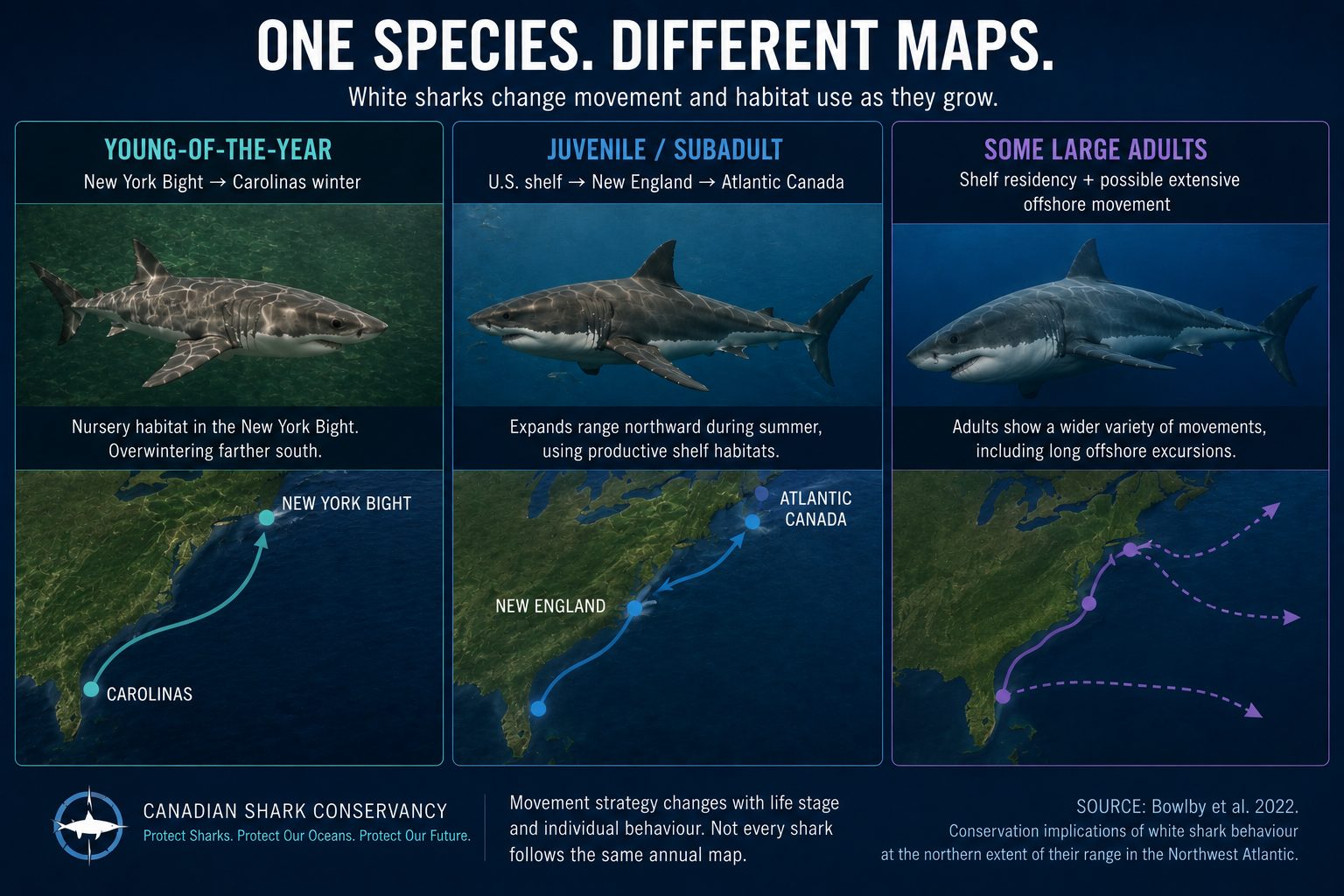
One species can therefore carry several different ecological maps during one lifetime.
Canada May Be Part of the Growing-Up Map
This is where the Canadian telemetry result becomes particularly intriguing.
The study did not simply show juvenile and subadult sharks occasionally entering Canada.
It found them substantially more likely than adults to make that northern movement.
Why?
We don't yet have a definitive answer.
But several possibilities deserve investigation.
Atlantic Canada's continental shelf becomes highly productive during the warmer months.
Fish are abundant.
Grey seals and other marine mammals occupy the region.
Oceanographic fronts and shelf features concentrate prey.
Seasonal temperatures become accessible to white sharks.
And younger sharks capable of travelling farther than neonates may find a large northern foraging landscape with comparatively abundant food.
That is a biologically plausible explanation.
But it remains a hypothesis.
Scientists have demonstrated who is disproportionately moving north much more confidently than they have demonstrated why age changes the probability of doing so.
That difference should remain visible in the story.
What Do They Do When They Get Here?
The Canadian telemetry data give us another clue.
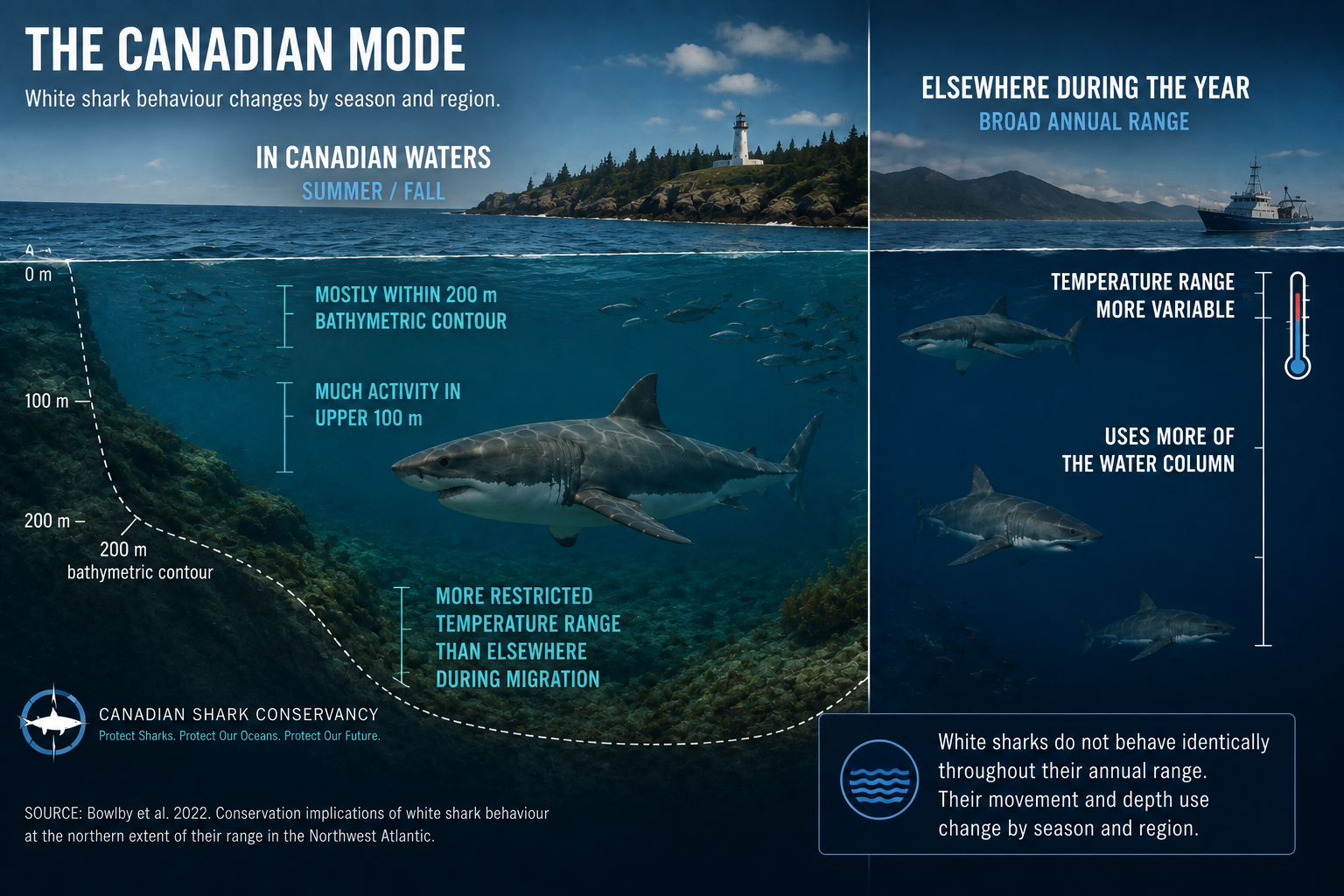
Between June and November, white sharks carrying pop-up archival tags remained predominantly associated with coastal and continental-shelf habitat inside the 200-metre depth contour.
They also spent much of their time in the upper 100 metres of the water column.
When the same sharks were in Canadian waters, they experienced a narrower range of temperatures and used proportionately less of the water column than at other points in their annual movements.
That suggests entering Canada is not simply the northern end of random wandering.
Behaviour changes.
The sharks become associated with a particular kind of environment.
Shelf habitat.
Comparatively shallow water use.
Seasonal residency.
The Canadian portion of the annual journey appears ecologically structured.
The Adults Haven't Disappeared
There is another correction we need to make.
Saying juveniles and subadults are more likely to enter Canada does not mean adult white sharks are absent.
They aren't.
Subadult and mature sharks of both sexes have been documented throughout Atlantic Canadian waters.
Large adults occur here.
Tracking has demonstrated adults moving through Canadian regions.
Historical Canadian records include very large animals.
Canada's recovery strategy explicitly recognizes subadult and mature sharks of both sexes using the region.
The difference is statistical.
Imagine 100 doors leading north.
Younger sharks appear more likely to walk through one.
Adults can still use the same door.
They simply do so at a lower rate within the tagged dataset.
And Then There Are the Large Females
This is where the life-stage story becomes even more mysterious.
White-shark telemetry from the western North Atlantic has shown that some larger animals—particularly mature females—can undertake extensive offshore movements that differ markedly from the shelf-oriented seasonal migrations common among many other sharks in the population.
Some have travelled far beyond the continental shelf and toward the open North Atlantic.
Why?
One hypothesis is that some offshore movement may relate to reproduction.
Researchers have suggested that female movements could be connected with gestation or reproductive cycles, based partly on patterns observed in other white-shark populations.
But for Northwest Atlantic females, much remains unresolved. Canada's recovery strategy acknowledges major gaps in understanding population structure, reproductive biology and habitat use.
So when a giant adult female does not appear in Nova Scotia while younger animals do, we should not assume she simply chose somewhere better to eat.
She may be living an entirely different chapter of the white-shark life cycle.
Why Would Younger Sharks Push Farther North?
There is an intriguing ecological idea hiding in the result.
Animals living near the edge of a species' range may not represent average members of the population.
They may be individuals more inclined—or more able—to disperse.
Bowlby and colleagues specifically noted that white sharks moving to the northern edge of the Northwest Atlantic range may represent a non-random component of the population, shaped by differences in life stage and behaviour.
That means Canada's white sharks might not simply be:
the same sharks found farther south, only farther north.
They may disproportionately represent sharks pursuing a particular movement strategy.
Think about what that means for everything we have already explored.
The feeding grounds.
Site fidelity.
The sharks that return.
Even the Canadian seasonal migration itself.
Perhaps we are observing not merely a population movement—
but one strategy within a population containing several different strategies.
A Young Shark Has Something an Adult Cannot Recover
Time.
A juvenile white shark represents decades of potential future life.
It may eventually reproduce.
Potentially many times.
That makes survival through immature life stages particularly important in a species with exceptionally slow population turnover.
White sharks mature late, reproduce slowly and produce relatively few offspring compared with many fishes.
These life-history characteristics are among the reasons Canada continues to list the Atlantic population as Endangered under the Species at Risk Act.
If Canadian waters disproportionately attract juveniles and subadults, then threats operating here may disproportionately affect sharks that have not yet contributed—or have only recently begun contributing—to reproduction.
Canada's recovery strategy explicitly highlights this concern: the disproportionately high representation of juveniles and subadults in Canadian waters could increase the wider population's vulnerability to threats affecting those life stages while they are here.
That gives Canadian protection an importance larger than the number of sharks physically present at any one moment.
The Canadian Population Is Not Really a Canadian Population
This may be the most important conservation concept in the entire series.
There is no biologically isolated population of white sharks that belongs only to Atlantic Canada.
The sharks using Nova Scotia, the Bay of Fundy, the Gulf of St. Lawrence and Newfoundland are part of the larger Northwest Atlantic population.
Canada represents the northern seasonal range of only a portion of that population.
A juvenile shark may begin its life off Long Island.
Spend winter farther south.
Later expand its seasonal movement toward New England.
Eventually begin travelling into Canada.
Then change its movement strategy again as it matures.
Canada receives one chapter of that life.
The United States receives others.
The ocean joins them.
That means protecting the shark in Canada is really an investment in an animal whose life is shared across jurisdictions.
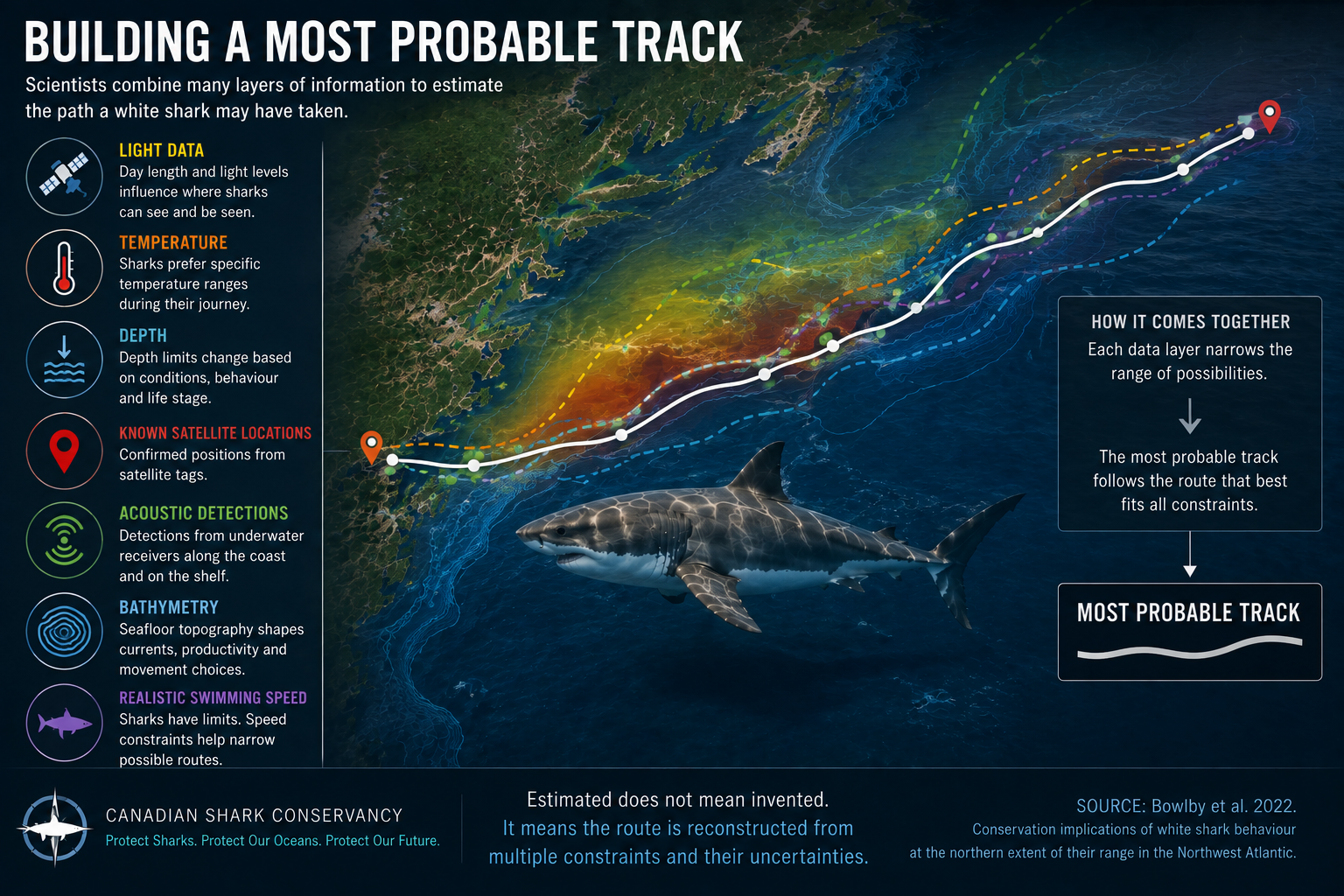
Could Climate Change Send More Young Sharks North?
This question deserves attention because Atlantic Canada sits near the northern edge of the current range.
Canada's recovery strategy notes that climate change could alter white-shark distribution.
Warming Canadian waters might increase habitat suitability and potentially increase seasonal use of the region, although the net effects of climate change on white sharks remain uncertain.
That possibility becomes particularly interesting when paired with the life-stage data.
Would juveniles and subadults expand farther north first?
Would residency seasons lengthen?
Would prey distributions shift with them?
Would Newfoundland become more heavily used?
Would the relative importance of Nova Scotia change?
We do not yet know.
But monitoring which life stages arrive, rather than merely counting shark detections, may provide important clues as the Northwest Atlantic changes.
Size Is More Than a Measurement
When researchers measure a white shark, they are not merely collecting a statistic for a database.
Length can help tell us what phase of life we are looking at.
Sex adds another layer.
Together those observations can transform a tracking point.
Instead of:
A white shark entered Canada.
science can ask:
Was it male or female?
Juvenile or subadult?
Mature or immature?
Has it been here before?
Is its movement typical of others at the same life stage?
Does it use the same habitat as adults?
Does it return?
That is how population ecology emerges from individual animals.
And it is why the same shark-tagging expedition may collect far more than a transmitter location.
Researchers may also record:
length,
sex,
maturity indicators,
body condition,
blood,
tissue,
genetic material,
hormones,
parasites,
contaminants,
and other measurements.
A tagged shark becomes not merely a moving dot—
but part of the story of how an entire population is structured.
Not All White Sharks Need Canada Equally
Perhaps this is the larger lesson.
We often talk about species habitat as though every individual uses the same map.
But animals change.
A habitat essential to one stage of life may matter much less to another.
The New York Bight appears particularly important to the youngest sharks.
Canadian waters appear disproportionately used by juveniles and subadults.
Certain mature animals follow broader offshore strategies.
The species needs all of those places because the species is not one biological moment.
It is an entire life cycle.
This is one reason identifying critical habitat for a wide-ranging predator is so difficult.
We cannot simply ask:
Where are white sharks?
We have to ask:
Which white sharks?
At what age?
At what season?
Doing what?
Who Comes North?
We began with that question.
The answer is now clearer.
Adults come.
Males come.
Females come.
Some very large sharks come.
But within the largest Canadian telemetry analysis available, juveniles and subadults were much more likely than adults to make the northern journey.
That gives Atlantic Canada a fascinating possible role in the wider Northwest Atlantic story.
Not a birthplace.
Not proven nursery habitat.
Not the permanent home of the population.
But perhaps an important seasonal landscape disproportionately used during a long period of growth between infancy and full adulthood.
A place where some sharks learn the northern ocean.
Find food.
Return to familiar waters.
And continue becoming the animals they will eventually be.
For an animal that may take decades to mature, that middle part of life matters enormously.
Which means Canada may matter enormously too.
They don't live in Canada.
They return to Canada.
But increasingly, we are discovering that the question is not simply whether a white shark returns.
It is which shark is making the journey—and where that animal is in the story of its life.
NEXT — PART 8
The Missing Mothers
What we know—and still don't know—about white shark reproduction in the Northwest Atlantic
The youngest white sharks are concentrated off New York.
Juveniles and subadults disproportionately move north toward Canada.
But some of the largest adult females follow very different paths—including long offshore movements.
Where do they mate?
How long are they pregnant?
Where do they give birth?
Why do mature females sometimes disappear into the open Atlantic?
And how much of the white shark reproductive cycle remains hidden from science?
In Part 8 of White Sharks in Canada, we follow perhaps the greatest mystery in the population:
the lives of the mothers that produce the next generation.